




3M, GM Collaborate on Aftermarket Adhesive for Multi-Material Structures
According to Dan Wittek, Technical Service Supervisor at 3M, aluminum vehicle bodies are not all that complicated to repair, reminding that “trucks have been made out of aluminum for a really long time.”
The company’s product lineup such as adhesives, body fillers, and abrasives all apply not just to steel- but aluminum-intensive vehicles as well.
“We’re not starting from scratch with aluminum repair; it’s not a whole new lineup of products,” Wittek said. “It’s just technique and how you use them is slightly different.” For example, repair shops need to be mindful of “cross-contamination”—i.e., galvanic corrosion—that can occur by using the same set of tools on aluminum and steel vehicles.
3M’s standard 08115 panel bonding adhesive, which has been on the market since the late 1990s, has already been approved by Ford for use on the new F-150 pickup truck, according to Wittek. “This is our standard product for steel, and it’s going to be standard for aluminum—but [only] for outer body, nonstructural sheet metal.”
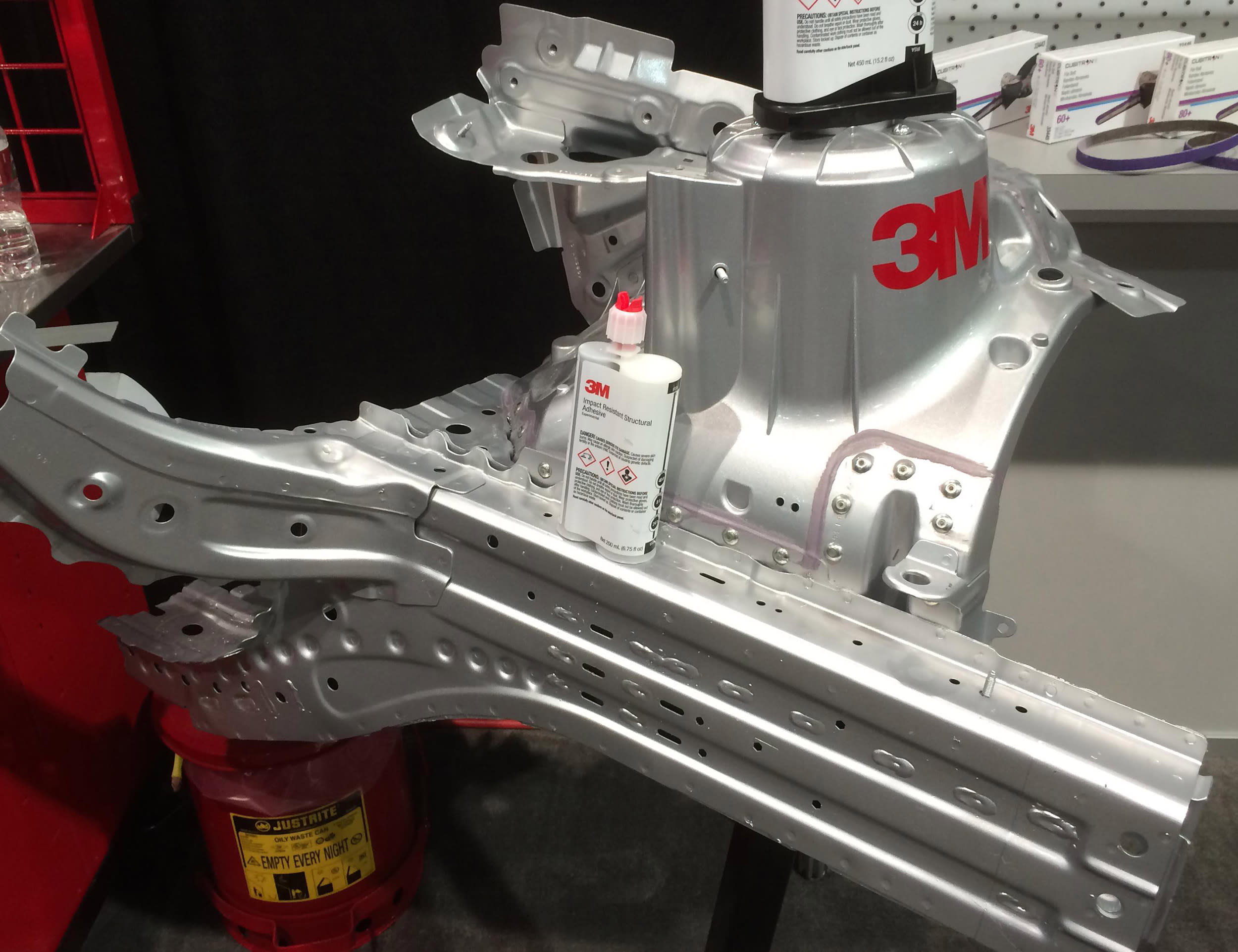
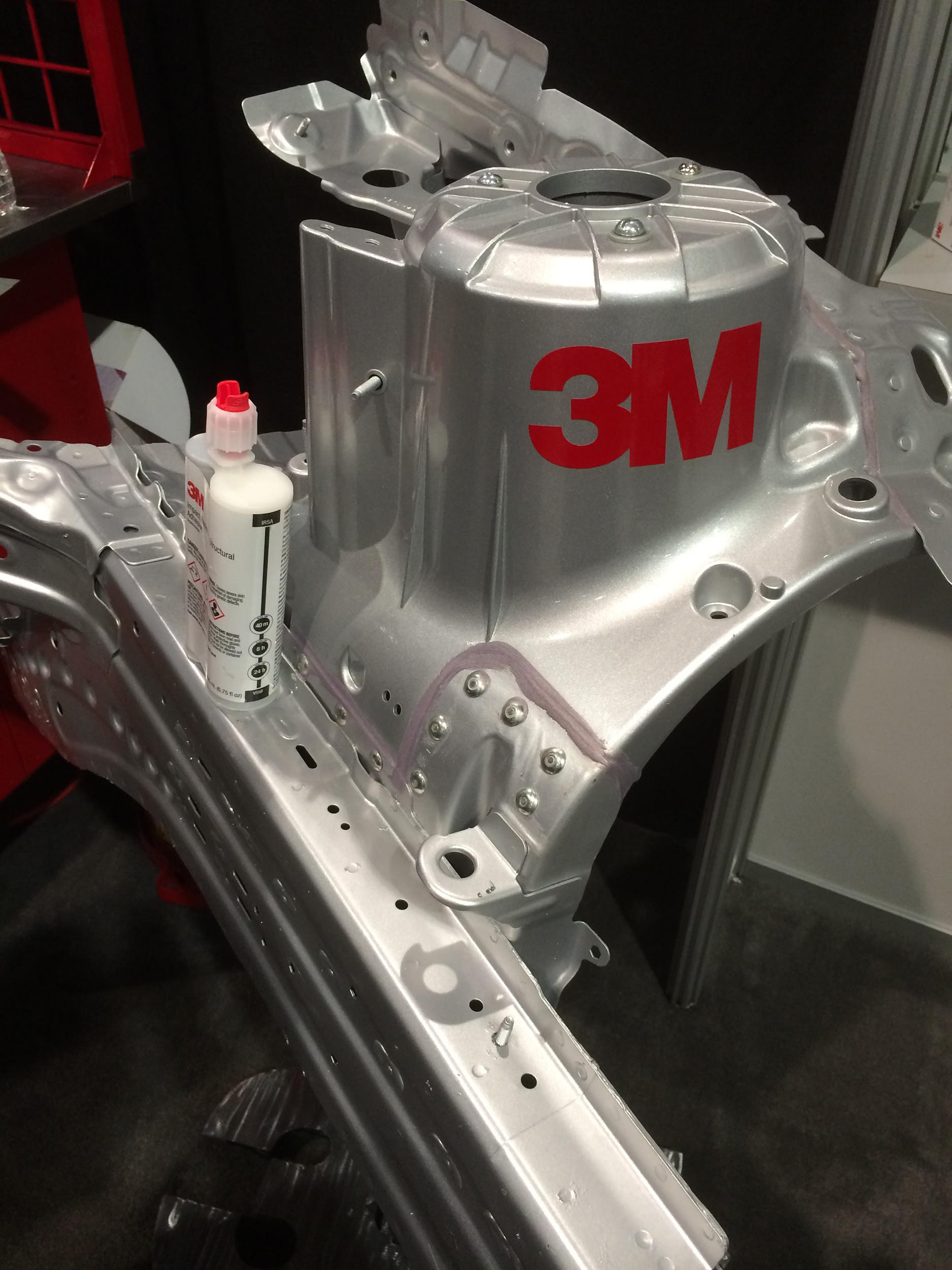
The real challenge, according to Wittek, comes from repairing multi-material structural applications. The Cadillac ATS and CTS cast-aluminum strut tower attached to a high-strength-steel frame rail—on display at 3M’s booth during the recent SEMA Show—is the perfect example of such a challenge.
“You can’t weld them together; it has to be mechanical or with adhesives, so General Motors came to us [for a solution] to meet this spec,” Wittek explained to Automotive Engineering. 3M and GM worked collaboratively on a new structural adhesive that is currently in field testing and is expected to be commercially available in February.
“There hasn’t been anything like it before. We already have GM’s stamp of approval for their vehicles, and we’re working to add other OEMs to that as we go,” Wittek said.
As a result of vehicle lightweighting and the use of thinner-yet-stronger materials, OEMs are using adhesives and under-coatings more often to reduce NVH, improve ride quality, and enhance the feeling of quality, particularly in luxury vehicles such as those in the Cadillac lineup.
“General Motors [in some cases] is bonding almost the whole car and welding it. Even if it’s all steel, they’re using a structural adhesive…because there’s still some flex,” Wittek said. “So that’s where this [new product] is going to be deployed for the aftermarket because today there isn’t something for that aftermarket repair in structural applications.”
Carbon fiber is a “different animal,” according to Wittek, because of its unique layup construction.
“There’s a big difference in carbon fiber between a cosmetic outer body panel and a structural inner panel,” he explained. “If it’s a structural inner panel and it’s damaged, today OEMs like BMW with their i3 structural carbon fiber just replace it. Things can change as technology advances, but today because of the weave and the way that it’s designed and engineered…it’s going to be a weak spot.”
Carbon-fiber outer body panels, however, are repairable with current adhesives.
“We have solutions today, but we’re still working on perfect solutions,” Wittek said. “Our panel bonding adhesive actually works really well for carbon fiber; the challenge with it is that it’s slow-drying, it’s a 4-h cure. It’s designed that way so you have enough time to get a body panel onto the car, but if you’re just doing a small crack in a [carbon fiber] fender, you don’t want to wait 4 h. So when I say we’re working to improve that, it’s not that we can’t do it, it’s just there isn’t a system designed for carbon fiber…We’re getting there.”
More From SAE Media Group
Automotive Engineering
Stuck on Structural Adhesives
Automotive Engineering
Innovations for Lightweighting: Magna and Ford test carbon-fiber subframes
Automotive Engineering
Aluminum: Toward 50% Body Content
Automotive Engineering
Cadillac Pursues Aluminum/steel Mix for New CT6 Luxury Sedan
Automotive Engineering
In Search of the Lightweight, Multi-Material Car
Automotive Engineering
Mass-Reducing Innovations Honored by Altair
Automotive Engineering
Innovations for Lightweighting: Audi brings CFRP to 2018 A8
Automotive Engineering
2019’s Best Automotive Plastics Innovations
Automotive Engineering
Altair Honors Lightweight Advances
Automotive Engineering
Steel Targets EV Structures, Battery Boxes
Automotive Engineering
Engineering Chevy's Lighter, Stronger CUV
Off-Highway Engineering
Carbon-Fiber Concept Trailer from Great Dane Cuts Weight by 4000 Lb
Aerospace & Defense Tech Briefs
Testing Military-Grade Adhesive in Extreme Loading Conditions
Automotive Engineering
2015 F-150: Ford Drops an Aluminum Blockbuster
Automotive Engineering
Aluminum Frame Rails, New Alloy Castings from Alcoa Help Cut 2500 Lb from Tractor-Trailers
Automotive Manufacturing and Machining
Aluminum’s Rising Star

Automotive Engineering
Metamaterials R&D Targets NVH Abatement
Automotive Engineering
Gearing Up Drive Axle Innovations
Medical Design Briefs
OEM Toll Processing Advances High-Value Products
Automotive Engineering
2016 Altair Enlighten Award Adds New Category to Honor Lightweighting Efforts
Automotive Engineering
Tesla’s Cybertruck Is Audaciously Austenitic
Automotive Engineering
Top Mass-Cutting Innovations Receive Altair Enlighten Awards
Automotive Engineering
Cadillac's Future-Tech Flagship
Automotive Engineering
Self-Piercing Rivets Shoot for Vehicle-Lightweighting Applications Beyond Aluminum
Automotive Engineering
ZF's CEO Talks About Lightweight Vehicle Applications
Automotive Engineering
Hyundai, Ford Pursue Structural Composites Despite Challenges
Automotive Engineering
Steel Red-hot for Weight Reduction
Automotive Engineering
Aluminum Sheet Capacity in N.A. to Increase
Automotive Engineering
Steel Stands Tall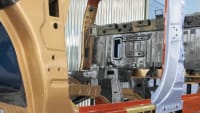
Top Stories
INSIDERManufacturing & Prototyping
 How Airbus is Using w-DED to 3D Print Larger Titanium Airplane Parts
INSIDERManned Systems
 FAA to Replace Aging Network of Ground-Based Radars
NewsTransportation
 CES 2026: Bosch is Ready to Bring AI to Your (Likely ICE-powered) Vehicle
NewsSoftware
 Accelerating Down the Road to Autonomy
EditorialDesign
 DarkSky One Wants to Make the World a Darker Place
INSIDERMaterials
 Can This Self-Healing Composite Make Airplane and Spacecraft Components Last...
Webcasts
Defense
 How Sift's Unified Observability Platform Accelerates Drone Innovation
Automotive
 E/E Architecture Redefined: Building Smarter, Safer, and Scalable...
Power
 Hydrogen Engines Are Heating Up for Heavy Duty
Electronics & Computers
 Advantages of Smart Power Distribution Unit Design for Automotive...
Unmanned Systems
 Quiet, Please: NVH Improvement Opportunities in the Early Design...
