




Metamaterials R&D Targets NVH Abatement
Nissan readies its lightweight acoustic solution for 2022 production – will Hyundai follow?

Acoustics engineers have a broad variety of materials from which to choose for reducing noise, vibration and harshness (NVH) in vehicles. But their selection often comes with a measurable downside: added mass. It’s not uncommon for a new vehicle to gain 100 lb (45 kg) or more during development as various absorbers, reflective barriers and absorber-barrier combinations – typically baked-on mastics, blankets, injected foams and acoustic glazing – are brought to bear.

In an era where “lightweighting rules” and engineers are rewarded on a per-gram basis for cutting vehicle weight, materials researchers are betting on new developments to win the NVH-vs.-mass battle. So-called metamaterials offer significant promise here, with a potential added benefit of being less costly than the traditional NVH solutions used by OEMs.
“Meta” comes from the Greek word μετα – “to go beyond.” Metamaterial mediums are man-made, macroscopic composites. Their three-dimensional cellular honeycomb-like architecture is such that local interaction between the cell assemblies gives them excellent properties for curbing or redirecting unwanted sound waves.

Nissan has been extensively studying metamaterials since 2008, when its scientists began using it on highly sensitive antennae used to study electromagnetic waves. The OEM is now vectoring its development toward production. Nissan first revealed the metamaterial at the 2020 CES and indicated that it will be used for NVH attenuation in the new 2022 Ariya luxury EV.
Susumu Miura, an advanced-materials engineer at Nissan, said the metamaterial offers the sound isolation of traditional solutions weighing four times as much. He described it as a simple lattice structure wrapped in a plastic film and capable of reducing 500-1,200-Hz wide-frequency-band noise typically originating from road or powertrain. A Nissan video indicates the metamaterial can reduce cabin background noise from more than 70 dB to less than 60 dB. The company claims material cost parity, if not a cost reduction, compared with incumbent NVH mitigation. Nissan has not revealed suppliers for the production of its metamaterials.
Hyundai materials researchers, along with colleagues at South Korea’s Gwangju Institute of Science and Technology, are also keenly focused on metamaterials opportunities. Hyundai, among other vehicle applications, has focused its research on using metamaterials to reduce the vibration and noise transfer of a firewall panel. See SAE Technical Paper, An Application of Acoustic Metamaterial for Reducing Noise Transfer through Car Body Panels . The study showed that the suggested metamaterial structure was effective in reducing noise transfer through the bodyshell.
More From SAE Media Group
Automotive Engineering
2020 Explorer Will Be First Product to Emerge – More Quietly – from Ford’s Newest NVH Lab.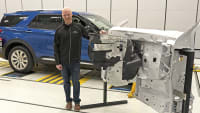
Automotive Engineering
Dürr Builds Advanced Paint Shop for EV Startup Byton
Automotive Engineering
Altair Honors Lightweight Advances
Motion Design
Built-In Vibration Control to Soundproof Spaces
Automotive Engineering
Nissan’s 2021 Rogue Is a COVID Beater
Aerospace & Defense Tech Briefs
Nonlinear Acoustic Metamaterials for Sound Attenuation Applications
Aerospace & Defense Tech Briefs
Design of New Piezoelectric Composites Using Nanocellulose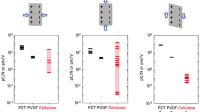
Automotive Engineering
Systems-engineering a New 4x4 Benchmark
Medical Manufacturing and Fabrication
Testing & Quality Control for Nanomanufacturing
Automotive Engineering
The Transformative Power of Large-Format Additive Manufacturing for Automotive
Automotive Manufacturing and Machining
Prodrive Process Expands Carbon Fiber’s Manufacturing Potential
Automotive Engineering
2019’s Best Automotive Plastics Innovations
Aerospace & Defense Tech Briefs
SAE International Extends Call for Abstracts, Seeks Submissions for AeroTech Conference
Automotive Engineering
Carbon Fiber Research Eyes Roof Frames, Doors
Off-Highway Engineering
Modern Approaches to Electric Vehicle Noise and Vibration
Aerospace & Defense Tech Briefs
Advanced CT Inspection and Data Analysis
Automotive Engineering
Virtual and Physical Testing of Third-Generation High Strength Steel
Automotive Engineering
All-Composite EV Wheel Heads to Production
Aerospace & Defense Tech Briefs
Modeling and Experimenting with 2D Materials for CMOS Type Devices and Digital Integrated Circuits
Motion Design INSIDER
Computer-Guided Drawing Machine Fabricates Paper Metamaterials
Automotive Engineering
2016 SAE Congress: Clemson University and Toyota Unveil UBox Concept
Automotive Engineering
Stuck on Structural Adhesives
Automotive Engineering
Linking Embroidery and Carbon Fiber to save Weight and Cost
Aerospace & Defense Tech Briefs
How Advanced Vacuum Bag Kits Streamline Composite Parts Manufacturing
Aerospace & Defense Tech Briefs
Designing Sensory and Adaptive Composite Materials

Automotive Engineering
Top Mass-Cutting Innovations Receive Altair Enlighten Awards
Tech Briefs
Products of Tomorrow
Tech Briefs
Compact, Lightweight, CMC-Based Acoustic Liner
Top Stories
NewsSensors/Data Acquisition
 Microvision Aquires Luminar, Plans Relationship Restoration, Multi-industry Push
INSIDERRF & Microwave Electronics
 A Next Generation Helmet System for Navy Pilots
INSIDERWeapons Systems
 New Raytheon and Lockheed Martin Agreements Expand Missile Defense Production
NewsAutomotive
 Ford Announces 48-Volt Architecture for Future Electric Truck
INSIDERAerospace
 Active Strake System Cuts Cruise Drag, Boosts Flight Efficiency
ArticlesTransportation

Webcasts
Aerospace
 Cooling a New Generation of Aerospace and Defense Embedded...
Energy
 Battery Abuse Testing: Pushing to Failure
Power
 A FREE Two-Day Event Dedicated to Connected Mobility
Automotive
 Quiet, Please: NVH Improvement Opportunities in the Early Design Cycle
Electronics & Computers
 Advantages of Smart Power Distribution Unit Design for Automotive &...
Unmanned Systems
 Sesame Solar's Nanogrid Tech Promises Major Gains in Drone Endurance