




Nonlinear Acoustic Metamaterials for Sound Attenuation Applications
Acoustic filter system material could be useful in protecting soldiers against hearing damage from weapons fire, while largely retaining their situational awareness.
An acoustic crystal composed of tightly packed spherical particles can exhibit a wide spectrum of acoustic properties with responses varying from linear to highly nonlinear regimes. The physical attractiveness of these crystals resides in the controllability of such acoustic responses by simple manipulation of static pre-compression applied to the material.

To combine the frequency filtering response governed by the discrete particles with an amplitude filtering response, a system composed of a highly nonlinear granular chain and a deformable linear medium was assembled. Acoustic wave propagation can be efficiently manipulated and redirected with such added degree of freedom.
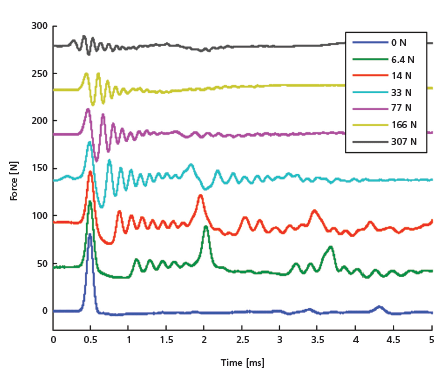
The proposed metamaterials are fundamentally different from any other approach to vibration isolation. They do not use active modulation to suppress external vibration/impacts, but rely on passive insulation. Furthermore, they are stiff and load-bearing, present large recovery to external deformation, and do not develop permanent damage in the ranges of excitations studied. The proposed systems are designed to forbid the propagation of waves in selected frequency ranges (also called as band gaps or stop bands). Incident waves in these forbidden frequency ranges experience an exponential decay of their amplitudes (i.e., they are evanescent waves), and they are fully reflected. The presence of nonlinearity in the structure may allow the redirection of part of the incoming energy into allowed modes.
This work was done by Jinkyu Yang and Chiara Daraio of the California Institute of Technology for DARPA. DARPA-0011
This Brief includes a Technical Support Package (TSP).
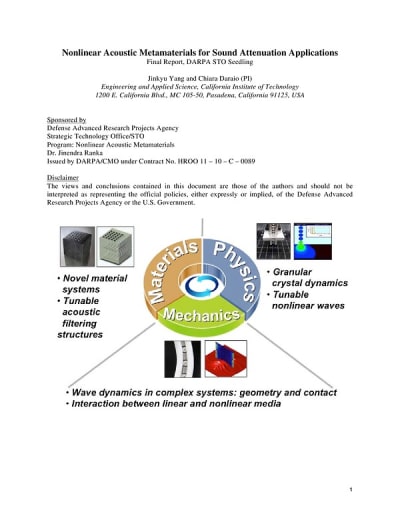
Nonlinear Acoustic Metamaterials for Sound Attenuation Applications
(reference DARPA-0011) is currently available for download from the TSP library.
Don't have an account?
More From SAE Media Group
Aerospace & Defense Tech Briefs
Expanding Possibilities for Superconducting Qubits With Niobium
Tech Briefs
Ultrasound Waves Move Objects Hands-Free


Photonics & Imaging Technology
Large Format Windows: From Material to Mission
Automotive Engineering
Metamaterials R&D Targets NVH Abatement

Automotive Engineering
Tata Steel Europe Innovates to Retain the Automotive Materials Lead
Tech Briefs
Understanding the Pseudogap
Medical Design Briefs
Helmet Made of Magnetic Metamaterials Could Improve Brain Scans


Battery & Electrification Technology
Enhancing the Performance of All-Solid-State Batteries
Tech Briefs
Compact Infrasonic Windscreen
Battery & Electrification Technology
Recyclable ‘Water Batteries’ That Won’t Catch Fire
Electronics & Sensors INSIDER
Record-Breaking Heat Conduction Material Will Save Computer Chips





Aerospace & Defense Tech Briefs
Evaluation of Additively Manufactured Ultrahard Steels
Battery & Electrification Technology
Designing Safer, Higher-Performance Lithium Batteries
Tech Briefs
Using 3D Printing to Strengthen Jet Engines
Automotive Engineering
Lyten Says 3D Graphene Could Disrupt Racing, Automotive and Space
Overview
The document titled "Nonlinear Acoustic Metamaterials for Sound Attenuation Applications" presents research focused on developing innovative acoustic filter systems using nonlinear acoustic metamaterials, specifically engineered granular crystals. The primary objective is to create a concept demonstrator that can effectively transmit or mitigate external impacts across a selected range of frequencies, particularly within the audible spectrum (20-20,000 Hz).
Granular crystals, which are aggregates of particles in elastic contact, exhibit a wide range of dynamic responses, from linear to highly nonlinear acoustic behaviors. The research aims to leverage these properties to design a new isolator that features amplitude-dependent acoustic filtering capabilities. This would allow the system to efficiently transmit small dynamic disturbances while attenuating stronger excitations, making it particularly useful in applications such as protecting soldiers from hearing damage caused by weapons fire while maintaining situational awareness.
The methodology involves manipulating the precompression of granular crystals to alter their dynamic regimes. Under strong precompression, these crystals can exhibit acoustic band gaps, creating distinct pass and forbidden frequency bands. Conversely, at zero or low precompression, they can support the formation of solitary waves—compact energy lumps characterized by unique properties such as robustness and amplitude-dependent wave propagation speed. These solitary waves have potential applications in various engineering fields, including acoustic imaging, sound scramblers, and impact mitigation systems.
The document outlines the development of a one-dimensional prototype to demonstrate the feasibility of the proposed acoustic filter system. The research includes both experimental and numerical simulations to validate the design. The findings from this one-dimensional study will inform future designs for three-dimensional structures, enhancing the potential for practical applications.
Overall, the report emphasizes the versatility of nonlinear acoustic metamaterials and their ability to control wave dynamics, offering promising solutions for sound attenuation and impact mitigation in various engineering contexts. The innovative approach to energy absorption, which does not rely on permanent deformation or structural buckling, highlights the potential for creating advanced materials that can adapt to different acoustic environments.
Top Stories
NewsRF & Microwave Electronics
 Microvision Aquires Luminar, Plans Relationship Restoration, Multi-industry Push
INSIDERAerospace
 A Next Generation Helmet System for Navy Pilots
INSIDERDesign
 New Raytheon and Lockheed Martin Agreements Expand Missile Defense Production
INSIDERMaterials
 How Airbus is Using w-DED to 3D Print Larger Titanium Airplane Parts
NewsPower
 Ford Announces 48-Volt Architecture for Future Electric Truck
ArticlesAR/AI

Webcasts
Electronics & Computers
 Cooling a New Generation of Aerospace and Defense Embedded...
Automotive
 Battery Abuse Testing: Pushing to Failure
Power
 A FREE Two-Day Event Dedicated to Connected Mobility
Unmanned Systems
 Quiet, Please: NVH Improvement Opportunities in the Early Design Cycle
Automotive
 Advantages of Smart Power Distribution Unit Design for Automotive &...
Energy
 Sesame Solar's Nanogrid Tech Promises Major Gains in Drone Endurance