




Innovations for Lightweighting: Audi brings CFRP to 2018 A8
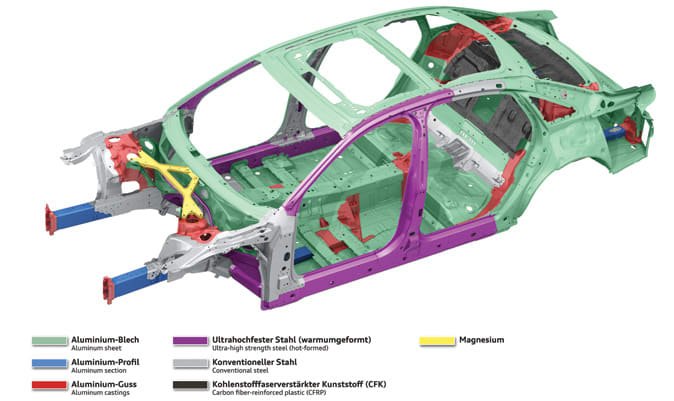
Audi helped pioneer aluminum-intensive bodies-in-white in volume production but for its recently unveiled 2018 A8 the company adopts a broader mixed-materials approach. Besides retaining aluminum alloys for most of the car’s BIW, Audi incorporates steel, magnesium and carbon-fiber reinforced polymer (CFRP).
Claimed torsional rigidity is up 24% compared with the incumbent A8. But the car still fights the dreaded “mass creep” due to the addition of new safety/autonomous driving technologies and the provision for plug-in hybrid propulsion. Despite the body engineers’ best efforts, the new A8’s BIW weighs 621 lb (282 kg) versus 509 lb (231 kg) for the incumbent model.
CFRP is used for the rear panel and associated parcel shelf, the largest component in the occupant cell of the A8. It provides some 33% of the torsional rigidity for the whole car, according to Audi engineers. They explained that to optimally absorb longitudinal and transverse loads and associated load-shearing forces, between six and 19 fiber layers are placed one above each other to deliver load optimization. The individual fiber layers comprise 2-in-wide (50-mm) tapes placed in a finished layered panel “with any desired fiber angle and minimal trimming of the fibers.”
The process obviates the need for an intermediary step of manufacturing entire sheets of carbon fiber. A further new process sees the layered panel wetted with epoxy resin and cured “within minutes.” Although hot-formed high-strength steel is used for the A8 occupant cell, cast-aluminum nodes and extruded profiles and sheets account for 58% of the car’s body.
The new heat-treated cast alloys provide a tensile strength of more than 230 MPa (33,359 psi); the corresponding yield strength in the tensile test is over 180 MPa (26,107 psi), engineers said. For the profile alloys, “significantly higher” values are delivered than those previously achieved.
Magnesium is used for a front brace linking the A8’s suspension towers and provides a 28% weight saving, the engineers claim. Aluminum bolts are used to secure it to the strut tower domes to boost torsional rigidity. In terms of safety performance, a frontal collision would distribute resultant generated forces to three impact buffers in the front end.
A further significant aspect of the A8 build is the use of 14 different joining processes in body assembly. These include roller hemming, grip punch riveting and remote laser welding of aluminum, claimed to be a world-first. Grip punch riveting fixes the side wall frame in position and is supported by structural bonding. Audi is particularly proud of its adaptation of these joining technologies, combining the aluminum side wall frame with the hot-formed HSS sheets at the B-pillar, the roof line and the thin-flange sills.
More From SAE Media Group
Automotive Engineering
Audi Reveals New A8 Technologies, Tightens Links with Porsche
Automotive Engineering
Innovations for Lightweighting: Magna and Ford test carbon-fiber subframes
Automotive Engineering
Aluminum: Toward 50% Body Content
Automotive Engineering
Innovations for Lightweighting: FCA slashes Pacifica mass with magnesium, hot-stamped steel
Automotive Engineering
Cetim, Momentive Develop Composite Crashbox Concept
Automotive Engineering
Hyundai, Ford Pursue Structural Composites Despite Challenges
Automotive Engineering
Cadillac Pursues Aluminum/steel Mix for New CT6 Luxury Sedan
Automotive Engineering
Multi-material Body Solutions: Possibilities and Manufacturing Challenges
Automotive Engineering
High-Strength Aluminum Alloys
Automotive Engineering
Graphene: Living in a Stronger Material World?
Automotive Engineering
Aluminum Frame Rails, New Alloy Castings from Alcoa Help Cut 2500 Lb from Tractor-Trailers
Automotive Engineering
Innovations for Lightweighting: Eaton’s “hybrid” materials replace metal
Automotive Engineering
Mass-Reducing Innovations Honored by Altair
Off-Highway Engineering
Carbon-Fiber Concept Trailer from Great Dane Cuts Weight by 4000 Lb
Automotive Engineering
Nissan Develops High-Volume, Fully Recyclable Composite Liftgate
Automotive Engineering
Altair Honors Lightweight Advances
Automotive Engineering
Carbon and Stainless Steel Solutions
Automotive Engineering
3M, GM Collaborate on Aftermarket Adhesive for Multi-Material Structures
Automotive Engineering
2015 F-150: Ford Drops an Aluminum Blockbuster
Automotive Engineering
High-Strength Sheet Steel That Bends
Automotive Engineering
Gearing Up Drive Axle Innovations

Tech Briefs
Shear Assisted Processing and Extrusion
Automotive Engineering
In Search of the Lightweight, Multi-Material Car
Automotive Engineering
Plasma Process Could Cut Carbon Fiber Costs
Tech Briefs
Why Hasn’t 3D Printing Caught On in Automotive?
Automotive Engineering
ZF's CEO Talks About Lightweight Vehicle Applications
Aerospace & Defense Tech Briefs
SAE International Issues First Technical Standards for Aerospace Additive Manufacturing
Automotive Engineering
Innovation More Than Skin Deep
Top Stories
INSIDERManufacturing & Prototyping
 How Airbus is Using w-DED to 3D Print Larger Titanium Airplane Parts
INSIDERManned Systems
 FAA to Replace Aging Network of Ground-Based Radars
NewsTransportation
 CES 2026: Bosch is Ready to Bring AI to Your (Likely ICE-powered) Vehicle
NewsSoftware
 Accelerating Down the Road to Autonomy
EditorialDesign
 DarkSky One Wants to Make the World a Darker Place
INSIDERMaterials
 Can This Self-Healing Composite Make Airplane and Spacecraft Components Last...
Webcasts
Defense
 How Sift's Unified Observability Platform Accelerates Drone Innovation
Automotive
 E/E Architecture Redefined: Building Smarter, Safer, and Scalable...
Power
 Hydrogen Engines Are Heating Up for Heavy Duty
Electronics & Computers
 Advantages of Smart Power Distribution Unit Design for Automotive...
Unmanned Systems
 Quiet, Please: NVH Improvement Opportunities in the Early Design...
