




Innovations for Lightweighting: Eaton’s “hybrid” materials replace metal
As product portfolios go, Eaton Corp.’s may be the broadest and deepest among Tier 1s supplying the mobility sectors. Materials innovation is core to the seven primary industries and at least five dozen product areas served, but you’d be forgiven if you answered “steel” to the question, “What material comes first to mind when you think of Eaton?”
The world’s dominant source of poppet valves for ICEs and a pioneer in drivelines and supercharger systems has played longer on the “heavy metal” stage than has Jimmy Page. But Eaton has quietly spent more than a decade developing what it calls “hybrid” materials technologies that blend various metals with a composite, to leverage the best properties of each. Examples include a carbon fiber-reinforced polymer (CFRP) over- molded-steel differential carrier and heavy-truck transmission gears.
“We don’t have specific targets for reducing weight but we’re definitely conscious of weight and maintain a competitive cost-to-weight ratio in our products,” explained Kelly Williams, Eaton’s Research and Technology Manager, Polymers and Nanocomposites, based in Southfield, MI. “So, when we’re looking at these “hybrid” technologies it helps balance the cost impact of lightweighting — to our customers and to theirs as well.”
With more-stringent emissions regulations, Williams’ composites-focused teams find themselves regularly challenged in respect to higher loads, torques, pressures, harsher thermal environments and relentless eternal duty cycles. She noted that the “hybrid” approach allows the engineers to do component- and system-level lightweighting “without having to go to aerospace-type processes with continuous carbon fiber and pre-preg layups. By combining the metal with the composites we can still use a high-volume/short-fiber composite solution to balance the cost,” she said.
There’s a major focus to drive component consolidation, starting with the current manufacturing process “and the ability to eliminate secondary finishing steps that we currently have in our metal applications,” Williams said.
As an example of unique parts consolidation enabled by a composite material, Williams cited a development on a differential product. The application included a metal piston that had two polymer seals, one outside diameter and one inside diameter. In a two-shot process, Williams’ team was able to mold the piston and the seals in a single piece. This significantly improved assembly and alleviated the hassle of precisely positioning the OD and ID seals during assembly.
Properties such as thermal conductivity or EMI [electro-magnetic interference] shielding are of high importance to many customers. Composites also allow more complex geometries than are possible using only metals: “That’s another way we’re able to balance the cost and weight savings” with the ‘hybrid’ solution,” she said.
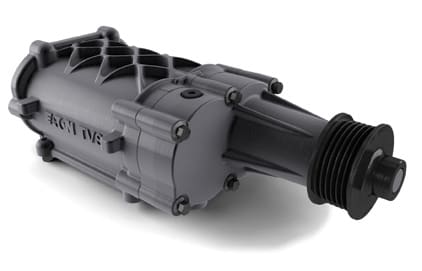
Williams is asked if an Eaton super-charger housing in composite would be feasible. It’s “an area we’re actively working to investigate alternative materials,” she replied. And reinforced-composite drive-axle housings?
“I can see it becoming commercially viable as carbon-fiber prices decline and we become more adept at processing,” Williams asserted. “Right now, the limitation is less technical and more commercial; the cost of the process and materials today are preventing that from becoming a reality. But yes, it’s definitely a technical solution,” she said.
More From SAE Media Group
Automotive Engineering
Cetim, Momentive Develop Composite Crashbox Concept

Automotive Engineering
Graphene: Living in a Stronger Material World?
Automotive Engineering
Hyundai, Ford Pursue Structural Composites Despite Challenges
Automotive Engineering
Nissan Develops High-Volume, Fully Recyclable Composite Liftgate
Automotive Engineering
Audi Reveals New A8 Technologies, Tightens Links with Porsche

Automotive Engineering
Innovations for Lightweighting: Audi brings CFRP to 2018 A8
Tech Briefs
Why Hasn’t 3D Printing Caught On in Automotive?
Aerospace & Defense Tech Briefs
SAE International Issues First Technical Standards for Aerospace Additive Manufacturing
Automotive Engineering
Plasma Process Could Cut Carbon Fiber Costs
Automotive Engineering
Innovations for Lightweighting: Magna and Ford test carbon-fiber subframes
Off-Highway Engineering
Thermal Shields
Off-Highway Engineering
Toughened Nanocomposite
Automotive Manufacturing and Machining
Prodrive Process Expands Carbon Fiber’s Manufacturing Potential

Automotive Engineering
Keeping Carbon-Composites Cool in Hot Applications
Automotive Engineering
The Transformative Power of Large-Format Additive Manufacturing for Automotive
Automotive Engineering
A Step-change in the Cost of CFRP
Power Electronics INSIDER
World’s Strongest Battery Paves Way for Light, Energy-Efficient Vehicles
Automotive Engineering
High-Strength Sheet Steel That Bends
Tech Briefs
Conductive Carbon Fiber Polymer Composite
Tech Briefs
Automated Tow/Tape Placement System
Aerospace Manufacturing and Machining INSIDER
Can This Self-Healing Composite Make Airplane and Spacecraft Components Last for Centuries?
Automotive Engineering
Sealing the Future of in-wheel Motors: Low Friction and Maximum Protection

Tech Briefs
Executive Roundtable: Additive Manufacturing
Top Stories
INSIDERManufacturing & Prototyping
 How Airbus is Using w-DED to 3D Print Larger Titanium Airplane Parts
INSIDERManned Systems
 FAA to Replace Aging Network of Ground-Based Radars
NewsTransportation
 CES 2026: Bosch is Ready to Bring AI to Your (Likely ICE-powered) Vehicle
NewsSoftware
 Accelerating Down the Road to Autonomy
EditorialDesign
 DarkSky One Wants to Make the World a Darker Place
INSIDERMaterials
 Can This Self-Healing Composite Make Airplane and Spacecraft Components Last...
Webcasts
Defense
 How Sift's Unified Observability Platform Accelerates Drone Innovation
Automotive
 E/E Architecture Redefined: Building Smarter, Safer, and Scalable...
Power
 Hydrogen Engines Are Heating Up for Heavy Duty
Electronics & Computers
 Advantages of Smart Power Distribution Unit Design for Automotive...
Unmanned Systems
 Quiet, Please: NVH Improvement Opportunities in the Early Design...
