




Kinetic Modeling of Laser-Induced D-T Fusion
It appears to be feasible to generate pulses of neutrons for radiography.
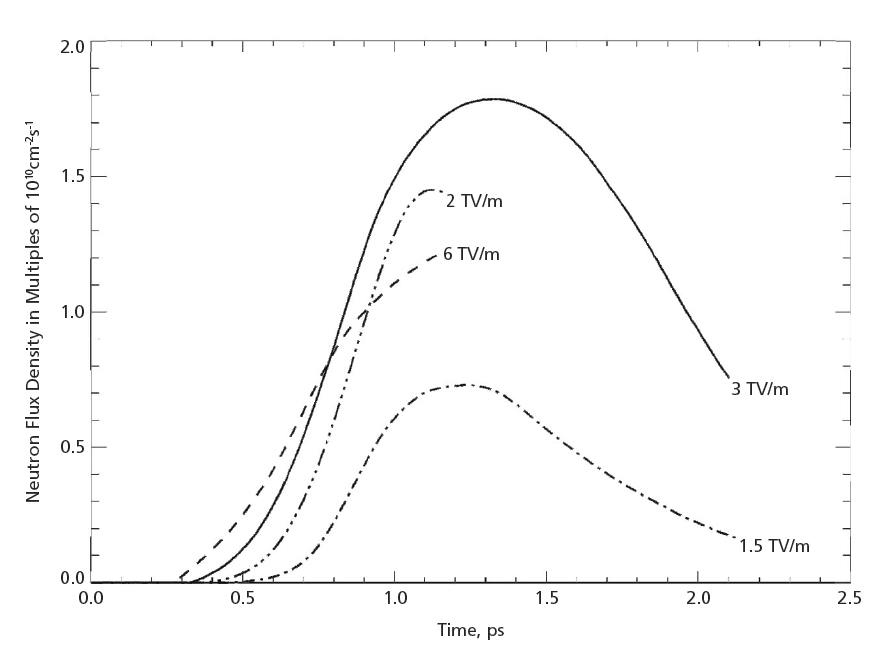
A computational- simulation study was performed to assess the feasibility of laser-induced fusion of deuterium nuclei with tritium nuclei as a means of generating neutrons for use in neutron radiography. [D-T fusion reactions produce α particles (He nuclei) plus the desired neutrons.] As in prior studies of laser-induced D-T fusion, the basic idea is to irradiate a small deuterium-and- tritium-containing target with a brief, intense laser pulse that causes a shock wave to propagate into the target. The shock wave ionizes and accelerates a substantial portion of the D and/or T molecules, resulting in, among other phenomena, collisions between D and T nuclei. The question of feasibility is essentially the question of whether, by use of a realistic target and a realistic laser pulse, a sufficient number of ions could be accelerated to sufficient kinetic energy such that the number of resulting D-T fusion reactions would suffice to produce a radiographically usefully large number of neutrons.
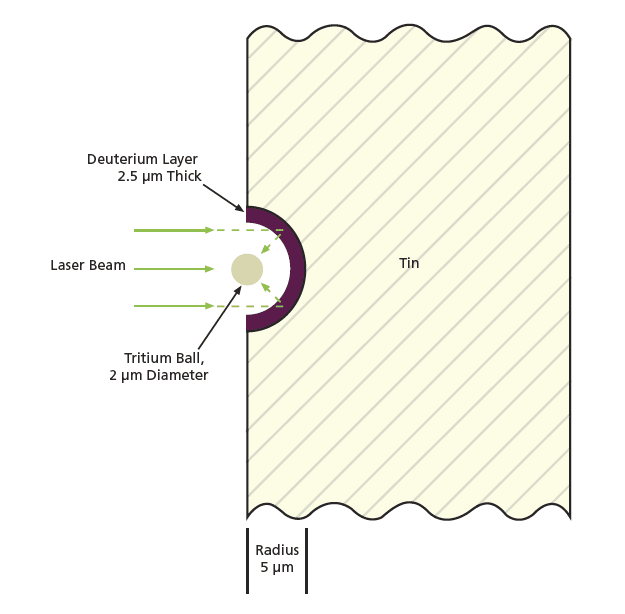
Shortly before the beginning of the study reported here, the program was enhanced by incorporation of a variety of models. One of them is a kinetic impact-ionization model that is a hybrid between a classical particle in cell model and a direct simulation Monte Carlo model. In this hybrid model, particles are represented as being pushed in their self-consistent electromagnetic field. At every time step, particles within a cell are considered for possible collision (and therefore reaction) by use of Monte Carlo methods. The main parameters required in this model are energy-dependent cross sections for ionization. While the model was designed mainly for ionization processes, it can relatively easily be adapted to other reaction-type processes, including fusion: in this study, the adaptation to D-T fusion was effected by incorporating a parameterized submodel of the energy dependence of the cross section for a D-T fusion reaction.
This work was done by Jean Luc Cambier of the Air Force Research Laboratory, and Peter Messmer, Kevin Paul, and Peter Stoltz of Tech-X Corp.
This Brief includes a Technical Support Package (TSP).
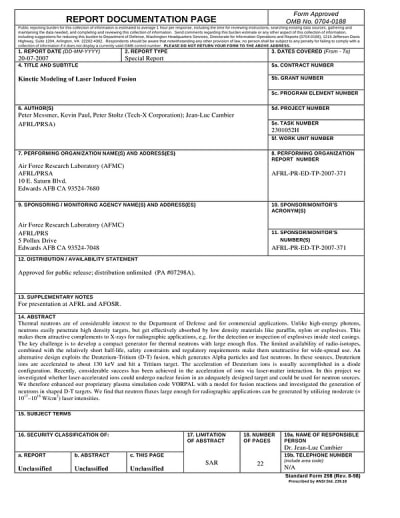
Kinetic Modeling of Laser-Induced D-T Fusion
(reference AFRL-0050) is currently available for download from the TSP library.
Don't have an account?
More From SAE Media Group
Photonics & Imaging Technology
LLNL Finds Reason Behind Defects in 3D Printing
Photonics & Imaging Technology
New Frequency Comb Can Identify Molecules in 20-Nanosecond Snapshots
Photonics & Imaging Technology
Photonics West 2021 Preview
Medical Design Briefs
OPO Lasers Spur Advances in Mass Spectrometry Diagnostics

Tech Briefs
Real-Time Airborne Particle Analyzer
Aerospace INSIDER
Using Ultrabright X-Rays to Test Materials for Ultrafast Aircraft
Tech Briefs
A New Material That Excels at Trapping Hydrogen
Photonics & Imaging Technology
Optical Coatings Technology
Photonics & Imaging Technology INSIDER
Advanced Microscope Techniques Could Improve Computer Memories
Aerospace & Defense Tech Briefs
Formation and Characterization of Gold Nanoparticles
Photonics & Imaging Technology
Can Harmful Gas Detection Improve With a New Way of Generating Powerful Lasers?
Photonics & Imaging Technology
OPO Lasers Put Optical Components to the Test


Medical Design Briefs
Laser-Driven Source of X-Rays for Medical Imaging
Photonics & Imaging Technology
Pratt & Whitney, Virginia Tech Pioneer Laser-Optical Approach for Turbofan Engine Thrust Measurement
Photonics & Imaging Technology
Nanoscale Machines Convert Light into Work
Tech Briefs
AI Identifies New Materials for Carbon Capture
Battery & Electrification Technology
Emerging Plasma FIB-SEM Techniques Advancing Battery Innovation
Photonics & Imaging Technology
Compact MEMS-Based NIR Spectroscopy for Mobile Applications
Aerospace & Defense Tech Briefs
Templated Synthesis of Aluminum Nanoparticles for Stable Energetic Materials
Photonics & Imaging Technology
A New Optical Metamaterial Makes True One-Way Glass Possible
Aerospace & Defense Tech Briefs
New Class of Excimer-Pumped Atomic Lasers (XPALS)
Photonics & Imaging Technology
A First-Of-Its-Kind Integrated Optical Isolator
Overview
The "Kinetic Modeling of Laser Induced Fusion" report by Tech-X Corporation and the Air Force Research Laboratory presents a comprehensive study on the generation and application of thermal neutrons, particularly in the context of defense and commercial uses. The report emphasizes the unique properties of thermal neutrons, which have energies around 0.025 eV. Unlike high-energy photons, thermal neutrons can penetrate high-density materials effectively while being absorbed by low-density substances such as paraffin, nylon, and explosives. This characteristic makes them particularly valuable for radiographic applications, such as detecting and inspecting explosives within steel casings.
A significant challenge identified in the report is the development of a compact neutron generator capable of producing a flux of at least (10^8) neutrons/cm²/s, which is deemed sufficient for effective radiographic applications. The report outlines various aspects of neutron generation, including the fusion of shock-accelerated ions and the reverse acceleration of ions, which are critical for enhancing neutron output.
The document also delves into the computational demands of simulating high-density plasmas, suggesting that algorithmic enhancements should be explored to improve efficiency. The plasma simulation framework, VORPAL, is discussed in detail, highlighting its role in modeling ionization processes and fusion reactions. The report includes sections on the fusion of shock-accelerated ions and the focusing of reverse-accelerated ions, which are essential for optimizing neutron generation in shaped targets.
In addition to the technical aspects, the report provides a summary of the findings and conclusions drawn from the research, emphasizing the importance of continued development in neutron generation technology. The insights presented in this report are crucial for advancing applications in both military and civilian sectors, particularly in enhancing safety and detection capabilities.
Overall, the report serves as a valuable resource for understanding the potential of thermal neutrons in various applications, the challenges associated with their generation, and the computational frameworks necessary for advancing research in this field. It underscores the importance of innovation in neutron technology to meet the growing demands of detection and inspection in complex environments.
Top Stories
INSIDERDefense
 New Raytheon and Lockheed Martin Agreements Expand Missile Defense Production
NewsAutomotive
 Ford Announces 48-Volt Architecture for Future Electric Truck
INSIDERManufacturing & Prototyping
 Active Strake System Cuts Cruise Drag, Boosts Flight Efficiency
ArticlesTransportation
 Accelerating Down the Road to Autonomy
INSIDERMaterials
 How Airbus is Using w-DED to 3D Print Larger Titanium Airplane Parts
Road ReadyTransportation

Webcasts
Electronics & Computers
 Cooling a New Generation of Aerospace and Defense Embedded...
Power
 Battery Abuse Testing: Pushing to Failure
Connectivity
 A FREE Two-Day Event Dedicated to Connected Mobility
Automotive
 Quiet, Please: NVH Improvement Opportunities in the Early Design Cycle
Transportation
 Advantages of Smart Power Distribution Unit Design for Automotive &...
Aerospace
 Sesame Solar's Nanogrid Tech Promises Major Gains in Drone Endurance