




Airbus Achieves Autonomous In-Flight Control of Drone From Tanker
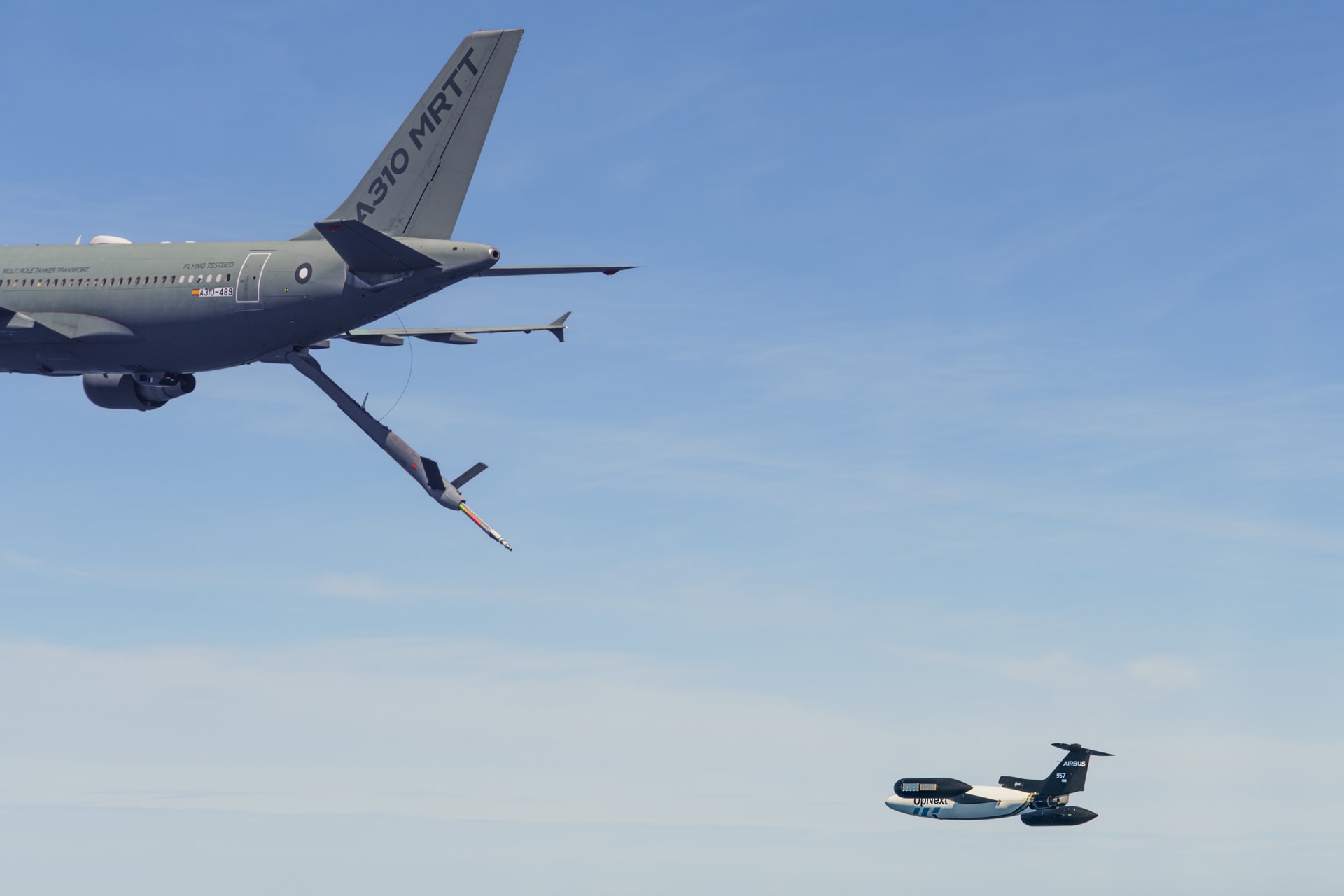
Autonomous in-flight guidance and control of a drone using an A310 MRTT was achieved during a recent flight-test in Spain performed by Airbus Defense and Space and the company’s wholly-owned subsidiary, Airbus UpNext. The achievement demonstrates a significant breakthrough for future aerial operations involving manned and unmanned assets, according to the Toulouse, France-based manufacturer.
“The success of this first flight-test campaign paves the way for developing autonomous and unmanned air-to-air refueling technologies,” said Jean Brice Dumont, Head of Military Air Systems at Airbus Defence and Space. “Even though we are at an early stage, we have achieved this within just one year and are on the right track for manned-unmanned teaming and future air force operations where fighters and mission aircraft will fly jointly with drone swarms.”
Known as Auto’Mate, the technologies to enable the in-flight guidance and control of the target drone DT25 were integrated on an A310 MRTT that Airbus uses as a flying testbed.
The flight test occurred on March 21, involving several DT-25s, acting as receiver aircraft and flying from Arenosillo Test Centre (CEDEA) at Huelva, Spain. Over the waters of the Gulf of Cadiz, the control of the drone transitioned from a ground station to the A310 MRTT, autonomously guiding the DT-25 to the in-flight refueling position.
During almost six hours of flight testing, the four successively launched receivers were sequentially controlled and commanded thanks to artificial intelligence and cooperative control algorithms, without human interaction. The different receivers were controlled and guided until a minimum distance of 150 feet (around 45 meters) from the A310 MRTT.
The Airbus Auto’Mate Demonstrator technology focuses on three pillars:
- Accurate Relative Navigation to precisely ascertain the relative position, speed and attitudes between the tanker and the receiver.
- Intra-Flight Communication between platforms to allow information exchange among the different assets, increasing the autonomy of the system of systems.
- Cooperative Control Algorithms to provide guidance, coordination, consensus and collision-avoidance functionalities to the tanker and the receivers.
- These pioneering technologies, developed by a European team from Spain, Germany and France, will continue to increase the capability gap among competitors, as well as being re-used in key technological projects, such as the Future Combat Air System (FCAS).
A second campaign is expected towards the end of 2023, exploring the use of navigation sensors based on artificial intelligence and enhanced algorithms for autonomous formation flight. In addition, there will also be two simulated drones flying in the vicinity of the A310 MRTT to demonstrate multi-receiver autonomous operations and collision-avoidance algorithms.
More From SAE Media Group
Aerospace & Defense Tech Briefs
ANSYS Will Help Airbus Develop AI-Enabled Flight Controls for the FCAS Program’s Autonomous Wingmen
Aerospace & Defense Tech Briefs
The New Airbus Wingman Aircraft
Aerospace & Defense Tech Briefs
AI Algorithms Fly Valkyrie XQ-58A
Aerospace INSIDER
Anduril Completes First Semi-Autonomous Flight of CCA Prototype
Aerospace INSIDER
VSR700 Unmanned Helicopter Performs Autonomous Flight Testing with DGA
Aerospace INSIDER
AI Algorithms Fly Uncrewed XQ-58A Valkyrie Drone for Three Hour Sortie
Aerospace INSIDER
Paris Air Show: New Aerospace Technologies, Updates and Research
Aerospace & Defense Tech Briefs
MQ-25 Vehicle Management Computer Upgrade
Aerospace & Defense Tech Briefs
Effectiveness of Inter-Vehicle Communications and On-Board Processing for Close Unmanned Autonomous Vehicle Flight Formations
Aerospace INSIDER
XQ-67A's First Flight Shows 'Genus' Approach to Aircraft Design
Aerospace INSIDER
German Air Force Starts Flight Testing New Heron ISR Drone
Aerospace Manufacturing and Machining INSIDER
A New AI-Piloted VTOL Fighter Jet for Contested Environments
Aerospace & Defense Tech Briefs
MUSHER Demonstrates Manned-Unmanned Aircraft Teaming Applications
Aerospace & Defense Tech Briefs
Autonomous Collaborative Platform
Defense INSIDER
Airbus Defence and Space Produces 2,000th Target Drone
Aerospace & Defense Tech Briefs
Airbus Will Lean on Start-Ups and Research Institutes for Europe’s Future Combat Air System
Aerospace INSIDER
Osprey MK III Completes First Autonomous Flight
Aerospace INSIDER
Helsing AI Agent Completes Saab Gripen E Test Flight
Aerospace & Defense Tech Briefs
VISTA X-62
Aerospace INSIDER
MQ-1C Completes First Air-Launched Effect Flight Demonstration
Aerospace INSIDER
DARPA AI Algorithms Transition from Simulator to Flying Modified F-16
Aerospace & Defense Tech Briefs
Raytheon, UTC Merger Will Direct $8B R&D Budget Toward Hypersonics, Cybersecurity, AI, and Next-Gen Connected Aircraft
Aerospace INSIDER
GA-ASI Announces Gray Eagle 25M for Multi-Domain Operations
Aerospace & Defense Tech Briefs
AI Algorithms Pilot X-62A in First Aerial Dogfight

Aerospace & Defense Tech Briefs
Helsing’s New CA-1 Europa Autonomous Fighter Jet
Aerospace INSIDER
Navy Completes 73-Hour Nonstop Flight of Solar-Powered UAS
Top Stories
NewsRF & Microwave Electronics
 Microvision Aquires Luminar, Plans Relationship Restoration, Multi-industry Push
INSIDERAerospace
 A Next Generation Helmet System for Navy Pilots
INSIDERDesign
 New Raytheon and Lockheed Martin Agreements Expand Missile Defense Production
INSIDERMaterials
 How Airbus is Using w-DED to 3D Print Larger Titanium Airplane Parts
NewsPower
 Ford Announces 48-Volt Architecture for Future Electric Truck
ArticlesAR/AI

Webcasts
Electronics & Computers
 Cooling a New Generation of Aerospace and Defense Embedded...
Automotive
 Battery Abuse Testing: Pushing to Failure
Power
 A FREE Two-Day Event Dedicated to Connected Mobility
Unmanned Systems
 Quiet, Please: NVH Improvement Opportunities in the Early Design Cycle
Automotive
 Advantages of Smart Power Distribution Unit Design for Automotive &...
Energy
 Sesame Solar's Nanogrid Tech Promises Major Gains in Drone Endurance