




Inexpensive Free-Form Fabrication of Titanium-Alloy Parts
Alloy/binder powder mixtures are deposited by 3D-printing machinery, then sintered.
A continuing effort to devise relatively inexpensive means of manufacturing titanium-alloy parts has been focused on a free-form fabrication approach. As used here, “free-form fabrication” refers generally to any or all of a number of methods and processes denoted, variously, as rapid prototyping or three-dimensional (3D) printing.

Freeform fabrication is a form of computer-aided manufacturing that involves the use of data on the 3D shape and size (hereafter called “3D data”) of a part that one seeks to fabricate. The 3D data are obtained from a computer-aided design (CAD) file or from a 3D digitizing system. Specialized software converts the 3D data into layered 2D data. These layered data are used by computer-controlled machinery in a process in which the part is formed by laying down one or more liquid, powder, and/or sheet material(s) in a succession of layers, point by point within each layer.
For the development of the present approach to free-form fabrication of titanium-alloy parts, a commercially available 3D-printing machine has been modified to add safety features to eliminate an explosion hazard that would be posed by airborne titanium-alloy dust. These measures consist mainly of enclosure of the volume in which the part is formed and addition of a forcedair system to purge the volume during operation (see figure).
In preparation for fabrication of a part, a titanium-alloy powder is mixed with a small amount (typically a few weight percent) of a binder material (which typically contains ammonium molybdate) in powder form and, optionally, with a carbonyl iron powder. The 3D-printing machine is used to lay down the powder mixture to form a part to nearly net size and shape.
The part as thus formed is heated to increasing temperature in a flowing argon/hydrogen atmosphere mixture with holds at various temperatures (typically from 230 to 850 °C) to remove the volatile chemical elements of the binder and carbonyl and to effect pre-sintering. Finally, the part is sintered by heating to a higher temperature (typically, 1,440 °C) in a vacuum to form a unitary (albeit somewhat porous) piece of molybdenum alloy. The iron powder contributes to reduction of porosity in that during sintering, it results in the formation of a transient iron-rich liquid phase that enhances densification.
It is planned, for future development efforts, to investigate the use of hot isostatic pressing as a means of bringing as-sintered titanium-alloy parts up to full density. It is also planned to investigate use of finiteelement modeling to simulate absorption of heat in, and shrinkage of, parts in order to devise means of controlling distortions and thereby bringing the parts closer to desired final sizes and shapes.
This work was done by Corby G. Anderson and John J. Krstulich of the University of Montana, and Stephen (Drew) Wilkerson of the Army Research Laboratory.
ARL-0024
This Brief includes a Technical Support Package (TSP).
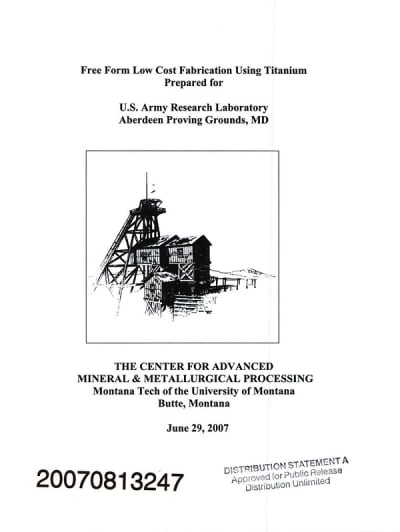
Inexpensive Free-Form Fabrication of Titanium-Alloy Parts
(reference ARL-0024) is currently available for download from the TSP library.
Don't have an account?
More From SAE Media Group
Tech Briefs
Rapid 3D Printing of Biomedical Parts
Tech Briefs
Direct Metal Laser-Sintering of Titanium
Aerospace & Defense Tech Briefs
Low Distortion Titanium in Laser Powder Bed Fusion Systems
Medical Design Briefs
What Medical Device OEMs Should Know About Outsourced MIM
Off-Highway Engineering
Bosch Invested in Large-Scale Metal 3D Printing
Tech Briefs
Using 3D Printing to Strengthen Jet Engines
Tech Briefs
Liquid Metal Lattice
Aerospace & Defense Tech Briefs
Finding the Perfect Aluminum for Additive Manufacturing
Aerospace & Defense Tech Briefs
3D Printable Superalloy
Tech Briefs
Sustainable 3D-Printed Magnets
Aerospace & Defense Tech Briefs
Evaluation of Additively Manufactured Ultrahard Steels

Tech Briefs
Nickel Titanium Alloy Ball Bearings
Aerospace & Defense Tech Briefs
High-Strength Aluminum Powder Developed for Additive Manufacturing in Aerospace, Automotive
Aerospace & Defense Tech Briefs
Experiments in Vacuum Brazing of Titanium
Aerospace Manufacturing and Machining
Getting the Most Out of Laser Wire Additive Manufacturing


Aerospace INSIDER
A New Platform for Developing Advanced Aerospace Metals at Scale
Tech Briefs
Contaminant-Free Steel
Air Force Research Laboratory Technology Horizons
Strain-Induced Porosity Model
Tech Briefs
5 Ws Of LEDs for 3D Metal Printing
NASA Spinoff
3D Printable Alloy Can Take the Heat
Off-Highway Engineering
MELD Exploits Plastic Deformation of Metals with Non-Melt Additive Manufacturing
Off-Highway Engineering
EOS Releases Four New Metal Materials for Series Additive Manufacturing
Aerospace & Defense Tech Briefs
Streamlining Post-Processing in Additive Manufacturing
Overview
The document titled "Free Form Low Cost Fabrication Using Titanium" is a comprehensive report prepared for the U.S. Army Research Laboratory, focusing on innovative methods for fabricating titanium components at reduced costs. The report emphasizes the importance of advanced manufacturing techniques to enhance the transportability, maneuverability, and durability of future Army weapons systems.
The document is structured into several key sections, beginning with an abstract that outlines the objectives of the research. It highlights the need for improved fabrication methods to meet the demands of modern military applications. The introduction sets the stage for the discussion on safety considerations, particularly in the context of working with titanium powders and the associated risks.
A significant portion of the report is dedicated to various fabrication techniques, including CNC milling, investment casting, and powder metallurgy. However, the primary focus is on free form fabrication, which utilizes specialized software to convert 3D data into layered 2D data. This layered approach allows for the creation of complex parts from materials such as plastic, metal, ceramic, or composites.
The work plan outlined in the document details the infrastructure required for research and development on low-cost titanium components through 3D printing. It includes tasks such as modifying printing machines for explosion prevention, installing printing systems, and providing training for operators. The report also discusses the evaluation and recommendation of design changes to comply with safety standards.
Additionally, the document covers baseline unit process development, which involves alloy and powder characterization, powder spreading tests, and binder development for printing. It emphasizes the importance of thermal processing, including sintering and distortion control, to ensure the quality and integrity of the fabricated parts.
Training and hands-on experience for operators are also highlighted, covering machine operation, maintenance, and safety protocols. The report concludes with a summary of the tasks completed and the anticipated outcomes of the research.
Overall, this document serves as a foundational resource for advancing titanium fabrication technologies, aiming to support the U.S. Army's future operational needs through innovative and cost-effective manufacturing solutions.
Top Stories
INSIDERDefense
 New Raytheon and Lockheed Martin Agreements Expand Missile Defense Production
NewsAutomotive
 Ford Announces 48-Volt Architecture for Future Electric Truck
INSIDERManufacturing & Prototyping
 Active Strake System Cuts Cruise Drag, Boosts Flight Efficiency
ArticlesTransportation
 Accelerating Down the Road to Autonomy
INSIDERMaterials
 How Airbus is Using w-DED to 3D Print Larger Titanium Airplane Parts
Road ReadyTransportation

Webcasts
Electronics & Computers
 Cooling a New Generation of Aerospace and Defense Embedded...
Power
 Battery Abuse Testing: Pushing to Failure
Connectivity
 A FREE Two-Day Event Dedicated to Connected Mobility
Automotive
 Quiet, Please: NVH Improvement Opportunities in the Early Design Cycle
Transportation
 Advantages of Smart Power Distribution Unit Design for Automotive &...
Aerospace
 Sesame Solar's Nanogrid Tech Promises Major Gains in Drone Endurance