




Hybrid Air Vehicles, Collins Aerospace, and University of Nottingham to Develop Electric Propulsion for Airlander 10

The United Kingdom (UK) Aerospace Research and Technology Programme has awarded grant funding in excess of £1m ($1.3m) to a partnership between Hybrid Air Vehicles Limited (HAV), Collins Aerospace Systems (Collins), and the University of Nottingham (UoN) to advance electric propulsion technologies. The team will be using HAV’s Airlander 10 hybrid airship – the world's largest aircraft by mass – as an integration platform for electric propulsion development.
The Airlander 10 hybrid airship uses combination of lighter-than-air flight, body-generated lift, and distributed vectored propulsors to achieve a speed of 80 knots and a service ceiling of 20,000 feet with a gross weight of 44,092 pounds (including 22,050 pounds of cargo capacity). It can stay airborne in an unmanned configuration for up to five days.
While the sole Airlander 10 prototype is currently powered by four 350-horsepower, four-liter, supercharged V8 diesel engines, the new partnership will work towards developing a full-sized prototype 500kW electric propulsor.
William Kucinski is content editor at SAE International, Aerospace Products Group in Warrendale, Pa. Previously, he worked as a writer at the NASA Safety Center in Cleveland, Ohio and was responsible for writing the agency’s System Failure Case Studies. His interests include literally anything that has to do with space, past and present military aircraft, and propulsion technology.
Contact him regarding any article or collaboration ideas by e-mail at
More From SAE Media Group
Aerospace & Defense Tech Briefs
Boeing’s CAV Makes First Outdoor Flight
Aerospace & Defense Tech Briefs
Astro’s Elroy Urban Air Mobility Vehicle to Get a New Stablemate This Summer

Aerospace & Defense Tech Briefs
Airlander 10 Hybrid Airship May Enter Production as Soon as 2019
Aerospace & Defense Tech Briefs
Battery Technology Is Still the Key Barrier to Better Urban Air Mobility
Aerospace & Defense Tech Briefs
Opener Unveils Zero-Emission, All-Electric Personal Aerial Vehicle
Aerospace & Defense Tech Briefs
Curtiss-Wright Black Boxes Receive European Approval
Aerospace & Defense Tech Briefs
BlackBird to Purchase 110 All-Electric Bye Aerospace EFlyer Aircraft
Aerospace & Defense Tech Briefs
Impossible Aerospace US-1 Makes Long-Distance Flight over Nevada Salt Flats
Aerospace & Defense Tech Briefs
Honeywell Acquires TruTrak and Expands General Aviation Avionics Portfolio
Aerospace & Defense Tech Briefs
Vertical Aerospace Is Honeywell’s Latest Partner in the UAM Industry
Aerospace & Defense Tech Briefs
CityAirbus Urban Air Mobility Vehicle Completes First Flight
Aerospace & Defense Tech Briefs
Rolls-Royce’s Race to Develop the World’s Fastest All-Electric Aircraft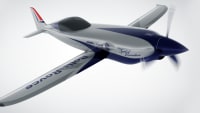
Aerospace & Defense Tech Briefs
Like a Good Neighbor, Impossible Aerospace Flew over to a Nearby Construction Fire to Help Locate Hotspots for First Responders
Aerospace & Defense Tech Briefs
SAE International’s Fundamentals of Electric Aircraft Takes Deep Dive on Aircraft Electrification Paradigm Shift, Innovation
Aerospace & Defense Tech Briefs
AVIC Subsidiary Continental Aerospace Will Power the Upcoming Diamond DA50, Expands into Electric Propulsion
Aerospace & Defense Tech Briefs
New Boeing Facility Will Improve V-22 Quality, Safety
Aerospace & Defense Tech Briefs
Bell V-280 Valor, V-247 Vigilant Will Be Engined by Rolls-Royce
Aerospace & Defense Tech Briefs
Raytheon, UTC Merger Will Direct $8B R&D Budget Toward Hypersonics, Cybersecurity, AI, and Next-Gen Connected Aircraft
Aerospace & Defense Tech Briefs
GoFly Announces Phase II Winning Teams at AeroTech Americas

Aerospace & Defense Tech Briefs
Collins Aerospace Cabin Solutions Maintain Passenger Experience While Reducing Aircraft Weight
Aerospace & Defense Tech Briefs
Jetoptera, GE Aviation Collaborate On, Demonstrate Hover with Fluidic Propulsion
Aerospace & Defense Tech Briefs
Air Racing Is Going Electric
Aerospace & Defense Tech Briefs
Deloitte Issues Report on Viability of EVTOL UAM Transportation
Aerospace & Defense Tech Briefs
Continental Aerospace Technologies Team with VerdeGo to Develop Hybrid Electric Urban Air Mobility Systems
Aerospace & Defense Tech Briefs
MTSI’s Latest Project Gives Fixed-Wing Aircraft Vertical Cargo Lift Capabilities
Aerospace & Defense Tech Briefs
Alakai Technologies Unveils the World’s First Hydrogen-Powered Urban Air Mobility Vehicle
Aerospace & Defense Tech Briefs
Transport Canada Grants Astro Aerospace a Flight Test Certificate for Autonomous Urban Air Mobility Vehicle
Aerospace & Defense Tech Briefs
Boeing Aerospace & Autonomy Center to Focus on Designing, Building, Flying Autonomous Aircraft
Top Stories
NewsRF & Microwave Electronics
 Microvision Aquires Luminar, Plans Relationship Restoration, Multi-industry Push
INSIDERAerospace
 A Next Generation Helmet System for Navy Pilots
INSIDERDesign
 New Raytheon and Lockheed Martin Agreements Expand Missile Defense Production
INSIDERMaterials
 How Airbus is Using w-DED to 3D Print Larger Titanium Airplane Parts
NewsPower
 Ford Announces 48-Volt Architecture for Future Electric Truck
ArticlesAR/AI

Webcasts
Electronics & Computers
 Cooling a New Generation of Aerospace and Defense Embedded...
Automotive
 Battery Abuse Testing: Pushing to Failure
Power
 A FREE Two-Day Event Dedicated to Connected Mobility
Unmanned Systems
 Quiet, Please: NVH Improvement Opportunities in the Early Design Cycle
Automotive
 Advantages of Smart Power Distribution Unit Design for Automotive &...
Energy
 Sesame Solar's Nanogrid Tech Promises Major Gains in Drone Endurance