




Airlander 10 Hybrid Airship May Enter Production as Soon as 2019
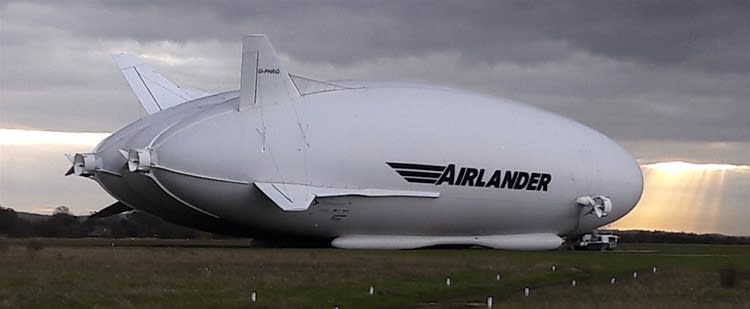
With a recently won production organization approval (POA) from the Civilian Aviation Authority (CAV), Hybrid Air Vehicles Limited (HAV) is one step closer to type certification of the Airlander 10 hybrid airship.
The POA certifies all aspects of Airlander 10 production, including supply chain management, HAV’s production facility, and manufacturing and assembly of the airship components – including 119 meter-long, triple-layered laminated hull fabric.

Learn more: RT LTA develops an improved bladder material for lighter-than-air SkyStar aerostats

The POA was awarded three months after HAV secured a design organization approval (DOA) from the European Aviation Safety Agency (EASA), which covers design activities and flight testing. Before then, Hybrid Air Vehicles had been operating the Airlander 10 under a prototype certificate. The company will now undertake a full flight test program and work toward type certification of the production Airlander 10. "The POA approval is a significant milestone for HAV. It is the culmination of months of hard work and focused effort," comments David Lindley, HAV’s head of aviation safety and quality assurance. "It demonstrates that the safety, quality assurance, and supply chain management processes are in place, along with the production facility." "Successfully being awarded our POA in the same year as our DOA is fantastic," adds Executive Director Nick Allman. "The POA is the regulator’s stamp of approval for us to move ahead with the productionisation of Airlander 10 on the path to type certification. This puts us in a great position going into 2019." Airlander 10 – the world's largest aircraft by mass – uses innovative technology to combine the best characteristics of fixed wing aircraft and helicopters with lighter-than-air technology to create a new breed of hyper-efficient aircraft. It can stay airborne for up to five days at a time.
Learn more: PAE ISR engineers boost Resolute Eagle UAS networking, endurance, payload capacity with Persistent Systems MPU5
The aircraft, originally designated HAV 304, was initially designed for the United States Army Long Endurance Multi-intelligence Vehicle (LEMV) program. In its current civilian iteration, it is capable of a wide range of communication, cargo carrying, and survey roles in both the military and commercial sectors all with a significantly lower carbon footprint than other forms of air transport.
However, HAV is currently marketing the Airlander 10 as a luxury airliner of sorts, with an interior designed for passenger comfort and panoramic views.
William Kucinski is content editor at SAE International, Aerospace Products Group in Warrendale, Pa. Previously, he worked as a writer at the NASA Safety Center in Cleveland, Ohio and was responsible for writing the agency’s System Failure Case Studies. His interests include literally anything that has to do with space, past and present military aircraft, and propulsion technology.
More From SAE Media Group
Aerospace & Defense Tech Briefs
Hybrid Air Vehicles, Collins Aerospace, and University of Nottingham to Develop Electric Propulsion for Airlander 10
Aerospace & Defense Tech Briefs
GA-ASI Maximizes Fuel Capacity for MQ-25 Entry
Aerospace & Defense Tech Briefs
NASA Crash Landing Is a Complete Success
Aerospace & Defense Tech Briefs
Vertical Flight Society Applauds EVTOL Innovation, Bell Nexus UAM Concept
Aerospace & Defense Tech Briefs
Boeing Aerospace & Autonomy Center to Focus on Designing, Building, Flying Autonomous Aircraft
Aerospace & Defense Tech Briefs
Lockheed Martin and Arconic Collaborate on 3D Printing and Advanced Aerospace Materials

Aerospace & Defense Tech Briefs
Sikorsky-Boeing’s FVL Contender Takes Flight
Aerospace & Defense Tech Briefs
Collins Aerospace Will Provide Avionics and Synthetic Vision for the Supersonic X-59 QueSST
Aerospace & Defense Tech Briefs
Boeing and NASA Unveil Lightweight, Ultra-Thin, More Aerodynamic Transonic Truss-Braced Wing Concept
Aerospace & Defense Tech Briefs
Lockheed Martin Skunk Works Begins Manufacturing X-59 Supersonic Aircraft Parts
Aerospace & Defense Tech Briefs
Martin UAV VTOL Unmanned Aircraft Taps Persistent Systems Wave Relay Data Link Technology
Aerospace & Defense Tech Briefs
Personal Air Transport Drives Need for Advanced VTOL Technologies, Standards
Aerospace & Defense Tech Briefs
Researchers Work to Uncover Turboelectric Propulsion’s Unknown Challenges
Aerospace & Defense Tech Briefs
Rolls-Royce to Work with Airframe Manufacturers, Seek Partners for EVTOL Project
Aerospace & Defense Tech Briefs
Paterson Composites to Build Components for Astro Aerospace Autonomous Passenger Drone
Aerospace & Defense Tech Briefs
Boeing Completes Assembly of the First 777X
Aerospace & Defense Tech Briefs
Russia to Bring Back the Wing-In-Ground-Effect Aircraft
Aerospace & Defense Tech Briefs
SES to Outfit Sikorsky UH-60A Black Hawk Helicopters with Unitech Composites Weapons Pylons
Aerospace & Defense Tech Briefs
J-10B Fighter Aircraft Debuts Chinese Thrust Vectoring Technology
Aerospace & Defense Tech Briefs
Stratolaunch Composite Air-Launch Aircraft Pulls the Wheels up During Latest Taxi Test
Aerospace & Defense Tech Briefs
UAV Turbines Designs Purpose-Built Microturbine Engine for Class 3 and 4 UAVs
Aerospace & Defense Tech Briefs
Maintainers Design a $400 Maintenance Fixture to save the U.S. Air Force $500k per Year
Aerospace & Defense Tech Briefs
Bell Nexus Full-Scale Air Taxi Design Debuts, Taps Novel VTOL, Hybrid Propulsion, Energy Storage, and Avionics Technologies
Aerospace & Defense Tech Briefs
Boeing's Latest Contract Secures New Wings for Remaining A-10 Fleet

Aerospace & Defense Tech Briefs
Sensuron Enables Real-Time Structural Health Monitoring Onboard NASA’s X-56 UAV
Automotive Engineering
Bye Aerospace’s Solar-Electric Prototype Completes First Flight
Aerospace & Defense Tech Briefs
Aerion Taps Siemens’ Xcelerator Portfolio to Enable Next-Generation Global Transportation Networks
Aerospace & Defense Tech Briefs
NASA and AeroVironment Are Building a Helicopter for Mars
Transcript
No transcript is available for this video.
Top Stories
INSIDERManufacturing & Prototyping
 How Airbus is Using w-DED to 3D Print Larger Titanium Airplane Parts
INSIDERManned Systems
 FAA to Replace Aging Network of Ground-Based Radars
NewsTransportation
 CES 2026: Bosch is Ready to Bring AI to Your (Likely ICE-powered) Vehicle
NewsSoftware
 Accelerating Down the Road to Autonomy
EditorialDesign
 DarkSky One Wants to Make the World a Darker Place
INSIDERMaterials
 Can This Self-Healing Composite Make Airplane and Spacecraft Components Last...
Webcasts
Defense
 How Sift's Unified Observability Platform Accelerates Drone Innovation
Automotive
 E/E Architecture Redefined: Building Smarter, Safer, and Scalable...
Power
 Hydrogen Engines Are Heating Up for Heavy Duty
Electronics & Computers
 Advantages of Smart Power Distribution Unit Design for Automotive...
Unmanned Systems
 Quiet, Please: NVH Improvement Opportunities in the Early Design...
