Opener Unveils Zero-Emission, All-Electric Personal Aerial Vehicle
The fixed-wing BlackFly will require no formal licensing to operate.

This week, Opener, Inc. , a Palo Alto, Calif.-based developer of consumer aero vehicles, debuted their zero-emission BlackFly prototype – and the latest foray into the personal mobility industry.

Opener’s BlackFly is the world’s first ultralight, all-electric, fixed-wing vertical take-off and landing (VTOL) aircraft. According to the company, the BlackFly personal aerial vehicle (PAV), is a single-seater with simple controls and requires no formal licensing (in the United States) or special skills to operate safely. It has a range of up to 25 miles at a US-restricted speed of 62 miles per hour.
The BlackFly is primarily designed to operate from small grassy areas, but it also has full amphibious capabilities. The aircraft has eight propulsion systems, spread across two wings for multiple-failure security. It also has geofence capabilities and an automatic return-to-home feature.
According to Opener, the BlackFly can fit within a small trailer and be prepped for flight in 30 minutes.
There is even a ballistic parachute option.
The Opener team has quietly spent the last nine years designing, developing, and testing new innovative technologies that led to the creation of the BlackFly – completing more than 1,400 flights and travelling more than 12,000 miles with a payload onboard.
One of the key concepts behind the aircraft is a fault-tolerant design with triple modular redundancy .
Triple modular redundancy refers to when three separate systems perform the same function. The three outputs are then processed, with the ideal output from one system being used. This is especially valuable if there is a breakdown or failure in one of the three systems.
“Opener is re-energizing the art of flight with a safe and affordable flying vehicle that can free its operators from the everyday restrictions of ground transportation,” says Marcus Leng, CEO of Opener.
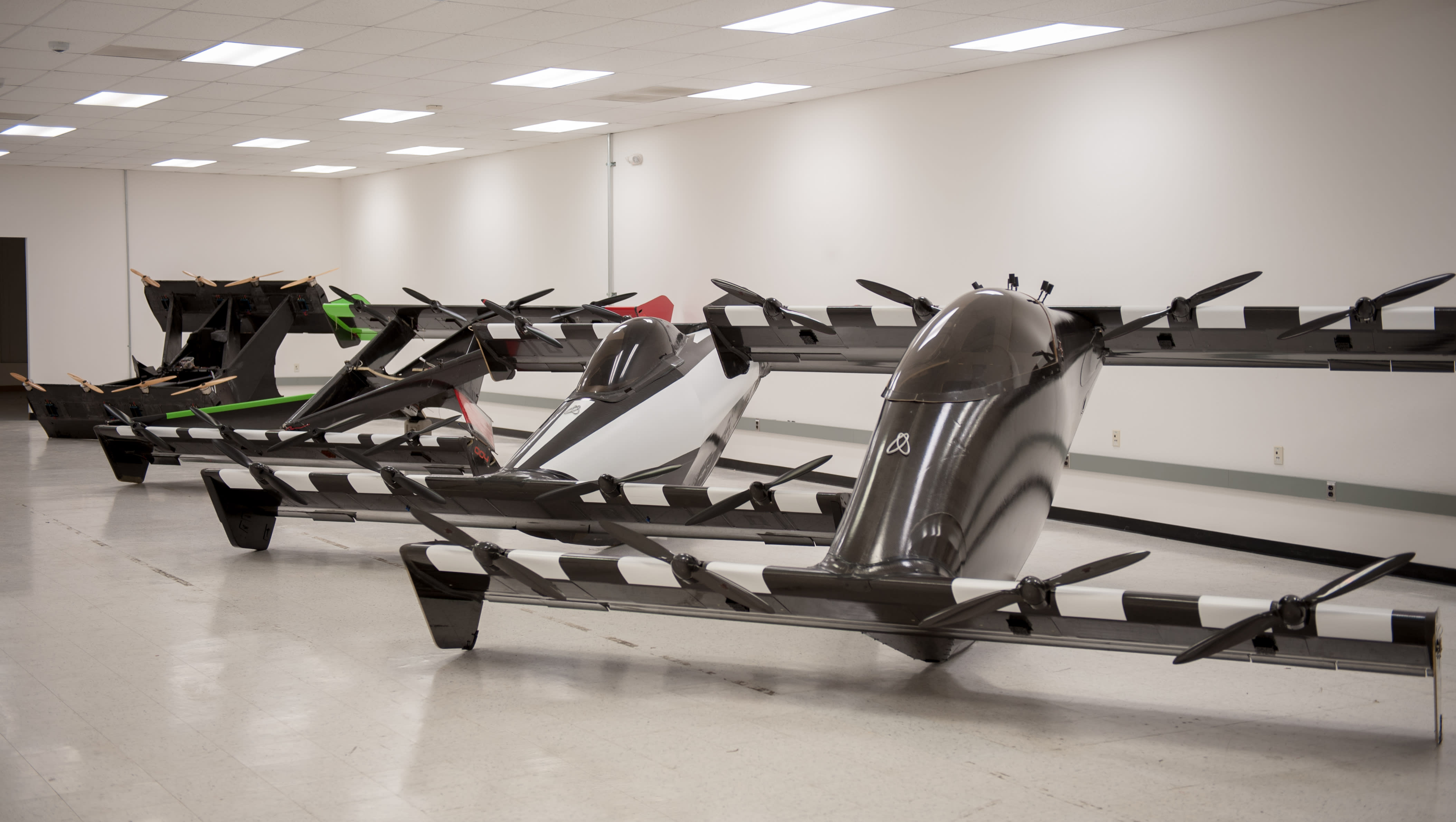


“We will offer competitive pricing in an endeavor to democratize three-dimensional personal transportation. Safety has been our primary driving goal in the development of this new technology. Opener will be introducing this innovation in a controlled and responsible manner. Even though not required by FAA regulations, BlackFly operators will be required to successfully complete the FAA Private Pilot written examination and also complete company-mandated vehicle familiarization and operator training.”
The aircraft will be manufactured domestically, and the company plans to price the BlackFly near the cost of a sport utility vehicle once large-scale production begins.
The BlackFly has a low noise signature and Super Charge capabilities, potentially charging in less than 30 minutes. Opener’s long-term vision is to integrate these vehicles into a rural/urban commuting networks powered by renewable energy sources.
The company will be displaying the vehicles from July 23 to July 29 at the 2018 EAA AirVenture Expo in Oshkosh, Wis.
William Kucinski is content editor at SAE International, Aerospace Products Group in Warrendale, Pa. Previously, he worked as a writer at the NASA Safety Center in Cleveland, Ohio and was responsible for writing the agency’s System Failure Case Studies. His interests include literally anything that has to do with space, past and present military aircraft, and propulsion technology.
Contact him regarding any article or collaboration ideas by e-mail at
More From SAE Media Group
Aerospace & Defense Tech Briefs
Boeing’s CAV Makes First Outdoor Flight
Aerospace & Defense Tech Briefs
CityAirbus Urban Air Mobility Vehicle Completes First Flight
Aerospace & Defense Tech Briefs
Astro’s Elroy Urban Air Mobility Vehicle to Get a New Stablemate This Summer
Aerospace & Defense Tech Briefs
MTSI’s Latest Project Gives Fixed-Wing Aircraft Vertical Cargo Lift Capabilities
Aerospace & Defense Tech Briefs
Transport Canada Grants Astro Aerospace a Flight Test Certificate for Autonomous Urban Air Mobility Vehicle
Aerospace & Defense Tech Briefs
Sikorsky’s Autonomous Black Hawk Helicopter Takes Flight
Aerospace & Defense Tech Briefs
Vertical Aerospace Is Honeywell’s Latest Partner in the UAM Industry
Aerospace & Defense Tech Briefs
Hybrid Air Vehicles, Collins Aerospace, and University of Nottingham to Develop Electric Propulsion for Airlander 10
Aerospace & Defense Tech Briefs
Curtiss-Wright Black Boxes Receive European Approval
Aerospace & Defense Tech Briefs
LIFT Aircraft Unveils Personal Multirotor Aircraft for Experiential Entertainment
Aerospace & Defense Tech Briefs
GoFly Announces Phase II Winning Teams at AeroTech Americas
Aerospace & Defense Tech Briefs
Battery Technology Is Still the Key Barrier to Better Urban Air Mobility
Aerospace & Defense Tech Briefs
FAA Certifies AeroVonics' Economical Avionics Upgrade for Light General Aviation Aircraft
Aerospace & Defense Tech Briefs
Rolls-Royce’s Race to Develop the World’s Fastest All-Electric Aircraft
Aerospace & Defense Tech Briefs
Deloitte Issues Report on Viability of EVTOL UAM Transportation
Aerospace & Defense Tech Briefs
Personal Air Transport Drives Need for Advanced VTOL Technologies, Standards
Aerospace & Defense Tech Briefs
First F-35 Crash; Pilot Safe

Aerospace & Defense Tech Briefs
Like a Good Neighbor, Impossible Aerospace Flew over to a Nearby Construction Fire to Help Locate Hotspots for First Responders
Aerospace & Defense Tech Briefs
Air Racing Is Going Electric
Aerospace & Defense Tech Briefs
BlackBird to Purchase 110 All-Electric Bye Aerospace EFlyer Aircraft
Aerospace & Defense Tech Briefs
Dart Aerospace’s Latest Emergency Float System Receives Certification in the U.S. and Europe
Aerospace & Defense Tech Briefs
Vertical Flight Society Applauds EVTOL Innovation, Bell Nexus UAM Concept
Aerospace & Defense Tech Briefs
Rolls-Royce to Work with Airframe Manufacturers, Seek Partners for EVTOL Project
Aerospace & Defense Tech Briefs
Researchers Work to Uncover Turboelectric Propulsion’s Unknown Challenges
Aerospace & Defense Tech Briefs
Sonex Aircraft Is Developing the World's Most Afforadable Jet Trainer
Aerospace & Defense Tech Briefs
Moog to Collaborate on Bell Air Taxi
Aerospace & Defense Tech Briefs
Embraer X EVTOL Debuts Design at Uber Elevate 2018
Aerospace & Defense Tech Briefs
New Boeing Facility Will Improve V-22 Quality, Safety
Aerospace & Defense Tech Briefs
AIA Predicts Flying Air Taxis, Supersonic Air Travel, and Space Industry for 2050
Transcript
00:00:01 [Music] [Music] That was great. That was really good. I mean the acceleration and the speed at which you fly immediately like you're you're just dancing It felt like snowboarding through powder or like, you know...it was really good Unbelievable Wow
Top Stories
INSIDERManufacturing & Prototyping
 How Airbus is Using w-DED to 3D Print Larger Titanium Airplane Parts
INSIDERManned Systems
 FAA to Replace Aging Network of Ground-Based Radars
NewsTransportation
 CES 2026: Bosch is Ready to Bring AI to Your (Likely ICE-powered) Vehicle
NewsSoftware
 Accelerating Down the Road to Autonomy
EditorialDesign
 DarkSky One Wants to Make the World a Darker Place
INSIDERMaterials
 Can This Self-Healing Composite Make Airplane and Spacecraft Components Last...
Webcasts
Defense
 How Sift's Unified Observability Platform Accelerates Drone Innovation
Automotive
 E/E Architecture Redefined: Building Smarter, Safer, and Scalable...
Power
 Hydrogen Engines Are Heating Up for Heavy Duty
Electronics & Computers
 Advantages of Smart Power Distribution Unit Design for Automotive...
Unmanned Systems
 Quiet, Please: NVH Improvement Opportunities in the Early Design...
Power

Similar Stories
Application BriefsAerospace
 Aircraft Parachute Recovery Systems
Technical InnovationEnergy
 Electrification’s Impact on Commercial-Vehicle Chassis Design
NewsAutomotive
 GoFly Announces Phase II Winning Teams at AeroTech Americas
INSIDERAerospace
 Air Force Receives First eVTOL Six Months Ahead of Schedule
NewsAerospace
 Sonex Aircraft Is Developing the World's Most Afforadable Jet Trainer