




The F-22 Raptor Gets Its First Metallic 3D-Printed Part
A new titanium component produced via powder bed fusion could save the U.S. Air Force time and money during F-22 maintenance.
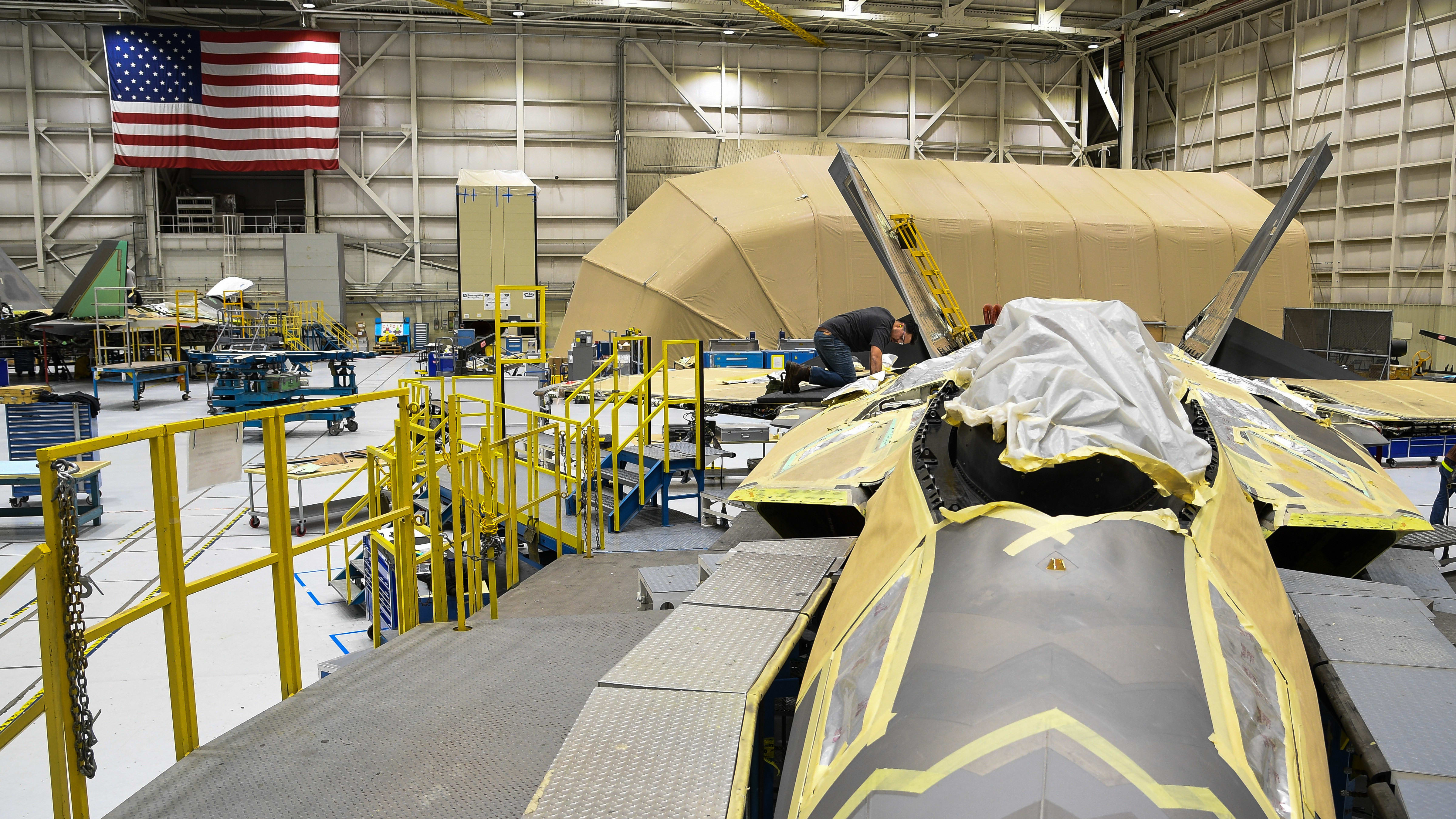
Maintainers from the U.S. Air Force 574th Aircraft Maintenance Squadron (AMXS) have installed the first titanium additively manufactured titanium component on an operational Lockheed Martin F-22 Raptor . While the U.S. Air Force routinely uses additive manufacturing (AM), also known as 3D printing, to create parts for legacy aircraft, the service is beginning to incorporate the practice into supply chains for fifth-generation aircraft.

The component – a bracket from the kick panel assemble of the cockpit – was manufactured using powder bed fusion, a popular AM process commonly used in the aerospace industry. During the process, a digitally guided laser selectively melts a metal powder medium, fusing it to the previous layer. The process is more economical than traditional subtractive manufacturing methods like stamping, milling, or drilling, as unused “scrap” powder can be recycled for later use.
“One of the most difficult things to overcome in the F-22 community, because of the small fleet size, is the availability of additional parts to support the aircraft,” says Robert Lewin, 574th AMXS director. AM technology enables maintainers to acquire replacement parts on short notice without minimum order quantities, which saves taxpayer dollars and reduces the time the aircraft is in maintenance.
According to the maintainers, the finished AM part can arrive as fast as three days after ordering. Furthermore, the original equipment manufacturer (OEM) bracket, a corrosion-prone aluminum component, is replaced 80 percent of the time during depot maintenance. Although the new, printed titanium part is will not corrode, it will be monitored while in service and inspected during the aircraft’s next scheduled maintenance at Hill Air Force Base in Utah. “We had to go to engineering, get the prints modified, we had to go through stress testing to make sure the part could withstand the loads it would be experiencing – which isn’t that much, that is why we chose a secondary part,” says Robert Blind, Lockheed Martin modifications manager.
Solutions that are faster, cheaper, and better are not often come by: the service says that the new bracket will be printed for and installed on all F-22 aircraft during maintenance if this test case is validated.
At least five more F-22 metallic AM parts are planned for validation through public-private partnerships, in order to reduce costs and maintenance turnaround on one of the U.S. Air Force’s most advanced and expensive fighter aircraft.
“We’re looking to go a little bit further as this part proves itself out,” says Blind.
“Once we get to the more complicated parts, the result could be a 60- to 70-day reduction in flow time for aircraft to be here for maintenance,” says Lewin.
Information and interviews originally sourced by R. Nial Bradshaw, 75th Air Base Wing Public Affairs

William Kucinski is content editor at SAE International, Aerospace Products Group in Warrendale, Pa. Previously, he worked as a writer at the NASA Safety Center in Cleveland, Ohio and was responsible for writing the agency’s System Failure Case Studies. His interests include literally anything that has to do with space, past and present military aircraft, and propulsion technology.
Contact him regarding any article or collaboration ideas by e-mail at
More From SAE Media Group
Aerospace & Defense Tech Briefs
Lockheed Martin and Arconic Collaborate on 3D Printing and Advanced Aerospace Materials
Aerospace & Defense Tech Briefs
Norsk and SAE International Collaborate on World’s First Directed Energy Deposition Specification
Aerospace & Defense Tech Briefs
Boeing Virtualizes, Secures Additive Manufacturing Across Supply Chain with Assembrix
Aerospace & Defense Tech Briefs
Sciaky, Aubert & Duval, and Airbus Join Together to Combine High-Power Forging with Additive Manufacturing
Aerospace & Defense Tech Briefs
SAE International Issues First Technical Standards for Aerospace Additive Manufacturing
Aerospace & Defense Tech Briefs
Air Force Begins 3D Printing Nonstructural Aircraft Parts
Aerospace & Defense Tech Briefs
Weber Metals Unveils New 540-Meganewton Press for Aerospace Components
Aerospace & Defense Tech Briefs
Arconic Unveils Advanced Titanium Alloy for Higher Temperature Aerospace Applications
Off-Highway Engineering
EOS Releases Four New Metal Materials for Series Additive Manufacturing
Off-Highway Engineering
Bosch Invested in Large-Scale Metal 3D Printing
Aerospace & Defense Tech Briefs
Etihad and Eos Partner to Develop 3D-Printed Cabin Interiors
Aerospace & Defense Tech Briefs
Lockheed Martin Will Merge Machine Learning with 3D Printing

Aerospace & Defense Tech Briefs
Equispheres Accelerates Additive Manufacturing Innovation with $5M from Lockheed Martin
Aerospace INSIDER
Honeywell Develops Cooling System Upgrade for F-35 Engine

Off-Highway Engineering
MELD Exploits Plastic Deformation of Metals with Non-Melt Additive Manufacturing
Aerospace & Defense Tech Briefs
3-D Printing in Aerospace: Not Just Winging It
Off-Highway Engineering
Moving Metal AM Forward
Aerospace & Defense Tech Briefs
Boeing's Latest Contract Secures New Wings for Remaining A-10 Fleet
Aerospace INSIDER
Helsing Unveils New Autonomous Fighter Jet 'CA-1 Europa'

Aerospace & Defense Tech Briefs
Composite Repair Engineering Case Studies for U.S. Army Aerostructures
Aerospace INSIDER
F-22 Pilot Controls Drone With Tablet
Aerospace & Defense Tech Briefs
Flight Testing Microvanes and Riblets
Aerospace INSIDER
Sweden Taps GKN, Saab to Design Concepts for Future Fighter Jet
Automotive Engineering
Directing GM’s 3D-Printed Future
Aerospace INSIDER
AFMC Completes First Ever Flight of F-35 with F-22 Software
Aerospace Manufacturing and Machining INSIDER
How Airbus is Using w-DED to 3D Print Larger Titanium Airplane Parts
Top Stories
NewsSensors/Data Acquisition
 Microvision Aquires Luminar, Plans Relationship Restoration, Multi-industry Push
INSIDERRF & Microwave Electronics
 A Next Generation Helmet System for Navy Pilots
INSIDERWeapons Systems
 New Raytheon and Lockheed Martin Agreements Expand Missile Defense Production
NewsAutomotive
 Ford Announces 48-Volt Architecture for Future Electric Truck
INSIDERAerospace
 Active Strake System Cuts Cruise Drag, Boosts Flight Efficiency
ArticlesTransportation

Webcasts
Aerospace
 Cooling a New Generation of Aerospace and Defense Embedded...
Energy
 Battery Abuse Testing: Pushing to Failure
Power
 A FREE Two-Day Event Dedicated to Connected Mobility
Automotive
 Quiet, Please: NVH Improvement Opportunities in the Early Design Cycle
Electronics & Computers
 Advantages of Smart Power Distribution Unit Design for Automotive &...
Unmanned Systems
 Sesame Solar's Nanogrid Tech Promises Major Gains in Drone Endurance