




First Airbus Helicopters H160 Takes Flight
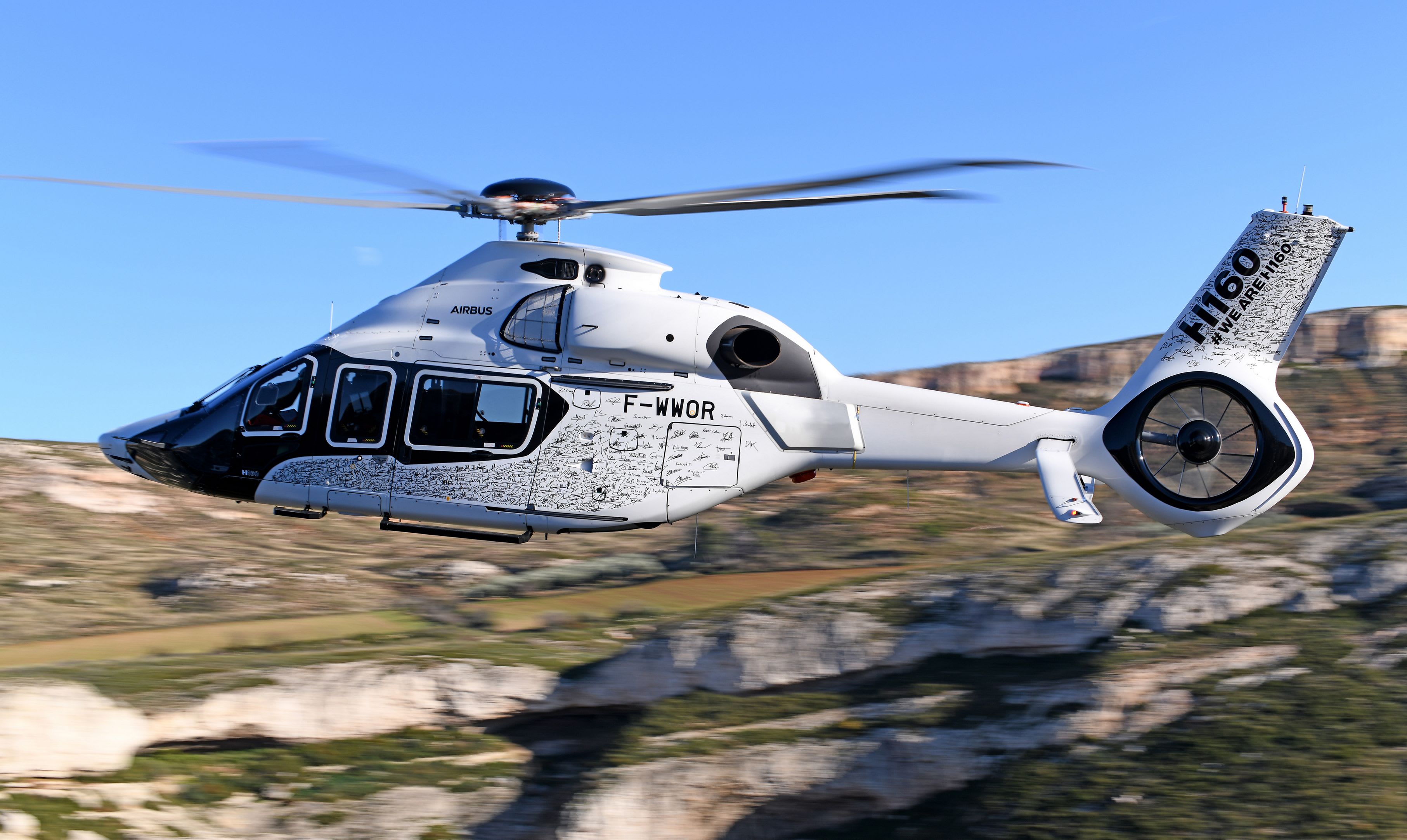
The first serial Airbus Helicopters H160 medium utility helicopter rolled off the brand-new assembly line in Marignane, France and performed its first flight in a unique “signature” livery. The helicopter, which bears the names of hundreds of people working towards its certification, will be delivered to launch customer Babcock International in 2020.
The H160, the first Airbus helicopter to bear the “H generation” designation, opens a new chapter in the history of Airbus. Airbus designed with H160 with a customer value focus, in terms of performance, economic competitiveness, safety, and comfort.
With 68 patents, the H160 integrates Airbus Helicopters’ latest technological innovations aimed at providing passengers with superior comfort thanks to the sound-reducing Blue Edge blades and superb external visibility for both passengers and pilots, and additional safety features provided by Helionix’s flight envelope protection systems and reduced pilot workload.
The first serial aircraft will join the three prototypes, which have already accumulated over 1,000 flight hours, in the final steps of the flight test campaign, namely confirming that the modifications that have been introduced through the serial configuration have no impact on the helicopter’s handling qualities.
The pre-serial prototypes were also used to mature the assembly process. Airbus Helicopters’ new industrial model, based on site specialization and a plug and play component assembly, has reduced the H160’s time to market to 24 weeks. This will enable customers to confirm their mission configuration at later stage based on market needs.
Babcock’s H160 fleet is destined for emergency medical service (EMS) and other critical services missions.
The H160 is equipped with two Safran Arrano , turboshaft engines, has a max takeoff weight of 12,500 pounds, a top speed of 202 miles per hour, and a range of 529 miles. Airbus claims that the H160 is 15% more efficient than previous generation models and has the largest cabin in its class.
William Kucinski is content editor at SAE International, Aerospace Products Group in Warrendale, Pa. Previously, he worked as a writer at the NASA Safety Center in Cleveland, Ohio and was responsible for writing the agency’s System Failure Case Studies. His interests include literally anything that has to do with space, past and present military aircraft, and propulsion technology.
More From SAE Media Group
Aerospace & Defense Tech Briefs
BendixKing and Airwork Are Developing Cockpit Upgrades for the Often Overlooked Small- and Medium-Sized Helicopter Market
Aerospace & Defense Tech Briefs
Airbus Helicopters VSR700 Makes First Fully Autonomous Flight
Aerospace & Defense Tech Briefs
Sikorsky’s Autonomous Black Hawk Helicopter Takes Flight
Aerospace & Defense Tech Briefs
Lockheed Martin’s Next-Gen, 360-Degree Vision System Flies on the Bell V-280 Valor
Aerospace & Defense Tech Briefs
MTSI’s Latest Project Gives Fixed-Wing Aircraft Vertical Cargo Lift Capabilities
Aerospace & Defense Tech Briefs
Like a Good Neighbor, Impossible Aerospace Flew over to a Nearby Construction Fire to Help Locate Hotspots for First Responders
Aerospace & Defense Tech Briefs
CityAirbus Urban Air Mobility Vehicle Completes First Flight
Aerospace & Defense Tech Briefs
Sikorsky-Boeing’s FVL Contender Takes Flight
Aerospace & Defense Tech Briefs
Dart Aerospace’s Latest Emergency Float System Receives Certification in the U.S. and Europe
Aerospace & Defense Tech Briefs
Boeing’s CAV Makes First Outdoor Flight
Aerospace & Defense Tech Briefs
Russian Helicopters Successfully Develops Helicopter Ditching System
Aerospace & Defense Tech Briefs
Bell V-280 Valor, V-247 Vigilant Will Be Engined by Rolls-Royce
Aerospace & Defense Tech Briefs
Bell Incorporates Bird-Deterring Lights as Standard Equipment on Bell 407 Helicopters
Aerospace & Defense Tech Briefs
Boeing to Modernize Spanish Chinook Fleet with Autonomous-Ready Avionics and Flight Control Systems
Aerospace & Defense Tech Briefs
Sikorsky, Boeing Debut Future Vertical Lift Dual-Rotor Design with SB>1 DEFIANT Helicopter
Aerospace & Defense Tech Briefs
Curtiss-Wright Black Boxes Receive European Approval
Aerospace & Defense Tech Briefs
BelugaXL Successfully Completes Maiden Flight
Aerospace & Defense Tech Briefs
Ministry of Defense of Qatar Orders 28 NHIndustries NH90 Multirole Military Helicopters
Aerospace & Defense Tech Briefs
NASA and AeroVironment Are Building a Helicopter for Mars
Aerospace & Defense Tech Briefs
Astro’s Elroy Urban Air Mobility Vehicle to Get a New Stablemate This Summer
Aerospace & Defense Tech Briefs
New Boeing Facility Will Improve V-22 Quality, Safety
Aerospace & Defense Tech Briefs
Vertical Flight Society Applauds EVTOL Innovation, Bell Nexus UAM Concept
Aerospace & Defense Tech Briefs
Honeywell Targets Urban Air Mobility Market with New Hybrid Turboshaft Engine
Aerospace & Defense Tech Briefs
The GE T901 Will Be the U.S. Army’s Next Gen Helicopter Engine
Aerospace & Defense Tech Briefs
First Airbus A330-800 Airliner Goes Airborne in Maiden Flight, Enters Flight Test Phase
Automotive Engineering
First Operational Use of Aurora’s AACUS System
Automotive Engineering
Subaru’s New ‘Souped Up’ Vehicle Is a Bell Helicopter
Aerospace & Defense Tech Briefs
Phase Three of DARPA’s ALIAS Aircraft Automation System Continues

Aerospace & Defense Tech Briefs
Battery Technology Is Still the Key Barrier to Better Urban Air Mobility
Transcript
No transcript is available for this video.
Top Stories
NewsRF & Microwave Electronics
 Microvision Aquires Luminar, Plans Relationship Restoration, Multi-industry Push
INSIDERAerospace
 A Next Generation Helmet System for Navy Pilots
INSIDERDesign
 New Raytheon and Lockheed Martin Agreements Expand Missile Defense Production
INSIDERMaterials
 How Airbus is Using w-DED to 3D Print Larger Titanium Airplane Parts
NewsPower
 Ford Announces 48-Volt Architecture for Future Electric Truck
ArticlesAR/AI

Webcasts
Electronics & Computers
 Cooling a New Generation of Aerospace and Defense Embedded...
Automotive
 Battery Abuse Testing: Pushing to Failure
Power
 A FREE Two-Day Event Dedicated to Connected Mobility
Unmanned Systems
 Quiet, Please: NVH Improvement Opportunities in the Early Design Cycle
Automotive
 Advantages of Smart Power Distribution Unit Design for Automotive &...
Energy
 Sesame Solar's Nanogrid Tech Promises Major Gains in Drone Endurance