




Honeywell Targets Urban Air Mobility Market with New Hybrid Turboshaft Engine
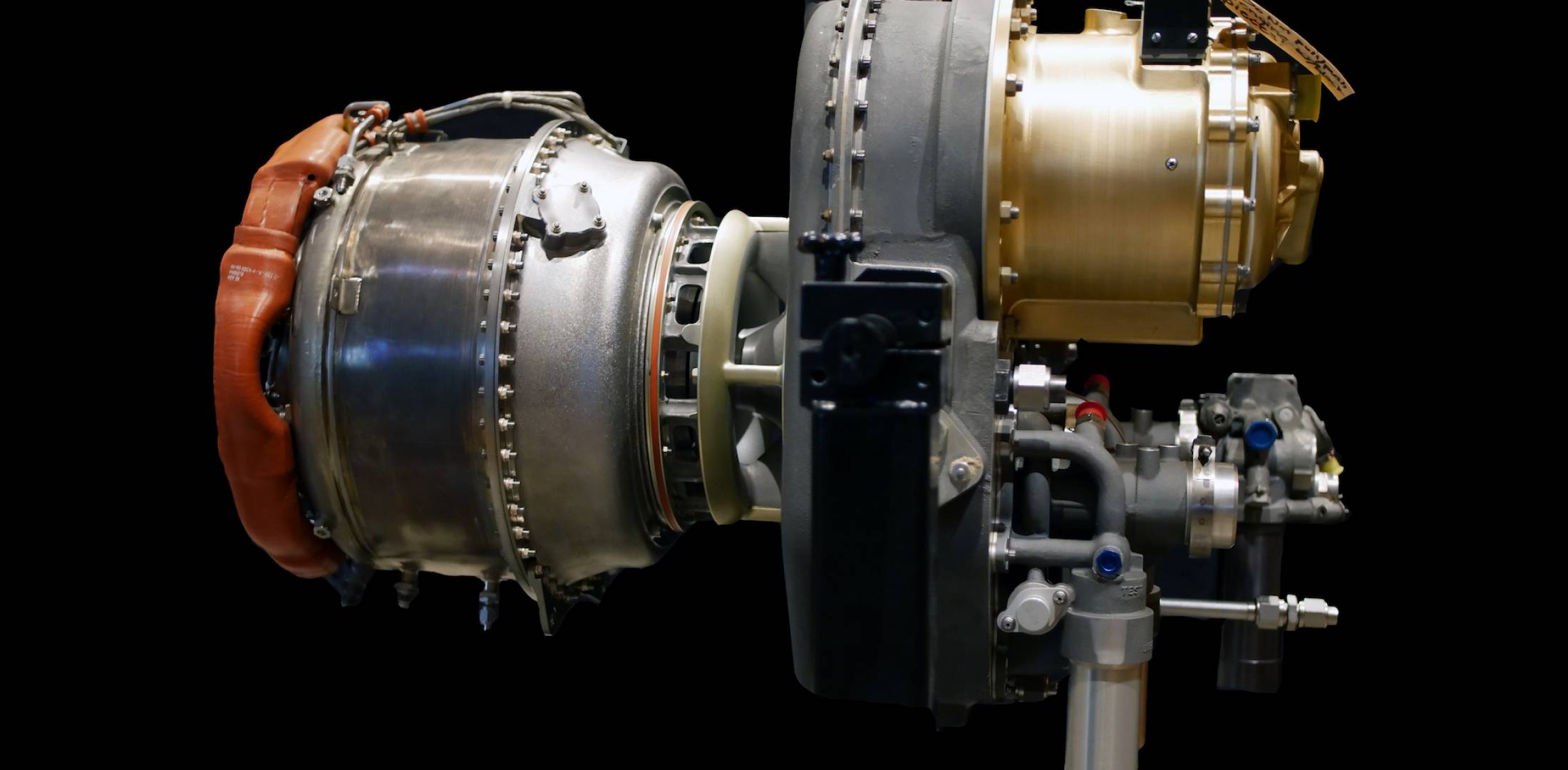
Looking to expand its offerings for urban air mobility solutions, Honeywell International, Inc. of Charlotte, North Carolina has developed a new hybrid-electric turbogenerator prototype based on its existing HTS900 turboshaft engine.
Supplementing the lightweight HTS900 turboshaft are two compact, high-power density generators putting out 200 kilowatts each. According to Honeywell, the combined output of the two generators would be enough to power 40 average homes running air conditioners at full blast. The prototype is designed to operate on bio-derived jet fuel and can be used to power high-capacity batteries of motors for a distributed propulsion system.
Learn more about distributed and hybrid-electric propulsion systems in So You Want to Design Engines: UAV Propulsion Systems
Conventional aircraft use fuel-burning engines to mechanically turn rotors, propellers or fans. But many new aircraft designs incorporate multiple electric motors, which can be tilted or turned off for vertical takeoff and horizontal flight. Aircraft designers believe this could usher in a new era of quiet, efficient, point-to-point aviation. A single Honeywell turbogenerator could power multiple electric motors located anywhere on an aircraft.
The company's solutions deliver highly reliable electric current from five to 200 kilowatts in constant speed, variable frequency and direct current configurations. Honeywell is now testing the aerospace industry's first one-megawatt generator.
"This redefines powered flight by providing electricity to spare in a safe, light package built for aviation," says Bryan Wood, senior director of Honeywell's hybrid-electric and electric propulsion programs. "As the urban air mobility segment grows, Honeywell is providing safe, reliable propulsion solutions as well as a host of other aviation technologies that are ready to install today on next-generation vehicles."
Read more about FADEC
The HTS900, already well known for its low-specific fuel consumption (SFC) and reliable “hot and high” performance, utilizes a dual-channel full authority digital engine control (FADEC) system for reduced pilot workload, easier engine troubleshooting, and on-demand maintenance scheduling. With the two generators, it will be able to produce 30- to 50-percent fewer carbon emissions than the traditional HTS900 engine.
Honeywell will unveil the turbogenerator prototype on March 5 at the HAI HELI-EXPO in Atlanta.
The push for urban air mobility
Honeywell has rapidly expanded its presence in urban air mobility, offering avionics, propulsion, flight controls, navigation, collision avoidance, power generation, actuation, logistics, satellite communication and connectivity technologies to companies developing new aircraft.
In January the company announced its work with Pipistrel Vertical Solutions to develop systems for a vertical takeoff and landing air vehicle that will eventually be capable of fully autonomous flight.
William Kucinski is content editor at SAE International, Aerospace Products Group in Warrendale, Pa. Previously, he worked as a writer at the NASA Safety Center in Cleveland, Ohio and was responsible for writing the agency’s System Failure Case Studies. His interests include literally anything that has to do with space, past and present military aircraft, and propulsion technology.
Contact him regarding any article or collaboration ideas by e-mail at
More From SAE Media Group
Aerospace & Defense Tech Briefs
Transport Canada Grants Astro Aerospace a Flight Test Certificate for Autonomous Urban Air Mobility Vehicle
Aerospace & Defense Tech Briefs
Alakai Technologies Unveils the World’s First Hydrogen-Powered Urban Air Mobility Vehicle
Aerospace & Defense Tech Briefs
Vertical Aerospace Is Honeywell’s Latest Partner in the UAM Industry
Aerospace & Defense Tech Briefs
CityAirbus Urban Air Mobility Vehicle Completes First Flight
Aerospace & Defense Tech Briefs
Deloitte Issues Report on Viability of EVTOL UAM Transportation
Aerospace & Defense Tech Briefs
Vertical Flight Society Applauds EVTOL Innovation, Bell Nexus UAM Concept

Aerospace & Defense Tech Briefs
Boeing’s CAV Makes First Outdoor Flight
Aerospace & Defense Tech Briefs
LIFT Aircraft Unveils Personal Multirotor Aircraft for Experiential Entertainment

Aerospace & Defense Tech Briefs
Astro’s Elroy Urban Air Mobility Vehicle to Get a New Stablemate This Summer
Aerospace & Defense Tech Briefs
Continental Aerospace Technologies Team with VerdeGo to Develop Hybrid Electric Urban Air Mobility Systems
Aerospace & Defense Tech Briefs
Jetoptera, GE Aviation Collaborate On, Demonstrate Hover with Fluidic Propulsion
Aerospace & Defense Tech Briefs
Phase Three of DARPA’s ALIAS Aircraft Automation System Continues
Aerospace & Defense Tech Briefs
The EVTOL Disruption Goes Viral
Aerospace & Defense Tech Briefs
Dart Aerospace’s Latest Emergency Float System Receives Certification in the U.S. and Europe
Aerospace & Defense Tech Briefs
Like a Good Neighbor, Impossible Aerospace Flew over to a Nearby Construction Fire to Help Locate Hotspots for First Responders
Aerospace & Defense Tech Briefs
GE Aviation’s AiRXOS Launches New Air Mobility Portfolio and Management Tools Purpose Built for the Urban Air Mobility Market
Aerospace & Defense Tech Briefs
Battery Technology Is Still the Key Barrier to Better Urban Air Mobility
Aerospace & Defense Tech Briefs
MTSI’s Latest Project Gives Fixed-Wing Aircraft Vertical Cargo Lift Capabilities
Aerospace & Defense Tech Briefs
Curtiss-Wright Black Boxes Receive European Approval


Aerospace & Defense Tech Briefs
Impossible Aerospace US-1 Makes Long-Distance Flight over Nevada Salt Flats
Automotive Engineering
Wing’s UAS Delivery Service Has FAA Certification
Aerospace & Defense Tech Briefs
Air Mobility Innovations Take Center Stage at Aerospace Systems and Technology Conference
Aerospace & Defense Tech Briefs
Boeing Aerospace & Autonomy Center to Focus on Designing, Building, Flying Autonomous Aircraft
Aerospace & Defense Tech Briefs
NASA and AeroVironment Are Building a Helicopter for Mars
Aerospace & Defense Tech Briefs
Raytheon, UTC Merger Will Direct $8B R&D Budget Toward Hypersonics, Cybersecurity, AI, and Next-Gen Connected Aircraft
Aerospace & Defense Tech Briefs
Paterson Composites to Build Components for Astro Aerospace Autonomous Passenger Drone
Transcript
00:00:03 Scott runan president of helicopter Express we primarily uh fight fires with the US Forest Service uh primarily in the west but also in the Southeast in the winter months we do prescribe burning we operate a fleet of uh 20 helicopters in Miss of bell uh 407s long Rangers europ b3s and Bell super 205s we currently operate four uh bell 205s with
00:00:27 a honey well engine in it and they are the best performers High hot for what we did and the best uh engine seems like so we really feel like that'll carry right down into the uh into the Bell 407 for us so we're excited to try the new Honey on the lights uh the Bell 407 is a really good aircraft um especially below 6,000 ft uh where it has its problems above 6,000 ft and 25° C uh we feel like
00:00:50 we could really uh do a lot better job for the for service if we could operate better high and hot when we looked at the HTS number on on the uh with the Bell showed us in back a couple years ago the perform performance above 6,000 ft and 25° C was substantially better than the 407 uh with the rollsroyce engine at the presently operate so you know if we can get an extra if we can
00:01:11 use an extra 20% of torque uh up at those altitudes would make a big difference on uh you know how much how much better it operate for the government and how much more we could get out of our helicopter from the government right now we're working with eagle copters and uh they're in the process of getting it certified they're hoping for certification I think in the
00:01:28 next year and uh we're going to we have six we want to convert and hopefully as soon as they get it certified we'll we'll start the process
Top Stories
NewsRF & Microwave Electronics
 Microvision Aquires Luminar, Plans Relationship Restoration, Multi-industry Push
INSIDERAerospace
 A Next Generation Helmet System for Navy Pilots
INSIDERDesign
 New Raytheon and Lockheed Martin Agreements Expand Missile Defense Production
INSIDERMaterials
 How Airbus is Using w-DED to 3D Print Larger Titanium Airplane Parts
NewsPower
 Ford Announces 48-Volt Architecture for Future Electric Truck
ArticlesAR/AI

Webcasts
Electronics & Computers
 Cooling a New Generation of Aerospace and Defense Embedded...
Automotive
 Battery Abuse Testing: Pushing to Failure
Power
 A FREE Two-Day Event Dedicated to Connected Mobility
Unmanned Systems
 Quiet, Please: NVH Improvement Opportunities in the Early Design Cycle
Automotive
 Advantages of Smart Power Distribution Unit Design for Automotive &...
Energy
 Sesame Solar's Nanogrid Tech Promises Major Gains in Drone Endurance