




Alfieri Concept Marks Maserati Centenary
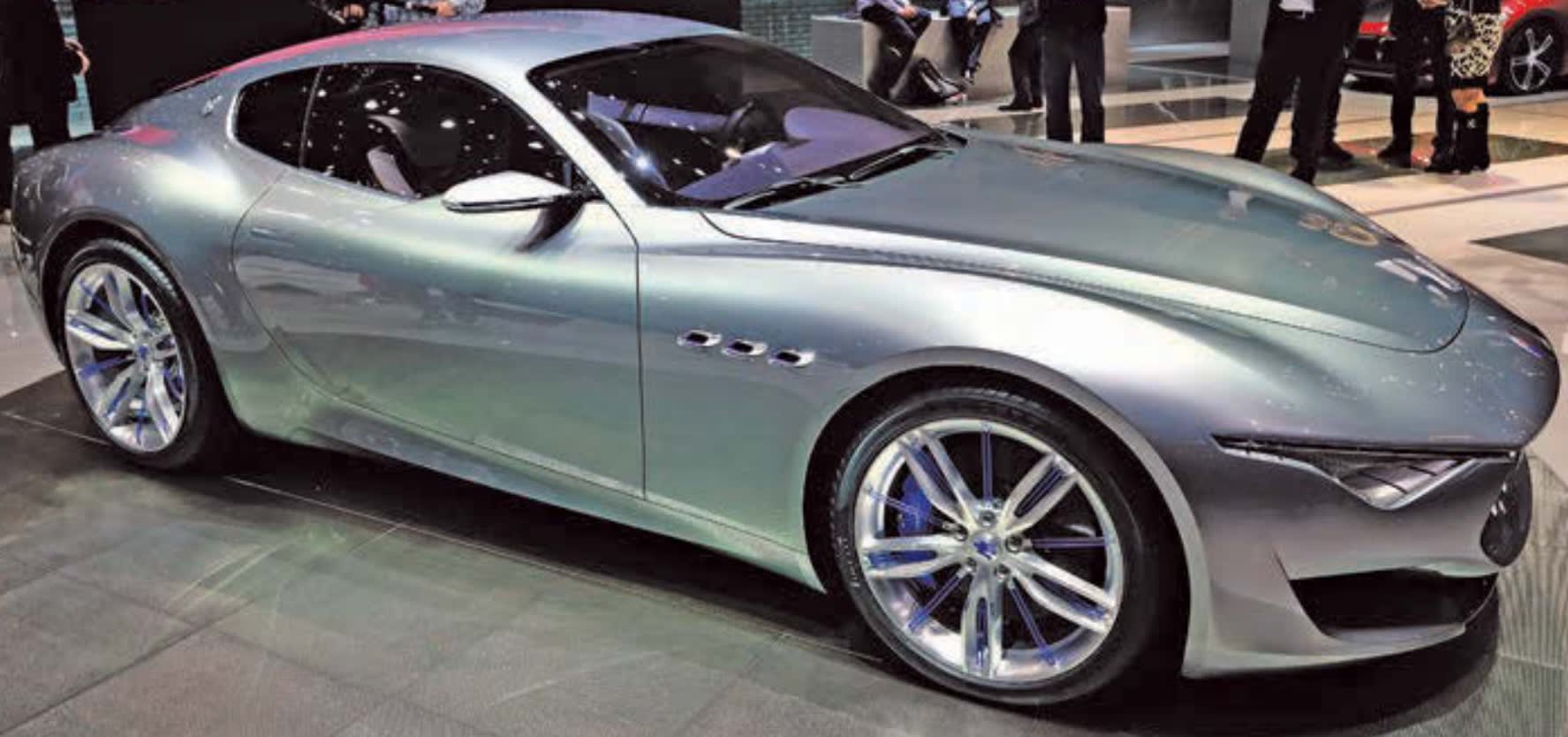
Maserati celebrates its centenary in 2014, and the Alfieri, named after Alfieri Maserati, founder of the original Maserati Company, is the concept car that was unveiled at the 2014 Geneva Motor Show to mark the centenary. Maserati described the 2+2 coupe concept as a “100 per cent functional prototype that says much about the design DNA of future Maseratis.”
The car was the work of a team of designers from Maserati Centro Stile in Turin under the direction of Marco Tencone, who led the design team for the Alfa Romeo 4C. The design was overseen by Lorenzo Ramaciotti and work began last summer. Ramaciotti has said that he believes that a car very similar to the Alfieri concept could go into production in the next two years.

The Alfieri is based on the Maserati GranTurismo MC Stradale chassis, with a wheelbase shortened by 240 mm (9.4 in).Overall, the concept is 4590 mm (180.7 in) long, 1930 mm (76.0 in) wide, and 1280 mm (50.4 in) tall, with a 2700-mm (106.3-in) wheelbase.
The GranTurismo MC Stradale uses a conventional front engine/rear-wheel drive format with a transaxle at the rear. It results in a slight rearward weight bias, according to Maserati. The six-speed electrically actuated gearbox is mounted in a single unit with the limited slip differential, connected to the engine by a rigid torque tube. Power comes from a Maranello-built 4.7-L naturally aspirated V8 gasoline engine producing 460 hp (343 kW) at 7000 rpm and 520 N·m (384 lb·ft) at 4750 rpm.

The Alfieri shares its carbon-ceramic disc brakes with the GranTurismo MC Stradale in conjunction with Brembo brake calipers. The brake calipers and other components including the wheels, front grille, and exhaust tail pipes are all finished in Maserati Blue.
Maserati cites the Pininfarina-designed Maserati A6 GCS-53 two-seat coupe of 1954 as an inspiration for the design team. There are a number of design features which refer to the 60-year-old model, such as the raised front and rear wings, long hood, large front grille, and near horizontal rear screen.
The front bumper/spoiler and rear diffuser are produced in carbon fiber with aluminum inserts. The forged aluminum wheels were designed specifically for the car with 21-in diameter wheels at the rear and 20-in examples for the front.
Inside, seat profile inserts, gear lever, and Maserati trademark oval clock are each milled from a single aluminum billet, then hand finished and anodized in a copper finish. The pedals, gearbox paddles, and steering wheel spokes are also finished by hand.
Although the instruments are housed in traditional binnacles, they feature TFT (thin-film transistor) screens to display road and engine speed. Instead of simulating a rotating meter needle, the numbers rotate and the speed is highlighted as if the numbers are being magnified.
White and dark basalt blue are the colors used to trim the interior. Leather is used extensively for the seats, dashboard, and center console.
More From SAE Media Group
Automotive Engineering
Horse Racing
Automotive Engineering
2026 Nissan Sentra Review: Putting the Pieces Together
Automotive Engineering
2021 Toyota Supra 2.0
Automotive Engineering
2016 Mazda MX-5 Stays True to Its Roots
Automotive Engineering
2020 Chevrolet Corvette Stingray Coupe
Off-Highway Engineering
College Students Design Lightweight Steel Wheels
Automotive Engineering
VW’s Carbon-Fiber XL Sport Concept Sports Ducati V2 Motorcycle Engine
Automotive Engineering
Volvo Concept Estate Shows Clues for New XC90
Automotive Engineering
Chevrolet Ups the Performance Ante with MY2015 Corvette Z06
Automotive Engineering
Toyota Stretches SUV Line-Up with World Debut of Grand Highlander
Off-Highway Engineering
ZM Trucks Starts Production in Fontana, California
Off-Highway Engineering
First Drive: Drifting in the Electric 2027 Mercedes GLC 400
Automotive Engineering
Driving Good Dynamics
Automotive Engineering
PSA, Toyota JV Spawns a New City Car Model Range
Automotive Engineering
Ford Refines Interior, Exterior on 2025 Explorer
Automotive Engineering
First Drive: 2027 Mercedes-Benz CLA Hybrid
Automotive Engineering
M3 Sedan, M4 Coupé Benefit from BMW’s Racing, CFRP Experience
Automotive Engineering
Ford Aims 2017 GT Supercar at the Street and Le Mans
Automotive Engineering
From Road to Racecar: A Five-Door, Front-Wheel-Drive SEAT
Automotive Engineering
Bentley Takes SUV to Super Premium Level
Automotive Engineering
Inside Honda’s New Two-motor 50-mpg Accord Hybrid
Automotive Engineering
A Rebel’s Guide to Chassis Engineering
Automotive Engineering
2018 Alfa Romeo Stelvio Ti
Automotive Engineering
Mercedes-AMG’s SLS Departure Opens Door to New GT
Automotive Engineering
Cadillac ATS-V Bulks up for Track Duty
Automotive Engineering
5 More HP for 2026 Kia Sportage: First Drive
Autonomous Vehicle Engineering
AV Powers Bring May Flowers
Automotive Engineering
A Hundred Innovations for Renault’s Eolab Concept
Automotive Engineering
New Toyota Avalon Gains Advanced Suspension, Lighting Systems
Automotive Engineering
How Land Rover Took the Lid off the Evoque
Top Stories
INSIDERManufacturing & Prototyping
 How Airbus is Using w-DED to 3D Print Larger Titanium Airplane Parts
INSIDERManned Systems
 FAA to Replace Aging Network of Ground-Based Radars
NewsTransportation
 CES 2026: Bosch is Ready to Bring AI to Your (Likely ICE-powered) Vehicle
NewsSoftware
 Accelerating Down the Road to Autonomy
EditorialDesign
 DarkSky One Wants to Make the World a Darker Place
INSIDERMaterials
 Can This Self-Healing Composite Make Airplane and Spacecraft Components Last...
Webcasts
Defense
 How Sift's Unified Observability Platform Accelerates Drone Innovation
Automotive
 E/E Architecture Redefined: Building Smarter, Safer, and Scalable...
Power
 Hydrogen Engines Are Heating Up for Heavy Duty
Electronics & Computers
 Advantages of Smart Power Distribution Unit Design for Automotive...
Unmanned Systems
 Quiet, Please: NVH Improvement Opportunities in the Early Design...
