




Horse Racing
America’s pony cars are a favorite of racers and fans alike, so racing them against each other is natural.

Detroit’s pony car category has been consistently popular with both car buyers and racing fans, so it makes sense that the U.S. automakers would pursue venues for racing their sporty 2+2s against each other.
Longtime fans regard the late-1960s/early-1970s period the glory days for the Trans Am racing series because that was when Ford’s Mustang, Chevrolet’s Camaro, American Motors’ AMX, and Dodge’s Challenger engaged in legendary battles on tracks across North America.
In a bid to recapture that fervor, sanctioning bodies have tweaked class rules to invite pony cars, and their fans, to participate.
NASCAR, whose vehicles otherwise bear little resemblance to the cars they pretend to represent, added Mustang, Camaro, and Challenger to its Nationwide series (renamed Xfinity for 2015), but even with the extra effort on NASCAR’s part, the demands of oval-track aerodynamic equality prevented the cars from looking much like their showroom counterparts.
In road racing, aerodynamic pressures aren’t so keen, though financial pressure also works against the idea of racing what you sell.
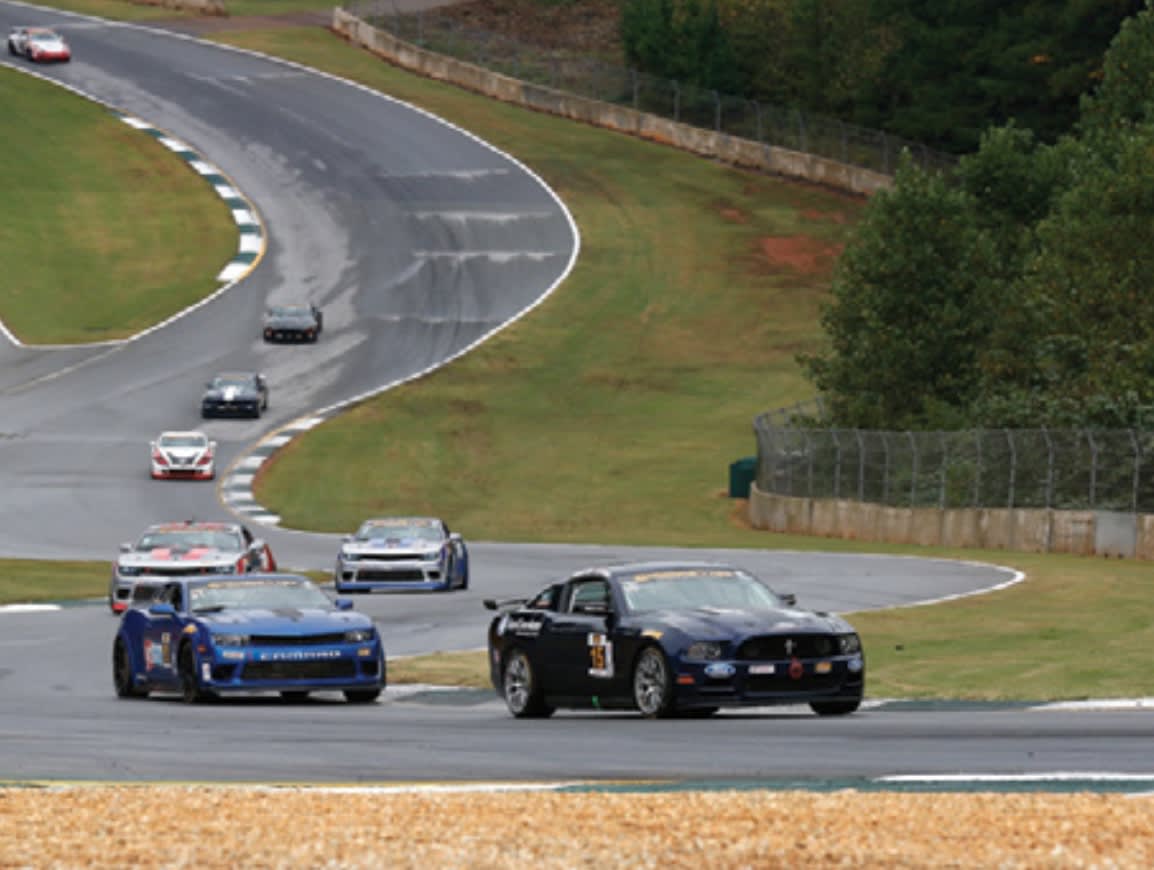
That’s why the Trans Am Series TA2 class, which was created to specifically provide a battleground for the pony car foes, still has to deal with factors such as a consistent wheelbase for all cars while trying to preserve their outward appearance.
The International Motor Sports Association’s (IMSA) Continental Tire Sportscar Challenge Grand Sport class, however, is a professional racing class that features honest-to-showroom production hardware contesting races. That’s where Mustang and Camaro battle weekly in more-or-less production form.
Naturally, there are adjustments that are needed to make the cars track-ready, and to level their competitive potential. All cars in the series compete on Continental racing tires, for example.
In the case of the Chevrolet Camaro Z/28.R, the race version of the 505-hp (377-kW) 7.0-L LS7 V8 engine runs a power-limiting 68-mm (2.7-in) restrictor plate on the 90-mm (3.5-in) production throttle body to restrain the engine’s power.
That lets cars like the 444-hp (331-kW) 5.0-L Ford Mustang Boss 302 compete despite its smaller displacement. The Boss 302 went out of production in 2013, and should be replaced by the rip-snorting Shelby GT350 in showrooms and production-based racing classes in 2015. The GT350’s preliminary rating of “more than 500 hp” will likely lead to that engine being restricted for racing.
Mustang mania
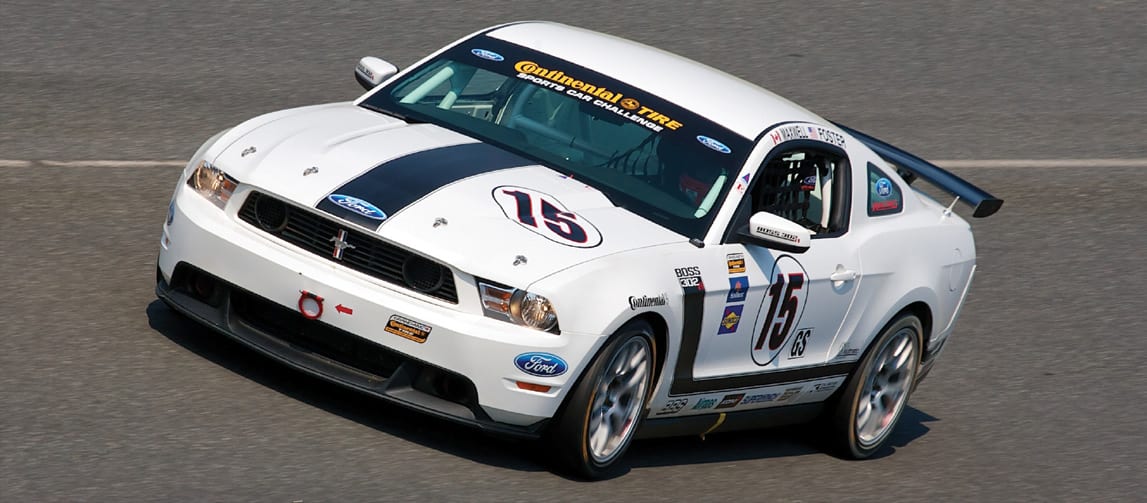
For the 2014 season, Ford offered a Boss 302S for $89,995 that is suitable for racing in a variety of series and which boasts a list of optional upgrades. Those include seam welding the body-in-white, a Recaro racing seat, and some paint and wheel packages.
Additionally, Ford offers the Boss 302R, which is specifically tweaked to meet with IMSA’s Continental Tire Sportscar Challenge. It lists for $134,995 and rolls in many of the Boss 302S’s options.
Both cars use a race-prepped Tremec TR6060 six-speed manual transmission with an integrated cooling pump, a JTEKT North America Torsen 3.73 limited-slip differential, fire suppression system, Dynamic Suspensions shocks and struts, and Brembo four-piston brake calipers with Performance Friction pads.
Specialized software plays a role too, with a unique racing calibration provided the racecars for their antilock braking system and for the electric power steering. An AIM data acquisition system records all the pertinent performance information on track.
Camaro charisma
The Camaro’s use of a bone-stock production engine is a point of pride among GM Powertrain engineers, according to Lisa Talarico, Engineering Manager for the Z/28.R program. “To be able to race for two and a half hours is a great accomplishment for a production engine,” she noted. “It is something GM Powertrain is really proud of.”
That accomplishment is particularly keen because of the racer’s use of the stock engine’s oiling system, rather than adding a racing-spec dry sump oil system.
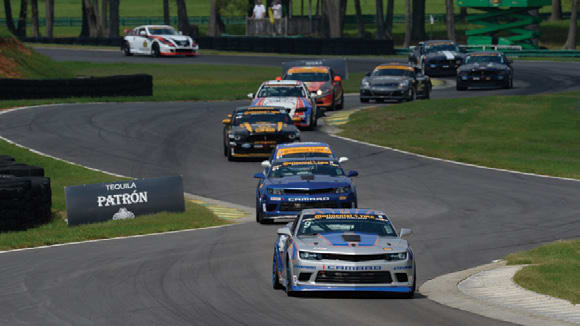
“I’ve never been able to race a car that has a bone-stock motor in it before,” observed Camaro driver Lawson Aschenbach.
With so many series cutting displacement for safety or perceived environmental reasons, the Camaro big V8 is a rarity, he added. “To be able to drive a racecar with a 7.0-L V8 in this day and age, that is pretty cool,” Aschenbach enthused.
The Camaro was limited in its use of some other trick technologies used on the production car — technologies that come straight from racing, but which are deemed too costly for use in the Continental Tire Sportscar Challenge.
That means the racecars are stripped of their exotic Multimatic shock absorbers, in favor of more conventional Penske racing shocks. And they also do without the carbon ceramic rotors and one-piece six-piston brake calipers from Brembo. In their place, racecars run iron rotors and two-piece AP Racing brake calipers to conform to the class rules for materials and design of components. The AP calipers are six-piston type, like those in the street car, however.
Chevrolet campaigned for an exception to the prohibition on six-piston calipers to help retain some bit of connection between the racer’s brakes and those on the production car. In exchange for that concession, the Z/28.R carries a weight penalty.
Despite that added mass, the Z/28.R still dives into corners with the best of them, according to Aschenbach. “We are braking as late or later than cars that are hundreds of pounds lighter,” he said.
Other changes to the car rely on production parts, but ones borrowed from other models for the purpose of optimizing the car for racing. That means substituting the 3.73 final drive from the ZL1 for the 3.91 ratio in the Z/28, Talarico reported. Similarly, while the Tremec TR6060 gearbox remains in place, its ratios are replaced with ones better suited to the track.
Production sixth gear is especially problematic for racing, she pointed out. Desire for an acceptable EPA highway fuel-economy score pushes production engineers to specify an overdrive sixth gear that would never see use on the track. “We really need a lower sixth gear for it to even be useable,” she said.
Further, the restrictor plate shifts the engine’s powerband downward, so the transmission’s other ratios needed changing to reflect that. For racing purposes, the goal is to optimize third, fourth, and fifth gears, because that is where the cars spend most of their time. But they also want to make second and sixth useable.
The engine is solidly mounted in the car for added rigidity, rather than using rubber-isolated engine mounts. And while the factory suspension attachment points are retained, the suspension bushings are replaced by non-compliant spherical bearings for improved precision.
Outside, the Z/28.R wears the production rear wing. In showroom guise, that wing features an adjustable element, but for racing it must be fixed in a single location rather than adjusted to match conditions. GM tested the wing to learn the best settings for different tracks, and that is information the company could share with customer racing teams, Talarico said.
Racer feedback
A benefit to the production car program is having access to the professional drivers who race the Z/28.R, said Talarico. “Having professional driver feedback has helped us a lot,” she noted. Their comments have helped to point the direction for future refinements of the Camaro, as well as for possible development of future performance parts to be offered for the car.
“She will be reading our race reports after every weekend,” added Aschenbach. “If we’re complaining about a certain aspect of the car, I’m sure Lisa will relay that to the engineers at GM,” he said. “They want to see the car get faster as well.”
The observation that the people working on the racing program are a real source of technology transfer concurs with the view of Kirk Ready, the just-retired technical manager for the Trans Am Series.
He says that the transfer from racing to production comes in the form of the people working on the cars.
“You start out with kids when they are young, and racing has a fascination. For some of us, that turns into an addiction. A lot of them come with interest in the performance industry. But there aren’t a lot of paying jobs. Being a driver is like wanting to be an NFL player. It is not a good career plan. The hours and travel are horrible. So their talents are directed toward production cars. That is really where racing has something to bring to the party that benefits the auto industry as a whole,” he said.
More From SAE Media Group
Automotive Engineering
Alfieri Concept Marks Maserati Centenary
Automotive Engineering
2026 Nissan Sentra Review: Putting the Pieces Together
Automotive Engineering
Ford Aims 2017 GT Supercar at the Street and Le Mans
Automotive Engineering
A Rebel’s Guide to Chassis Engineering
Off-Highway Engineering
College Students Design Lightweight Steel Wheels
Automotive Engineering
2021 Toyota Supra 2.0
Automotive Engineering
2016 Mazda MX-5 Stays True to Its Roots
Automotive Engineering
Toyota Stretches SUV Line-Up with World Debut of Grand Highlander
Automotive Engineering
2020 Chevrolet Corvette Stingray Coupe
Automotive Engineering
Ford Refines Interior, Exterior on 2025 Explorer
Automotive Engineering
Designing for Downforce
Automotive Engineering
Chevrolet Ups the Performance Ante with MY2015 Corvette Z06
Automotive Engineering
Designer Yin Meets Engineer Yang
Automotive Engineering
Ford’s Latest Mustang Improves the Breed
Off-Highway Engineering
ZM Trucks Starts Production in Fontana, California
Automotive Engineering
5 More HP for 2026 Kia Sportage: First Drive
Off-Highway Engineering
First Drive: Drifting in the Electric 2027 Mercedes GLC 400
Autonomous Vehicle Engineering
AV Powers Bring May Flowers
Automotive Engineering
Agility Training for Cars
Automotive Engineering
PSA, Toyota JV Spawns a New City Car Model Range
Automotive Engineering
Ford’s Max Mustang Brings ‘World Class’ into the Sports Coupe Conversation
Automotive Engineering
Ford Unveils 2019 Mustang Bullitt, Promises Performance EV
Automotive Engineering
Cadillac ATS-V Bulks up for Track Duty
Automotive Engineering
2015 GT350 Mustang Aimed at Track-Day Dominance
Automotive Engineering
MAGNA Say Some Hurdles of Seat-reconfiguration System to Be Addressed by OEMs
Automotive Engineering
TRD Spells Capability for Toyota’s Latest Tundra
Automotive Engineering
From Road to Racecar: A Five-Door, Front-Wheel-Drive SEAT
Automotive Engineering
First Drive: 2027 Mercedes-Benz CLA Hybrid
Automotive Engineering
Domino's Tasty New Pizza Delivery Vehicle Designed by Crowdsourcing, Developed by Roush
Automotive Engineering
AVSC Develops Best Practices for Traceable AV Safety Inspection Protocols
Top Stories
INSIDERManufacturing & Prototyping
 How Airbus is Using w-DED to 3D Print Larger Titanium Airplane Parts
INSIDERManned Systems
 FAA to Replace Aging Network of Ground-Based Radars
NewsTransportation
 CES 2026: Bosch is Ready to Bring AI to Your (Likely ICE-powered) Vehicle
NewsSoftware
 Accelerating Down the Road to Autonomy
EditorialDesign
 DarkSky One Wants to Make the World a Darker Place
INSIDERMaterials
 Can This Self-Healing Composite Make Airplane and Spacecraft Components Last...
Webcasts
Defense
 How Sift's Unified Observability Platform Accelerates Drone Innovation
Automotive
 E/E Architecture Redefined: Building Smarter, Safer, and Scalable...
Power
 Hydrogen Engines Are Heating Up for Heavy Duty
Electronics & Computers
 Advantages of Smart Power Distribution Unit Design for Automotive...
Unmanned Systems
 Quiet, Please: NVH Improvement Opportunities in the Early Design...
