




Automotive Engineering - March 2015
Inside this issue
Overview
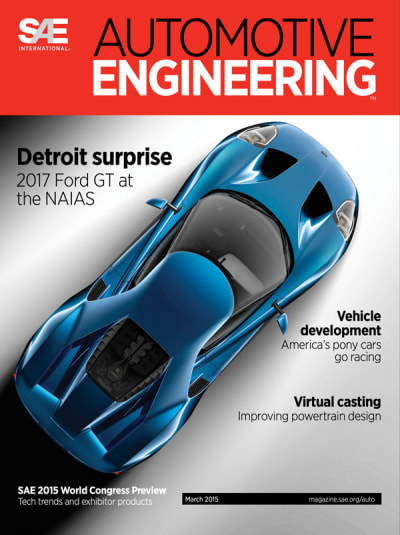
The March 2015 issue of Automotive Engineering presents a comprehensive overview of the latest trends, innovations, and insights in the automotive industry. This edition is particularly notable for its coverage of the 2017 Ford GT, which made a significant impact at the North American International Auto Show (NAIAS). The Ford GT is a modern interpretation of the iconic GT40, which famously dominated the 24 Hours of Le Mans in the 1960s. This new supercar aims to blend high performance with street usability, showcasing Ford's commitment to both racing heritage and consumer appeal.
The issue opens with a focus on fuel efficiency, a critical concern for consumers even amidst lower gasoline prices. A feature discusses a recent J.D. Power study that highlights how fuel economy continues to drive car sales, indicating that buyers prioritize efficiency alongside performance and design. This reflects a broader trend in the automotive market where manufacturers are increasingly investing in technologies that enhance fuel efficiency, even as the cost of fuel fluctuates.
In the realm of technology, the magazine covers the rapid evolution of infotainment systems, particularly as showcased at the Consumer Electronics Show (CES). The integration of advanced electronics into vehicles is transforming the driving experience, with features that enhance connectivity and user interaction. Johnson Controls also presents an innovative interior concept designed for autonomous driving, emphasizing the shift towards smart vehicle interiors that prioritize safety and user comfort.
The issue also highlights advancements in materials science, particularly the use of recycled content and bio-based polyols in concept cars. This focus on sustainability is becoming increasingly important as manufacturers seek to reduce their environmental impact while maintaining performance standards. Advanced steels are also making inroads in vehicle design, offering manufacturers new options for lightweighting without compromising safety or durability.
A significant feature in this issue is the exploration of virtual casting, a technology that is improving powertrain design. By utilizing casting simulations, designers can optimize their processes, leading to faster and more accurate predictions of the casting outcomes. This innovation is crucial for reducing development time and costs, allowing manufacturers to bring new products to market more efficiently.
The magazine also delves into the world of motorsports, discussing the popularity of America’s pony cars and the natural inclination to race them against one another. This segment highlights the cultural significance of these vehicles and their performance capabilities, which resonate with both racers and fans alike.
In addition to these features, the issue includes a preview of the SAE 2015 World Congress, which promises to showcase the latest tech trends and exhibitor products. This event is a key gathering for industry professionals, providing a platform for networking and knowledge sharing.
The editorial team, led by Kevin Jost, emphasizes the importance of staying informed about technical trends and innovations in the automotive sector. The magazine encourages readers to take advantage of membership benefits, which include access to technical publications, industry news, and discounts on various resources.
Overall, the March 2015 issue of Automotive Engineering encapsulates the dynamic nature of the automotive industry, highlighting the interplay between performance, technology, and sustainability. It serves as a valuable resource for professionals seeking to stay ahead in a rapidly evolving market, offering insights that are both informative and actionable. The combination of in-depth articles, expert opinions, and coverage of significant events positions this issue as a must-read for anyone involved in the automotive field.
Features
Regulars
-
Global Vehicles
Cross Coupé GTE Previews Seven-Seat SUV from VW Chattanooga
Ford Aims 2017 GT Supercar at the Street and Le Mans
2016 Volt: GM Gives Its PHEV Longer Range, less Weight, Easier Charging
-
Technology Reports
Fuel Efficiency SUV Notches 10 Mpg Improvement Vs. Baseline Vehicle
Recycled Content and Bio-Based Polyols Featured in Suppliers' Concept Car
3-D 'Printed Car' Displayed at NAIAS
Johnson Controls Presents Interior Concept for Autonomous Driving at 2015 NAIAS
Infotainment at CES Shows Rapid Evolution
Advanced Steels Making Inroads
Honda Introduces 'Industry First' Intelligent Adaptive Cruise Control
-
Product Briefs
-
What’s Online
Stories
-
News
Jeep's B-Segment Renegade: U.S. Developed, Built in Italy
Cadillac CT6 to Use Advanced Mixed-Material and Manufacturing Approach
Audi Lightens New Generation Q7
Lower-Cost Lidar Is Key to Self-Driving Future
GM's Production 2017 Bolt EV to Offer +200-Mi Range at K Price
Redesigned, Re-Engineered 2016 Honda Pilot
Ford’s Top EV Engineer Advocates More Inclusive Charging Tech
Racing to Solve the Lubrication Challenges of Stop/start-Equipped Engines
Top Stories
INSIDERManufacturing & Prototyping
 How Airbus is Using w-DED to 3D Print Larger Titanium Airplane Parts
INSIDERManned Systems
 FAA to Replace Aging Network of Ground-Based Radars
NewsTransportation
 CES 2026: Bosch is Ready to Bring AI to Your (Likely ICE-powered) Vehicle
NewsSoftware
 Accelerating Down the Road to Autonomy
EditorialDesign
 DarkSky One Wants to Make the World a Darker Place
INSIDERMaterials
 Can This Self-Healing Composite Make Airplane and Spacecraft Components Last...
Webcasts
Defense
 How Sift's Unified Observability Platform Accelerates Drone Innovation
Automotive
 E/E Architecture Redefined: Building Smarter, Safer, and Scalable...
Power
 Hydrogen Engines Are Heating Up for Heavy Duty
Electronics & Computers
 Advantages of Smart Power Distribution Unit Design for Automotive...
Unmanned Systems
 Quiet, Please: NVH Improvement Opportunities in the Early Design...
