




Aftertreatment System
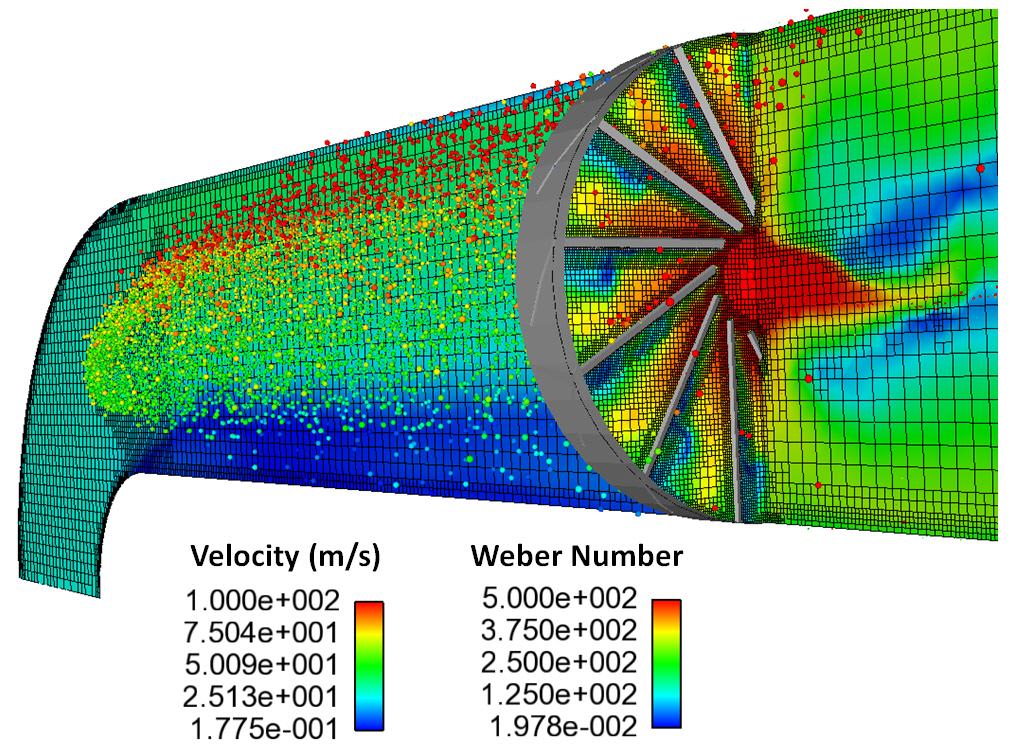
To achieve Tier and Euro emissions compliance with minimal impact on efficiency, system size, and maintenance, Convergent Science has developed an aftertreatment simulation approach for on- and off-road urea/selective catalytic reduction (SCR) systems that combines spray, wall-interaction, chemistry, and heat transfer models with automatic meshing. Built for in-cylinder simulations, the approach is suited for urea/SCR systems with transient sprays that impact mixers, potentially producing liquid films resulting in solid urea deposits. Convergent’s approach gives designers the flexibility to change geometry and exhaust system layout to improve performance. The use of computer simulation and code reduces aftertreatment system design time; in-cylinder combustion modeling timeframes are shortened by replacing user-defined meshing with the automated mesh generation process.
More From SAE Media Group
Battery Technology
Using Multiphysics to Predict and Prevent EV Battery Fire
Automotive Engineering
Dimensional Metrology Beyond the CMM
Automotive Engineering
Engine System Analysis

Aerospace Manufacturing and Machining INSIDER
Argonne and Raytheon to Collaborate on Aircraft Engine Design
Off-Highway Engineering
Digitalization of Product Engineering
Battery Technology
An Immersive Solution for Thermally Safer EV Batteries


Aerospace INSIDER
Streamlining Jet Engine Design
Tech Briefs
National Renewable Energy Laboratory
Battery & Electrification Technology
The Rechargeable Renaissance
Automotive Engineering
DEF Filters


Automotive Engineering
DSpace Launches Simphera AV Development Simulator
Tech Briefs
Product of the Month

Tech Briefs
Product of the Month
Sensor Technology
What Will 5G Do for the IoT/IIoT?

Aerospace INSIDER
Tool Detects Engine-Destroying Oscillations


Tech Briefs
Simulation for Everyone
Top Stories
INSIDERManufacturing & Prototyping
 How Airbus is Using w-DED to 3D Print Larger Titanium Airplane Parts
INSIDERManned Systems
 FAA to Replace Aging Network of Ground-Based Radars
NewsTransportation
 CES 2026: Bosch is Ready to Bring AI to Your (Likely ICE-powered) Vehicle
NewsSoftware
 Accelerating Down the Road to Autonomy
EditorialDesign
 DarkSky One Wants to Make the World a Darker Place
INSIDERMaterials
 Can This Self-Healing Composite Make Airplane and Spacecraft Components Last...
Webcasts
Defense
 How Sift's Unified Observability Platform Accelerates Drone Innovation
Automotive
 E/E Architecture Redefined: Building Smarter, Safer, and Scalable...
Power
 Hydrogen Engines Are Heating Up for Heavy Duty
Electronics & Computers
 Advantages of Smart Power Distribution Unit Design for Automotive...
Unmanned Systems
 Quiet, Please: NVH Improvement Opportunities in the Early Design...
