




Argonne and Raytheon to Collaborate on Aircraft Engine Design
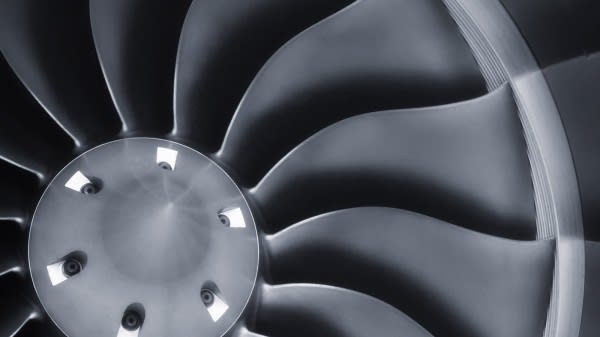
As fuel is burned in aircraft engines, temperatures reach extremely high levels, necessitating the use of thermal management strategies, such as effusion or film cooling, to prevent damage to aircraft components. At the thin boundary layers near the walls of an aircraft turbine and combustor, the interaction between cooling air and hot gases creates a variable mixing environment that scientists need to study in order to ensure better design and durability of engine components.
Thanks to a new Cooperative Research and Development Agreement between the U.S. Department of Energy’s (DOE) Argonne National Laboratory and the Raytheon Technologies Research Center, researchers are using high-performance computing and machine learning algorithms to do this. These tools will dramatically improve and reduce the computational expense of fluid dynamics models that look at coolant flow mixing and heat transfer in near-wall environments.
“The overarching goal of this project is geared towards optimizing the combustor and turbine cooling designs for modern engines,” said Argonne research scientist Pinaki Pal, who leads the project with co-investigators Prithwish Kundu and postdoctoral appointee Opeoluwa Owoyele.
“Typically, aircraft engines operate at very high pressures with small-sized engine cores, and this tends to bring a lot of hot gases closer to the walls and increase the heat loads on combustor liner and turbine blades. This then requires a focus on thermal management,” said Michael Joly, principal investigator and research engineer at the Raytheon Technologies Research Center. “Design improvements to reduce the cooling air flow requirements can increase the engine’s thermal efficiency.”
Researchers attempting to design aircraft engines need to consider several factors when it comes to cooling. For example, to optimize these cooling designs, they need to take into account how the cooling air is injected by selecting particular angles and the arrangement of cooling holes.
Until now, scientists only had two general classes of models for looking at these flow questions. They could opt to use highly resolved computational fluid dynamics (CFD) simulations, which can achieve great accuracy but require tremendous computational expense — particularly in the boundary regions near the walls. Or they could opt for under-resolved simulations with models applied to capture near-wall flow dynamics, which produce a somewhat less-accurate solution more quickly.
By leveraging the power of advanced CFD modeling, high-performance computing and deep learning, Pal and his colleagues, along with industry partners from Raytheon Technologies, intend to create a harmonious merger of both approaches. First, they will perform wall-resolved simulations of a number of engine configurations, using a massively-parallel CFD code called Nek5000, which has been recently enhanced for engine flow and combustion modeling.
Researchers will use Argonne supercomputing resources, including the Theta system at the Argonne Leadership Computing Facility, a DOE Office of Science User Facility. Then, they will take the high-fidelity data generated from these simulations to train a faster and less computationally expensive deep learning-based spatial emulators to capture near-wall heat transfer. The surrogate models will be able to realize many of the accuracy benefits of a high-fidelity simulation, while performing computations at a fraction of its cost, according to Kundu.
More From SAE Media Group

Aerospace & Defense Tech Briefs
2050 Aircraft Engine Designs Go Radical, Part 2
Aerospace INSIDER
Breakthroughs in Testing Solid-Fuel Ramjets Advance Research
Aerospace Manufacturing and Machining INSIDER
New HPC4EI Project to Create 'Digital Twin' Models for Aerospace Manufacturing
Aerospace & Defense Tech Briefs
Bringing Turbine Power to Small Aircraft
Aerospace & Defense Tech Briefs
New Exhaust Configuration for the AW609 Tilt Rotor Engine Bay
Aerospace & Defense Tech Briefs
Surviving the Challenge of Thermal Design in Aerospace Electronics
Aerospace INSIDER
Software Accelerates Hypersonic Engine Development

Aerospace & Defense Tech Briefs
2050 Aircraft Engine Designs Go Radical, Part 1
Aerospace INSIDER
Streamlining Jet Engine Design
Aerospace & Defense Tech Briefs
Using System Simulation to Manage Increasing Thermal Loads on Aircraft Fuel Systems

Motion Design INSIDER
Megawatt Electrical Motor Could Help Electrify Aviation

Motion Control and Automation Technology INSIDER
Second, Smaller Rotor Increases Wind Turbine Efficiency
Aerospace Manufacturing and Machining INSIDER
How Airbus is Leveraging Digital Twins for a Smarter Approach to Manufacturing

Aerospace INSIDER
Accelerating Climate-Compatible Aircraft Design with AI

Tech Briefs
2025 Award Finalists

Automotive Engineering
Virtual Casting Improves Powertrain Design
Off-Highway Engineering
Assessing a Vehicle’s Cooling System Performance
Top Stories
NewsSensors/Data Acquisition
 Microvision Aquires Luminar, Plans Relationship Restoration, Multi-industry Push
INSIDERRF & Microwave Electronics
 A Next Generation Helmet System for Navy Pilots
INSIDERWeapons Systems
 New Raytheon and Lockheed Martin Agreements Expand Missile Defense Production
NewsAutomotive
 Ford Announces 48-Volt Architecture for Future Electric Truck
INSIDERAerospace
 Active Strake System Cuts Cruise Drag, Boosts Flight Efficiency
ArticlesTransportation

Webcasts
Aerospace
 Cooling a New Generation of Aerospace and Defense Embedded...
Energy
 Battery Abuse Testing: Pushing to Failure
Power
 A FREE Two-Day Event Dedicated to Connected Mobility
Automotive
 Quiet, Please: NVH Improvement Opportunities in the Early Design Cycle
Electronics & Computers
 Advantages of Smart Power Distribution Unit Design for Automotive &...
Unmanned Systems
 Sesame Solar's Nanogrid Tech Promises Major Gains in Drone Endurance