




Ford and University of Michigan Unveil Automated-vehicle Testbed
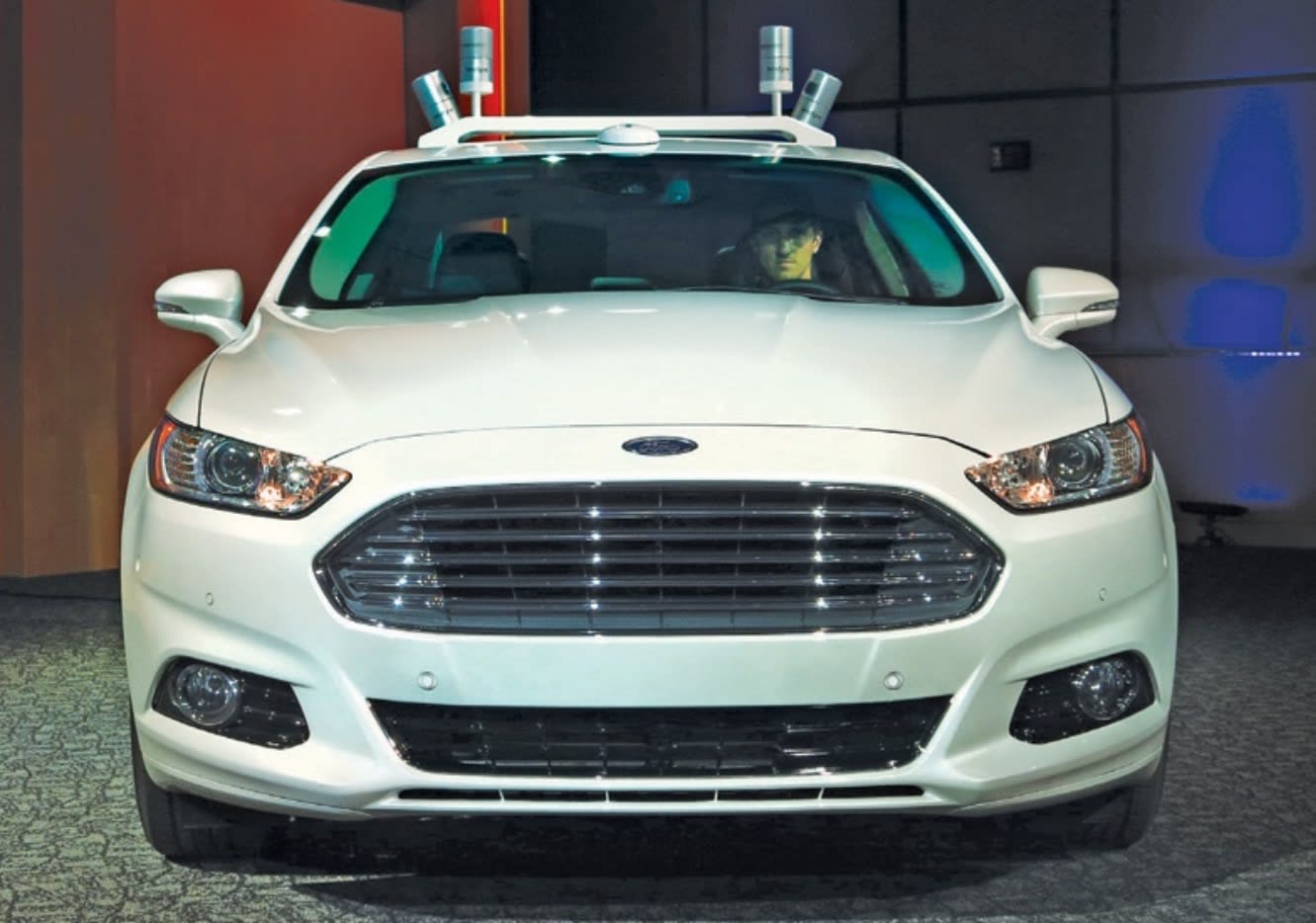
Ford recently unveiled a heavily modified Fusion Hybrid that is serving as a testbed for the automaker’s automated-vehicle research. Ford is conducting the program with the University of Michigan, which has the algorithm-development lead, and State Farm Insurance, which is analyzing how driver-assist technologies can lower the rate of rear collisions.
The goal of the program, in which Ford has the lead on systems and vehicle integration, is to advance development of new sensor and control technologies with the aim of applying them to the active safety systems of future vehicles, said Raj Nair, Ford Group Vice President of Global Product Development. Nair stressed that the automaker’s current focus is on automated vehicles — in which the driver is always in control — rather than autonomous self-driving types.

The Fusion Hybrid testbed features a quartet of roof-mounted LIDAR (Light Detection And Ranging) IR sensors that scan the surroundings. LIDAR measures distance by using a laser to illuminate everything within 200 ft (61 m) of the vehicle and then analyzes the light that is reflected back, similar in principle to radar. The reflected light is combined with GPS data to generate a real-time, high-resolution 3-D map of the area surrounding the vehicle. The map is used to help guide the vehicle.
The rooftop sensor array resembles spinning coffee cans. It is sourced from Velodyne, a major LIDAR hardware supplier. The sensors can track any stationary or moving object that is sufficiently dense to reflect light. The testbed vehicle currently can process data at the rate of approximately 2.8 million bytes per second, said Ed Olson, a University of Michigan professor involved with the program, who co-founded MIT’s Mobile Autonomous Systems Laboratory.
Professor Olson noted that the biggest challenge currently is range; “closing rates on the highway can be in excess of 140 mph,” he explained. Because of this, the LIDAR would likely be used in conjunction with a radar for distances beyond 200 ft.
Radar and LIDAR operate in different spectra. Radar is in the millimeter wavelength range (e.g., 77-GHz radar used in automated cruise control [ACC] systems has a wavelength of about 4 mm) while LIDAR operating near the visible spectrum has very short wavelengths typically ranging from about 10 μm (394 μin) to around 250 nm (9.8 μin). Experts note that the short wavelengths are preferred for mapping because they generate more granular detail. ACC, by comparison, needs only range and range-rate.
There is a critical difference: LIDAR images degrade in poor weather. “Rain or snow can put LIDAR out of business. That is why very early ACCs, such as those used by Chrysler, started out with LIDAR but quickly adopted microwave radar because the latter can ‘see’ through inclement weather,” explained Gerald Conover, Managing Director at PRC Associates, a technology consultancy.
In the current development phase, vehicle-to-vehicle and vehicle-to-infrastructure (V2V and V2I, respectively) capability are not included in development because “they’re not critical for the vehicle to operate safely,” said Dr. Ryan Eustice, Associate Professor at the University of Michigan’s School of Naval Architecture & Marine Engineering, an expert in imaging technologies who has been involved with the Ford automated vehicle program since its 2007 inception.
Dr. Eustice said the range accuracy of the current system is ± 2 cm (0.8 in), controlled by the LIDAR spin rates (now 10 Hz). He said the hardware’s size and form factor are steadily evolving into more compact units. Satellite imaging could potentially be incorporated in future vehicle configurations, he added.
Ford, which is responsible for developing unique components allowing the vehicle to function at high levels of automation, already has technology that enables production vehicles to park themselves, understand a driver’s voice commands, detect dangerous driving situations, and assist with emergency braking.
Competitors Mercedes-Benz and Mitsubishi have shown ranging devices based on binocular cameras operating in the visual spectrum like human eyes. Mitsubishi’s system is currently available on production cars.
More From SAE Media Group
Automotive Engineering
2020 Chevrolet Corvette Stingray Coupe
Off-Highway Engineering
Autonomous Vehicle Challenges Span Many Fields
Automotive Engineering
2026 Nissan Sentra Review: Putting the Pieces Together
Automotive Engineering
Ford Scores Greater Autonomous Capability with New Velodyne Ultra Puck LiDAR
Automotive Engineering
Ford Refines Interior, Exterior on 2025 Explorer
Motion Design INSIDER
Improving Traffic Signal Timing with a Handful of Connected Vehicles
Off-Highway Engineering
Freightliner’s Medium-Duty Makeover
Automotive Engineering
Designing for Downforce
Automotive Engineering
OEMs Deny Suppliers the Limelight
Automotive Engineering
2022 SAE President Sri Srinath: Engineer, Leader, Mentor
Automotive Engineering
Ford’s Market 'Fusion' Creates Mondeo for Europe
Automotive Engineering
2026 Nissan Leaf First Drive: Fun and More Efficient
Off-Highway Engineering
First Drive: Drifting in the Electric 2027 Mercedes GLC 400
Automotive Engineering
2018 Volkswagen Arteon
Off-Highway Engineering
ABS Ramps up Commercial-Vehicle Battery-Pack Assembly
Automotive Engineering
Cybersecurity Gets Input from Students, Others
Off-Highway Engineering
Systems That Talk Together, Are Efficient Together
Automotive Engineering
2019 Toyota Avalon Hybrid
Tech Briefs
Future Cars Learn to Prevent Motion Sickness
Automotive Engineering
Ford Approved for Hands-Off Driving on German Autobahn
Automotive Engineering
Ford EV Engineers ‘Always On’ for Customer Feedback
Automotive Engineering
Toyota Stretches SUV Line-Up with World Debut of Grand Highlander
Automotive Engineering
Honda Surprises with Civic Concept
Automotive Engineering
Creating Chrysler 200's Interior Identity
Automotive Engineering
2026 Toyota RAV4 Review: All Hybrid, All the Time
Automotive Engineering
New Toyota Avalon Gains Advanced Suspension, Lighting Systems
Automotive Engineering
2021 Toyota Supra 2.0
Automotive Engineering
5 More HP for 2026 Kia Sportage: First Drive
Autonomous Vehicle Engineering
First Smile, Last Smile
Automotive Engineering
TRD Spells Capability for Toyota’s Latest Tundra
Top Stories
INSIDERManufacturing & Prototyping
 How Airbus is Using w-DED to 3D Print Larger Titanium Airplane Parts
INSIDERManned Systems
 FAA to Replace Aging Network of Ground-Based Radars
NewsTransportation
 CES 2026: Bosch is Ready to Bring AI to Your (Likely ICE-powered) Vehicle
NewsSoftware
 Accelerating Down the Road to Autonomy
EditorialDesign
 DarkSky One Wants to Make the World a Darker Place
INSIDERMaterials
 Can This Self-Healing Composite Make Airplane and Spacecraft Components Last...
Webcasts
Defense
 How Sift's Unified Observability Platform Accelerates Drone Innovation
Automotive
 E/E Architecture Redefined: Building Smarter, Safer, and Scalable...
Power
 Hydrogen Engines Are Heating Up for Heavy Duty
Electronics & Computers
 Advantages of Smart Power Distribution Unit Design for Automotive...
Unmanned Systems
 Quiet, Please: NVH Improvement Opportunities in the Early Design...
