




First Smile, Last Smile
May Mobility is building a unique business model around AV shuttle services, explains COO and co-founder Alisyn Malek.
Entering the busy headquarters of May Mobility, my eyes fix almost immediately on a huge red Corvette brake caliper sitting on a tool cart beside an engineer’s work station. “You guys must be planning some really fast self-driving shuttles,” I quip to COO and co-founder Alisyn Malek moments later, when she greets me for our interview.
“In order to have a safe and reliable system we have to know the hardware as well as the software,” Malek explained. “And to gain that knowledge we do the systems-level design and development on both. From brakes, to sensor suite integration, to wire harness design — all are done in house. We have to make sure we get the checks and balances between both systems.”
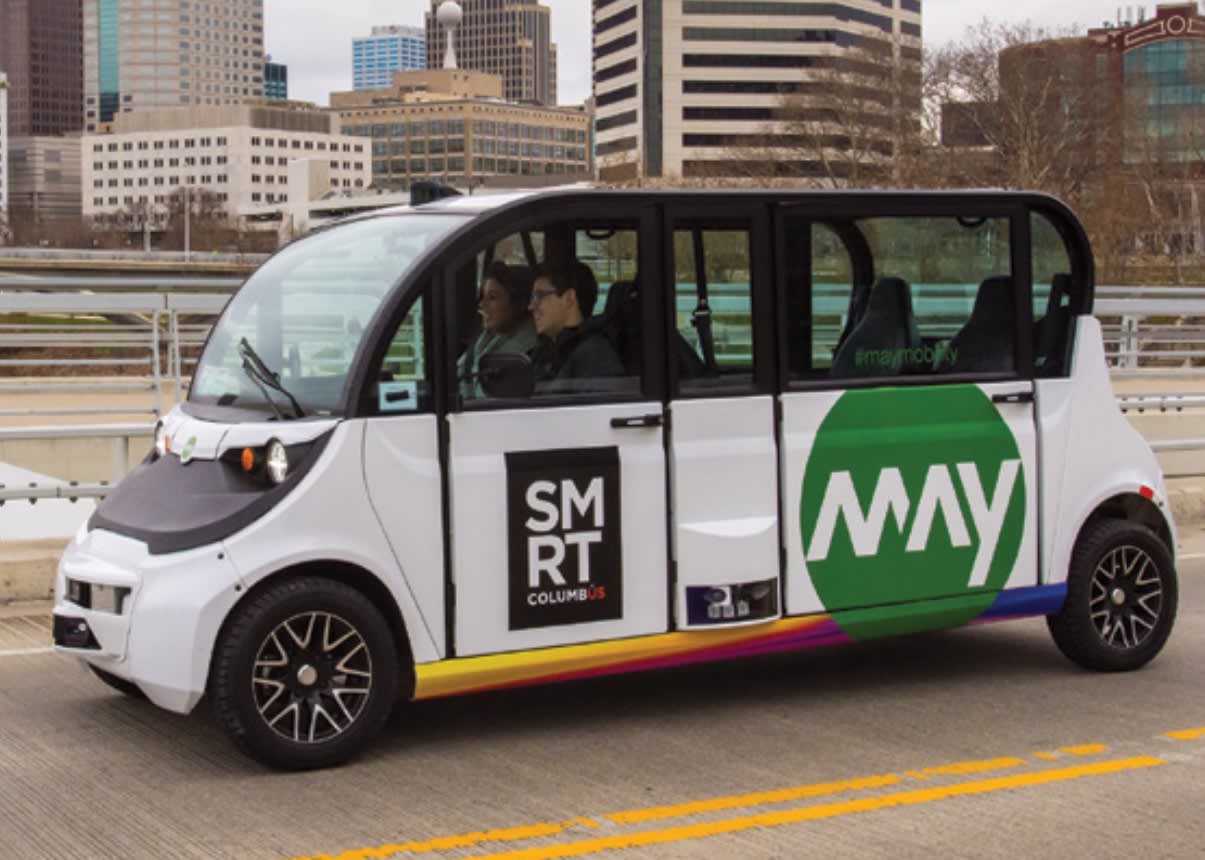
The young Ann Arbor-based company’s shuttles currently are servicing routes (with human safety operators Malek calls “fleet attendants”) in Detroit; Columbus, Ohio, and Providence, Rhode Island. A service in Grand Rapids, Michigan, launches this summer. The boxy, six-seat shuttles are based on the Polaris GEM electric platform, which May’s product team has iterated to improve the rider experience. Partner Magna handles initial production, retrofitting the vehicle from the chassis up. May then fits its proprietary technology stack. Cepton has the lead on LiDAR.
“We don’t need to build the cars,” said Malek, who was a rising-star engineer on GM’s original Volt program. Nor does May Mobility sell its vehicles to customers. Instead, its aim is to deliver top-notch transportation services for riders while maintaining full management of the shuttle fleets. This model is attracting interest from both cities and investors. The latest major round of funding, $22 million, came earlier this year. The venture-capital divisions of BMW and Toyota are also invested.
“First Mile-Last Mile operations are the best ‘first market’ for us,” Malek said, referring to moving people at the start and to the final destinations of their journeys, typically interfacing with public transportation. Autonomous technology can’t do everything today, she acknowledged, and a growing list of companies have dialed back their deployment plans. “AVs aren’t going to take over whole cities,” she asserted, “because whole cities are too big in scope for you to validate that you can operate safely and reliably.”
‘Table stakes’ for AVs

First Mile-Last Mile strategy provides a level of focus: to get to market with a product that has a good chance to prove itself safe and reliable enough within the next few years. “It allows us to get out early and learn the lessons that will let us scale over time,” Malek explained. It is also the highest-value problem the May Mobility team can solve with the lowest amount of effort.
“With this model, I have a distinct understanding of who needs to move, roughly when they need to move, how many people, and over what road networks,” she emphasized. “That’s a much easier business problem to solve than what load balancing I need across an entire city. That’s a challenge that Uber and Lyft have to deal with today.”
May Mobility’s debut in Providence integrates its shuttles with two of the city’s transit systems on a five-mile loop — an “exciting next step” for the operating system. “We’re looking to explore how we can really serve First Mile-Last Mile in terms of transit needs,” Malek noted, “versus serving riders that arrive by car and mainly need it from a parking perspective.” Service there is free, with the state of Rhode Island covering the first year of operation.
The learnings gained from the work in Detroit and Columbus are in two spheres. One is how to run an operation and deliver high levels of transportation service. “That is key, as we work toward the autonomous future,” Malek stated. “At some point, AV capability is going to be ‘table stakes’ [a term for the minimum amount required to play a hand of poker] and the winning company will be the one that’s able to put together the best service offering — unless they only want to sell the vehicle and have someone else do the service. We’re learning how to create the on-the-ground, back-end service and keep it really high.”
Serving enterprise clients in the two cities allows May to learn what riders like and dislike about self- driving vehicles. Rider data that’s collected goes directly to the Product team—feedback on ride and handling, ergonomic comfort, HVAC effectiveness. “Building rider trust in AVs, and keeping them coming back are really critical to the growth of this business,” Malek said.
A glimpse of the self-driving-shuttle future was shown at CES 2019: Myla 2.0. This prototype four-passenger May Mobility shuttle offers a 2-facing-2 “campfire” seating configuration. Windows, including a panoramic glass roof, are larger for a better view, and two 49-inch curved touch-screen displays provide easy user interface.
Multi-modal opportunities
May Mobility’s technical staff of over 70 people is the core of the company and it continues to grow. “We’re looking to hire software talent in the back- end, data-management side of things,” Malek said. “We have all these vehicles with a lot of data being produced which require software capabilities to ‘ingest’ that data and make it usable across the company. And we’re hiring people with automotive experience, in project and product management, and making sure we’re building those ‘muscles’...to make sure we get those products out at the right time.”
She said the company is pulling strong soft- ware-development expertise out of the University of Michigan as well as from the University of Waterloo in Ontario, Harvey Mudd College and Johns Hopkins University. It has also landed engineers who have worked in both the traditional and “new mobility” business units of OEMs and Tier 1s. “They know how to engineer safe and reliable systems” — skillsets that are not broadly available in Silicon Valley, she opined.
To Malek, the most exciting aspect of the changing landscape is getting people to think about transportation in a multi-modal way. “Pulling people out of the immediate knee-jerk that ‘I have to take my car,’” she said, when a scooter, a ride-share, a train, a VTOL air taxi, a May Mobility autonomous shuttle — or any combination of those — may better serve everybody’s mobility.
More From SAE Media Group
Automotive Engineering
Mobileye Ready to Meet FMVSS 127 with Vision-Only System
Autonomous Vehicle Engineering
AV Powers Bring May Flowers
Off-Highway Engineering
Sensing Changes in Autonomous Trucks

Automotive Engineering
The Future of “Core” Vehicle Systems
Autonomous Vehicle Engineering
GM’s Self-Driving Car Strategy: Vertical Integration
Automotive Engineering
Uhnder Dives Into the Ocean With Digital Radar
Automotive Engineering
MAGNA Say Some Hurdles of Seat-reconfiguration System to Be Addressed by OEMs

Automotive Engineering
Plotting the Vehicle Autonomy Revolution
Tech Briefs
Are In-Wheel Motor Systems Catching On?

Automotive Engineering
Ford Approved for Hands-Off Driving on German Autobahn

Automotive Engineering
GM Announces SAE Level 3 Autonomy and SDV Technology
Off-Highway Engineering
ZM Trucks Starts Production in Fontana, California

Autonomous Vehicle Engineering
Senso-Rama!
Off-Highway Engineering
Digital Tech a Las Vegas Headliner
Automotive Engineering
Taking Aim at the Drowsy-driver Threat
Automotive Engineering
EcoCAR 3 Teams Work to Improve Fuel Economy, Reduce Emissions of Chevy Camaro
Autonomous Vehicle Engineering
Autonomy: the New Age of Automobility

Motion Design
Self-Contained Wheel Unit
Autonomous Vehicle Engineering
Road Tested
Automotive Engineering
CES 2019: Blueprint for Future Auto Shows?
Autonomous Vehicle Engineering
The Road to Automobility
Automotive Engineering
Magna Prepared for AV “Marathon”
Top Stories
INSIDERManufacturing & Prototyping
 How Airbus is Using w-DED to 3D Print Larger Titanium Airplane Parts
INSIDERManned Systems
 FAA to Replace Aging Network of Ground-Based Radars
NewsTransportation
 CES 2026: Bosch is Ready to Bring AI to Your (Likely ICE-powered) Vehicle
NewsSoftware
 Accelerating Down the Road to Autonomy
EditorialDesign
 DarkSky One Wants to Make the World a Darker Place
INSIDERMaterials
 Can This Self-Healing Composite Make Airplane and Spacecraft Components Last...
Webcasts
Defense
 How Sift's Unified Observability Platform Accelerates Drone Innovation
Automotive
 E/E Architecture Redefined: Building Smarter, Safer, and Scalable...
Power
 Hydrogen Engines Are Heating Up for Heavy Duty
Electronics & Computers
 Advantages of Smart Power Distribution Unit Design for Automotive...
Unmanned Systems
 Quiet, Please: NVH Improvement Opportunities in the Early Design...
