




Motor Driver IC for Engines

Toshiba America Electronic Components, Inc. has released a small-sized motor driver IC for brushed dc motors used in vehicle engine applications such as electronic throttles and valve controls. The new TB9051FTG, housed in a flat 6- x 6-mm (0.24- x 0.24-in) P-QFN28 package, employs double-diffused MOSFET (DMOS FET) transistors as driver circuits. These devices do not require base current biasing, so they have virtually no input current, which lets them process high current density per device area with low on-resistance. The new motor driver ICs have the flexibility to enable control of a range of automotive electronics—not only engine applications, which are the primary target, but also other onboard systems such as wing mirrors and trunk locks, operating at up to 5 A. The TB9051FTG features a single, H-bridge channel and on-resistance of 0.34 ohm (H-side + L-side, max). Its two power supplies, VBAT and VCC, operate at 4.5 to 28 V and 4.5 to 5.5 V, respectively. Control functions include motor-related (forward, reverse, brake), as well as PWM control, current limit control, H-side current monitor, diagnosis output, and power-on-reset circuit. Built-in detection circuits include over current, over heat, and low/high voltage. Sample shipments started in September 2015, with mass production scheduled to start in October 2016.
More From SAE Media Group
Automotive Engineering
Brushed Motor Pre-Driver IC
Automotive Engineering
IGBT Module
Automotive Engineering
1000-V SiC MOSFET
Automotive Engineering
DC Power Supply
Automotive Engineering
Automotive Voltage Detectors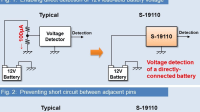
Off-Highway Engineering
Synchronous Step-Down Controller
Aerospace & Defense Tech Briefs
VPT Rad-Hard Point of Load Converters Designed for Digital Processing in Space Environments
Automotive Engineering
1200-V Discrete IGBT
Automotive Engineering
Efficient Power Electronics for Hybrids and EVs
Off-Highway Engineering
High-Temp Dual Valve Controller
Automotive Engineering
Silicon Carbide 1200-V MOSFET
Automotive Engineering
150V Power MOSFETs
Automotive Engineering
Polymer Capacitors
Off-Highway Engineering
MEM Inertial Accelerometer
Automotive Engineering
Heavy-Duty LVIT Inductive Linear Position Sensors
Automotive Engineering
Molded Current Sense Resistors
Off-Highway Engineering
Power Distribution Modules
Automotive Engineering
Bidirectional ESD Protection Diodes
Off-Highway Engineering
Fan Driver
Off-Highway Engineering
14-Mm Mount Panel LED
Off-Highway Engineering
LVIT Linear Position Sensors
Automotive Engineering
Q&A: Print Your Next Wiring Harness
Automotive Engineering
SIDACtor Protection Thyristors
Automotive Engineering
Maxim Chips Help Trim Space Requirements in Dashboards
Automotive Engineering
Semiconductor Power-Device Analyzer
Off-Highway Engineering
Shunt Resistors
Sensing Technology
How to Optimize Self-Powered Sensing
Automotive Engineering
Current Sense Resistor
Automotive Engineering
Photodiode Chips
Automotive Engineering
Flat Aluminum Electrolytic Capacitors
Top Stories
NewsSensors/Data Acquisition
 Microvision Aquires Luminar, Plans Relationship Restoration, Multi-industry Push
INSIDERRF & Microwave Electronics
 A Next Generation Helmet System for Navy Pilots
INSIDERWeapons Systems
 New Raytheon and Lockheed Martin Agreements Expand Missile Defense Production
NewsAutomotive
 Ford Announces 48-Volt Architecture for Future Electric Truck
INSIDERAerospace
 Active Strake System Cuts Cruise Drag, Boosts Flight Efficiency
ArticlesTransportation

Webcasts
Aerospace
 Cooling a New Generation of Aerospace and Defense Embedded...
Energy
 Battery Abuse Testing: Pushing to Failure
Power
 A FREE Two-Day Event Dedicated to Connected Mobility
Automotive
 Quiet, Please: NVH Improvement Opportunities in the Early Design Cycle
Electronics & Computers
 Advantages of Smart Power Distribution Unit Design for Automotive &...
Unmanned Systems
 Sesame Solar's Nanogrid Tech Promises Major Gains in Drone Endurance