




New Device Measures How Birds Take Flight
It's quite easy to look at a bird and deduce that it flies by flapping its wings, but understanding exactly how a bird generates lift has long eluded scientists. Now engineers at Stanford have developed a device that precisely and humanely measures the forces generated by a bird's wings while in flight. The work promises to answer many mysteries of bird flight, providing aid in the design of innovative and efficient unmanned aerial vehicles, known as UAVs or, more recently, drones.
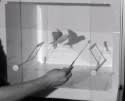
Measuring the lift forces of a bird in free flight has been a holy grail for biomechanical engineers, said David Lentink, an assistant professor of mechanical engineering at Stanford. But every technique developed so far has provided uncertain results. Experiments that involve measuring airflow over the bird, and extrapolating force from that, suffer when the flow becomes turbulent. Measuring the flow also requires strong lasers, which can put the birds in harm's way. Alternative techniques rely on measuring the bird's body motion to calculate the acceleration produced by its body parts, but that requires a post-flight dissection to determine the associated body masses in order to calculate how much force the bird exerted.
"We've developed a way for the bird to just freely fly in a nice environment. It's a very animal-friendly method, and very precise, too," Lentink said. "We reward the birds with seed for their flight. We have happy birds and happy researchers afterward."
Lentink calls his device an aerodynamic force platform, and it works very similarly to the force platforms that have allowed bioengineers to study the forces that humans exert to walk or run. It's a box the size and shape of a large birdcage, with an acrylic observation window and two bird perches inside. Supersensitive force sensors are attached to the bottom of the box. This force transfer is based on Newton's third law of motion, which states that for every action there is an equal and opposite reaction. As the bird flies perch-to-perch, each beat of its wings pushes against the air, which in turn pushes against the bottom of the box and also sucks down the ceiling slightly. These forces are recorded to produce a precise measurement for each stroke of the bird's wings.
Each wing beat lasts 50 milliseconds, and the sensors take a new measurement every 1 millisecond. A very precise value can be determined every 10 milliseconds, producing highly detailed data of the bird's lift. The system is so sensitive, Lentink said, that it registers vibrations in the air from the lab's ventilation system.
"We have to turn off the air conditioning to conduct experiments, but we get very clean, precise data, so it's worth it," Lentink said.
For the proof of principle, Lentink's team first calibrated their aerodynamic force platform with a quadcopter programmed to generate variable thrust, which they measured independently, and demonstrated the device is accurate within the sensors' resolution of 0.2 gram. Next they tested the device using two trained Pacific parrotlets – named Ray and Gaga – and already the work is producing interesting results. They have found that the birds produce lift equal to two times their body weight during their downstroke, and generate virtually no lift on their upstroke, clarifying classic work done in the field.
The engineers are putting the finishing touches on a refined version of their device, made of carbon fiber, and will soon begin testing more complex flight maneuvers made by birds. They also hope to resolve an ongoing debate of how hummingbirds, whose wing strokes are more similar to an insect than a bird, generate lift. Other animals of interest include bats, which fly with membranous wings controlled by tiny muscles under the skin.
Understanding how animals fly so effectively could lead to improved designs for drones, Lentink said. In particular, his group has built a flapping winged robot, with sail-like wings and carbon fiber stiffeners, but they had no way to measure exactly how its aerodynamics worked, or if it could be improved upon. With the new device, he said, they'll be able to measure the aerodynamic forces, and get instant feedback to improve upon their designs with greater certainty.
More From SAE Media Group
Aerospace & Defense Tech Briefs
The Future of Better Drones Is for the Birds
Aerospace & Defense Tech Briefs
Aerodynamic Modeling of a Flapping Wing Unmanned Aerial Vehicle

Aerospace & Defense Tech Briefs
Drone Parachute Rescue System
Aerospace INSIDER
Engineers Assess Flow Quality in Wind Tunnel Test Facility
Defense INSIDER
Researchers Design Bat-Inspired Wings for Micro Air Vehicles

Aerospace & Defense Tech Briefs
Shaking Outside the Box to Advance Flight Research
Aerospace & Defense Tech Briefs
Sensuron Enables Real-Time Structural Health Monitoring Onboard NASA’s X-56 UAV
Motion Design INSIDER
Tailless Jet Flies Free with Novel Control Technique
Defense INSIDER
AFWERX Tests Alternative Navigation System on Osprey MK III
Aerospace & Defense Tech Briefs
Notre Dame’s New Boundary Breaking Mach 10 Quiet Wind Tunnel
Aerospace & Defense Tech Briefs
Rising Star Awards: Women in Engineering Aerospace Winner - Heather Cummings

Aerospace INSIDER
Reliable Robotics to Provide Aircraft Automation Study for US Air Force
Aerospace INSIDER
MQ-1C Completes First Air-Launched Effect Flight Demonstration
Aerospace INSIDER
Helsing AI Agent Completes Saab Gripen E Test Flight
Aerospace INSIDER
Quarterhorse Hypersonic Test Aircraft Completes First Flight
Aerospace INSIDER
Anduril Completes First Semi-Autonomous Flight of CCA Prototype

Tech Briefs
Drone Zips Through Narrow Windows On Its Own
Aerospace INSIDER
New DARPA X-Plane Will Have No Moving Control Surfaces
Aerospace & Defense Tech Briefs
Jetoptera, GE Aviation Collaborate On, Demonstrate Hover with Fluidic Propulsion
Aerospace INSIDER
NASA’s Folding Wing Reduces Drag and Increases Efficiency
Aerospace & Defense Tech Briefs
UAV Fuel Management System
Top Stories
INSIDERManufacturing & Prototyping
 How Airbus is Using w-DED to 3D Print Larger Titanium Airplane Parts
NewsAutomotive
 Microvision Aquires Luminar, Plans Relationship Restoration, Multi-industry Push
INSIDERAerospace
 A Next Generation Helmet System for Navy Pilots
INSIDERDesign
 New Raytheon and Lockheed Martin Agreements Expand Missile Defense Production
ArticlesAR/AI
 CES 2026: Bosch is Ready to Bring AI to Your (Likely ICE-powered) Vehicle
Road ReadyDesign

Webcasts
Semiconductors & ICs
 Advantages of Smart Power Distribution Unit Design for Automotive...
Unmanned Systems
 Quiet, Please: NVH Improvement Opportunities in the Early Design...
Electronics & Computers
 Cooling a New Generation of Aerospace and Defense Embedded...
Power
 Battery Abuse Testing: Pushing to Failure
AR/AI
 A FREE Two-Day Event Dedicated to Connected Mobility
