




High-Tech Bird Watching Could Lead to Shapeshifting Airplane Wings
An international team of engineers and biologists will gain unprecedented insights into how birds fly so efficiently and then use that knowledge to build unmanned aircraft with shapeshifting wings. These planes should be lighter, faster and dramatically more maneuverable than today’s stiff-winged aircraft.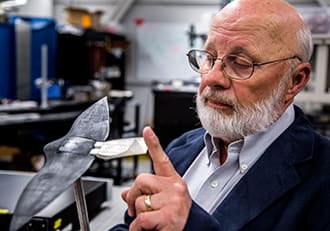
Recently awarded a $6 million grant from the Air Force Office of Scientific Research, the researchers will first produce the most detailed analysis of bird flight ever made for an aerospace engineering project. The project is headed by Daniel Inman, the Clarence “Kelly” Johnson Professor and a professor of aerospace engineering at the University of Michigan, with researchers at Stanford and the University of California, Los Angeles leading parts of the effort.
While modern, rigid-wing airplanes use drag-inducing flaps and slats for control, birds manipulate individual feathers or clusters of feathers on their wings, creating surfaces that control flight without wasting energy.
“With new materials, advanced sensing and control techniques, and inventive methods for observing birds in flight, our team will begin to bring avian efficiency and agility to aircraft,” said Inman.
Better efficiency will make battery-powered unmanned aircraft more practical, whereas many now rely on fossil fuels. The team will also explore whether their new wings and tail could work on small, crewed aircraft.
Rather than burdening small birds with sensors to measure airflow, pressure and other forces, David Lentink, an assistant professor of mechanical engineering at Stanford University, has developed a system that measures pressure disturbances in the air around the bird.
“It is really exciting that we can now finally study bird flight with an engineering eye,” said Lentink, who is also a biologist. “The time-resolved forces on the wings, in combination with 3D wing shape measurements at 1,000 frames per second, are key to deciphering how birds change shape to control the aerodynamic force they generate.”
Other biologists on the project will mount cameras on the backs of large species such as eagles. These will provide close-up views of the wings as the birds take off, glide, maneuver and land. A third group will explore how wing muscles work together to manipulate the shape of the wing.
The engineers will investigate a variety of avenues toward producing morphing wings for aircraft. They’ll test materials that alter wing shape in response to stimuli such as temperature changes or electric current. The researchers believe they can assemble structures resembling the bone and muscle in birds’ wings through 3D printing. To regulate the shapes of the wings, another group of engineers will program the control computer using techniques that mimic neurons in the brain and develop sensors that can be distributed through the wing like nerves. These will report airflow and pressure data back to the computer—information that birds instinctively collect and use in flight.
“A biological neural network can process signals at a speed comparable to a supercomputer while weighing only one millionth as much and consuming one millionth the power,” said Yong Chen, a professor of mechanical and aerospace engineering at the UCLA. Chen’s brain-like circuits will be able to quickly and efficiently process information from the sensors, using it to choose the best wing shapes to maneuver the aircraft.
More From SAE Media Group
Motion Design INSIDER
Tailless Jet Flies Free with Novel Control Technique
Aerospace & Defense Tech Briefs
Rising Star Awards: Women in Engineering Aerospace Winner - Heather Cummings
Aerospace & Defense Tech Briefs
2025 RISING STAR AWARDS Aerospace and Defense Winner – Keshika Warnakula
Aerospace INSIDER
Anduril Completes First Semi-Autonomous Flight of CCA Prototype
Aerospace INSIDER
New DARPA X-Plane Will Have No Moving Control Surfaces
Aerospace INSIDER
Air Force Researchers Design, Build and Fly Drone in 24 Hours
Aerospace INSIDER
Navy Completes 73-Hour Nonstop Flight of Solar-Powered UAS
Aerospace INSIDER
Two Startups Partner to Expand Hydrogen-Powered Drone Production

Aerospace & Defense Tech Briefs
Human-Focused Research Aims to Enhance UAS Effectiveness, Readiness
Aerospace INSIDER
BAE Systems Acquires Developer of Electric Heavy Lift Quadcopters
Aerospace & Defense Tech Briefs
UAV Fuel Management System
Aerospace INSIDER
Reliable Robotics to Provide Aircraft Automation Study for US Air Force
Defense INSIDER
Controlling Drones with the Human Brain



Aerospace INSIDER
Paris Air Show: New Aerospace Technologies, Updates and Research
Aerospace INSIDER
Quarterhorse Hypersonic Test Aircraft Completes First Flight
Aerospace INSIDER
F-22 Pilot Controls Drone With Tablet
Aerospace INSIDER
New Web-Based Software Enables Quick Drone Design
Aerospace & Defense Tech Briefs
Improving Low-Altitude UAS Navigation


Aerospace INSIDER
German Air Force Starts Flight Testing New Heron ISR Drone
Aerospace Manufacturing and Machining INSIDER
Small Low-Cost Engines for Drones and Collaborative Combat Aircraft
Aerospace INSIDER
WATCH: Air Force Research Lab's First Flight of XQ-67A Drone
Top Stories
INSIDERManufacturing & Prototyping
 How Airbus is Using w-DED to 3D Print Larger Titanium Airplane Parts
INSIDERManned Systems
 FAA to Replace Aging Network of Ground-Based Radars
NewsTransportation
 CES 2026: Bosch is Ready to Bring AI to Your (Likely ICE-powered) Vehicle
NewsSoftware
 Accelerating Down the Road to Autonomy
EditorialDesign
 DarkSky One Wants to Make the World a Darker Place
INSIDERMaterials
 Can This Self-Healing Composite Make Airplane and Spacecraft Components Last...
Webcasts
Defense
 How Sift's Unified Observability Platform Accelerates Drone Innovation
Automotive
 E/E Architecture Redefined: Building Smarter, Safer, and Scalable...
Power
 Hydrogen Engines Are Heating Up for Heavy Duty
Electronics & Computers
 Advantages of Smart Power Distribution Unit Design for Automotive...
Unmanned Systems
 Quiet, Please: NVH Improvement Opportunities in the Early Design...
