




Controlling Drones with the Human Brain

A researcher from Arizona State University wants to command machines with the human brain. In fact, within ten years, Panagiotis Artemiadis, professor of mechanical and aerospace engineering at Arizona State University, envisions a swarm of brain-controlled drones playing a critical role in a range of applications, including agriculture and search-and-rescue operations.
The essential technology component of mind-controlled UAVs, or unmanned aerial vehicles, is the interface: a combination of hardware and algorithms that maps one’s brain activation to commands for a robotic system. Using electrodes placed on the scalp to record electrical activity, the non-invasive Electroencephalography (EEG) method measures voltage fluctuations resulting from the neurons’ ionic current. The hardware then measures brain activation as the subject thinks about an intended motion for the machine. The algorithms decode those activations to control commands for the robotic system.
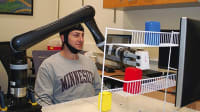
At ASU’s Human-Oriented Robotics and Control (HORC) Lab, Artemiadis and his fellow researchers have evaluated the brain's capacity to direct non-human behaviors, including the flight of drones. In 2016, Artemiadis tested the ability of a single operator to control three UAVs, guiding each through a narrow loop. The subject used a hybrid brain-machine interface, combining EEG-recorded brain activity with input from a joystick. To control the multiple drones, the user had to think about shrinking or expanding the shape of the UAV grouping as a whole. By developing algorithms that extracted specific information from the brain, the experiment demonstrated the ability for humans to steer not just a single machine, but a swarm.
Collective behaviors are abundant in nature, but the idea of a flock or herd has only recently been adopted to robotic concepts. A robotic “swarm” system consists of a large group of interchangeable vehicles that use information, obtained via local sensing and communication, to execute autonomous decisions. Artemiadis and his team tested a “human-swarm interface” to, in effect, decode the brain and extract information related to desired collective behaviors, like the expansion of a swarm’s coverage or the implementation of a specific formation.
The algorithms developed at the HORC lab extract brain signals. The ASU team applies machine learning and pattern recognition algorithms to translate the brain’s electrical signals into control commands that are wirelessly transmitted to the drones.
The integration of very large teams of robots into comprehensive systems enables new tasks and missions, including search, exploration, and surveillance, according to the ASU researcher. Armed with infrared imaging equipment, a drone swarm, for example, could provide real-time tracking of a forest fire, allowing responders to adjust their plans on the fly. Teams of drones could also be called on to create topographic maps for soil analysis and irrigation planning.
More From SAE Media Group
Tech Briefs INSIDER
Drone Control: How the Human Brain Can Guide Robotic Swarms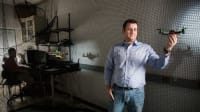
Defense INSIDER
Researcher Creates System to Control Robots With the Brain
Aerospace & Defense Tech Briefs
2025 RISING STAR AWARDS Aerospace and Defense Winner – Keshika Warnakula
Robotics & Automation INSIDER
A New Model Offers Robots Precise Pick-and-Place Solutions
Aerospace & Defense Tech Briefs
AI Co-Pilot Enhances Human Precision for Safer Aviation
Motion Design INSIDER
MultiRobot Team Walks, Flies, and Rolls
Motion Design INSIDER
A Low-Cost Robot Ready for Any Obstacle
Motion Design INSIDER
Stable AI-Controlled Systems for Safe Autonomous Motion
Aerospace & Defense Tech Briefs
Creating and Verifying Stable AI-Controlled Systems in a Rigorous, Flexible Way
Motion Design
Maneuvering Robot Control Using Machine Learning
Tech Briefs
A Highly Dexterous Robot Hand
Motion Design
Improved Grasping with an Energy-Efficient Robotic Hand
Motion Design INSIDER
Unleashing the Power of Intelligent Drone Swarms
Motion Design INSIDER
Programming Robots with Rubber Bands
Defense INSIDER
Algorithms for Autonomous Marine Vehicles
Tech Briefs
Soft Robots with Human-Like Intelligence


Motion Design INSIDER
Teaching a Robot to Hang a T-shirt Starts with Data
Motion Design INSIDER
Resource-Sharing Boosts Robotic Resilience
Aerospace & Defense Tech Briefs
New Cyber Algorithm Shuts Down Malicious Robotic Attacks
Aerospace & Defense Tech Briefs
Autonomous Surveillance Technologies Relating to Dismounted Soldiers
Motion Design INSIDER
Using an AI-Powered Robotic Unicycle to Study How People Learn Complex Motor Skills
Robotics & Automation INSIDER
Innovative Robot Navigation Inspired by Brain Function Boosts Efficiency and Accuracy

Robotics & Automation INSIDER
MIT Engineers Help Multirobot Systems Stay In the Safety Zone
Aerospace & Defense Tech Briefs
Aerospace & Defense Podcasts
Aerospace & Defense Tech Briefs
One Person Can Supervise a Swarm of 100 Unmanned Autonomous Vehicles
Top Stories
INSIDERDefense
 New Raytheon and Lockheed Martin Agreements Expand Missile Defense Production
NewsAutomotive
 Ford Announces 48-Volt Architecture for Future Electric Truck
INSIDERManufacturing & Prototyping
 Active Strake System Cuts Cruise Drag, Boosts Flight Efficiency
ArticlesTransportation
 Accelerating Down the Road to Autonomy
INSIDERMaterials
 How Airbus is Using w-DED to 3D Print Larger Titanium Airplane Parts
Road ReadyTransportation

Webcasts
Electronics & Computers
 Cooling a New Generation of Aerospace and Defense Embedded...
Power
 Battery Abuse Testing: Pushing to Failure
Connectivity
 A FREE Two-Day Event Dedicated to Connected Mobility
Automotive
 Quiet, Please: NVH Improvement Opportunities in the Early Design Cycle
Transportation
 Advantages of Smart Power Distribution Unit Design for Automotive &...
Aerospace
 Sesame Solar's Nanogrid Tech Promises Major Gains in Drone Endurance