




Researcher Creates System to Control Robots With the Brain
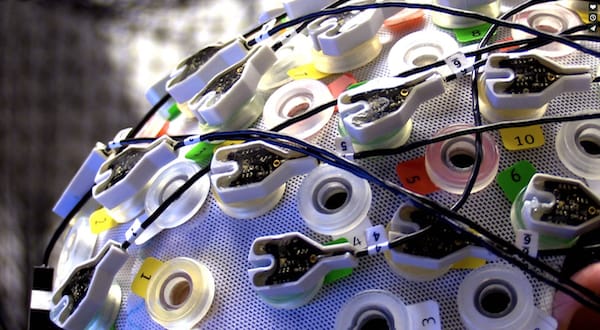
A researcher at Arizona State University has discovered how to control multiple robotic drones using the human brain. A controller wears a skull cap outfitted with 128 electrodes wired to a computer. The device records electrical brain activity. If the controller moves a hand or thinks of something, certain areas light up.
“I can see that activity from outside,” said Panagiotis Artemiadis, director of the Human-Oriented Robotics and Control Lab and an assistant professor of mechanical and aerospace engineering in the School for Engineering of Matter, Transport and Energy in the Ira A. Fulton Schools of Engineering. “Our goal is to decode that activity to control variables for the robots.”
If the user is thinking about decreasing cohesion between the drones — spreading them out, in other words — “we know what part of the brain controls that thought,” Artemiadis said. A wireless system sends the thought to the robots. “We have a motion-capture system that knows where the quads are, and we change their distance, and that’s it,” he said.
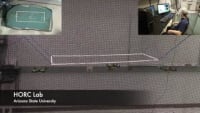
Up to four small robots, some of which fly, can be controlled with brain interfaces. Joysticks don’t work, because they can only control one craft at a time. To make them move, the controller watches on a monitor and thinks and pictures the drones performing various tasks.
Artemiadis has been working on the brain-to-machine interface since he earned his doctorate in 2009, specifically neural interfaces with robot hands and arms. “During the last two to three decades there has been a lot of research on single brain/machine interface, where you control a single machine,” he said. A few years ago, he had the idea to go to a lot of machines. It’s part of a trend in robotics and space exploration: Instead of building one giant expensive machine or plane or spacecraft, researchers build a lot of little cheap ones. “If you lose half of them, it doesn’t really matter,” Artemiadis said.
He already knew what area of the brain controlled what motions, but one discovery jumped out at him.
“I was surprised the brain cares about swarms and collective behaviors,” he said. “What I didn’t know — or hypothesized — is that the brain cares about things we are not doing ourselves,” he added. “We don’t have a swarm we control. We have hands and limbs and all that stuff, but we don’t control swarms.” In other words, our brains are not used to all of our fingers and toes running off on their own and then returning.
The Air Force pilots Artemiadis worked with were skeptical. Their main objection was what would happen if they thought of something else while controlling the drones. Artemiadis said controllers have to stay focused. If it’s close to lunch and all you can think about is pizza, it doesn’t work.
The next step in Artemiadis’ research is multiple people controlling multiple robots. He plans to move to a much larger experimental space to refine the proof of concept. In the future, he sees drone swarms performing complex operations, such as search-and-rescue missions.
More From SAE Media Group
Tech Briefs
Operators Control Multiple Drones by Thought
Defense INSIDER
Controlling Drones with the Human Brain
Tech Briefs INSIDER
Drone Control: How the Human Brain Can Guide Robotic Swarms
Robotics & Automation INSIDER
New Vision-Based System Teaches Machines to Understand Their Bodies
Robotics & Automation INSIDER
Robotic Arms Connected Directly to Brain of Partially Paralyzed Man Allows Him to Feed Himself
Robotics & Automation INSIDER
A New Model Offers Robots Precise Pick-and-Place Solutions
Tech Briefs
Teaching Robots to Predict Humans' Actions
Robotics & Automation INSIDER
Teaching Robots to Serve Humans
Motion Design INSIDER
Programming Robots with Rubber Bands
Motion Design INSIDER
Teaching Robots to Build Without Blueprints
Aerospace & Defense Tech Briefs
AFRL Demos Advanced Multipurpose Robotics for Aerospace
Tech Briefs
Getting Robots to “Bee” have Without a Plan
Tech Briefs
A Highly Dexterous Robot Hand
Motion Design INSIDER
AI Helps Robots Manipulate Objects with Their Whole Bodies
Motion Design INSIDER
Simulation-Based Pipeline Tailors Training Data for Dexterous Robots
Motion Design
Maneuvering Robot Control Using Machine Learning
Motion Design INSIDER
Unleashing the Power of Intelligent Drone Swarms
Motion Design INSIDER
Using an AI-Powered Robotic Unicycle to Study How People Learn Complex Motor Skills


Robotics & Automation INSIDER
Using AI to Design a New Robot from Scratch in Seconds
Motion Design INSIDER
Physics-Aware Neural Networks Improve Camera-Based Machines
Motion Design INSIDER
MultiRobot Team Walks, Flies, and Rolls
Tech Briefs
Giving Robots the Human Touch via Listening
Aerospace & Defense Tech Briefs
Drone Swarms: A Transformational Technology
Robotics & Automation INSIDER
Innovative Robot Navigation Inspired by Brain Function Boosts Efficiency and Accuracy
Top Stories
INSIDERDefense
 New Raytheon and Lockheed Martin Agreements Expand Missile Defense Production
NewsAutomotive
 Ford Announces 48-Volt Architecture for Future Electric Truck
INSIDERManufacturing & Prototyping
 Active Strake System Cuts Cruise Drag, Boosts Flight Efficiency
ArticlesTransportation
 Accelerating Down the Road to Autonomy
INSIDERMaterials
 How Airbus is Using w-DED to 3D Print Larger Titanium Airplane Parts
Road ReadyTransportation

Webcasts
Electronics & Computers
 Cooling a New Generation of Aerospace and Defense Embedded...
Power
 Battery Abuse Testing: Pushing to Failure
Connectivity
 A FREE Two-Day Event Dedicated to Connected Mobility
Automotive
 Quiet, Please: NVH Improvement Opportunities in the Early Design Cycle
Transportation
 Advantages of Smart Power Distribution Unit Design for Automotive &...
Aerospace
 Sesame Solar's Nanogrid Tech Promises Major Gains in Drone Endurance