




Parallel Hybrid Vehicles Using Fuzzy Logic Control
A fuzzy logic controller for hybrid vehicles with parallel configuration was proposed. Using the state-of-charge (SOC) of the energy storage, the driver command, and the motor/generator speed, a set of rules was developed. The fuzzy logic controller can determine the split between the electric motor and the internal combustion engine to achieve better fuel economy and low emission performance without losing vehicle performance.
Hybrid systems use a combination of an internal combustion engine (ICE) and an electric motor (EM). This combination has the potential of improving fuel economy by making use of regenerative braking on deceleration. There are three different types of hybrid systems:
- Series — The internal combustion engine (ICE) is used as a generator, providing electrical power to the electric motor (EM) and the battery.
- Parallel — The electric motor (EM) supplements torque to the internal combustion engine (ICE), both of which are connected to the drive train.
- Series-Parallel — A combination of the two configurations.
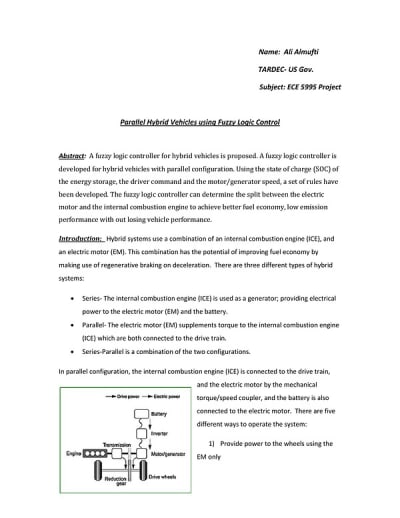
In parallel configuration, the ICE is connected to the drive train, and the electric motor by the mechanical torque/speed coupler. The battery is also connected to the electric motor. There are five different ways to operate the system:
- Provide power to the wheels using the EM only.
- Using the ICE only.
- Using both the ICE and the EM simultaneously.
- Charge the battery using the ICE power to drive the EM as a generator.
- Slow down the vehicle by letting the wheels drive the EM as a generator that provides power to the battery (regenerative braking).
In order to manage the flow of energy among all components, a power controller is required to take into account the energy available in the battery.
It is important to optimize the architecture and components of the hybrid vehicle. The energy management strategy used is just as important as the architecture and components. A power controller is used to control the energy flow among all components, and optimizes power generation and conversion in the individual components. The energy in the system should be managed as follows:
- The driver input (from brake and accelerating pedals) is satisfied consistently.
- Battery has full charge at all times.
- All four components — ICE, EM, battery, and transmission — should have an optimized overall system efficiency.
During the operation of the parallel hybrid vehicle, the power controller should determine how much power is needed to drive the wheels based on the driver input and how much is needed to charge the battery. Then, the power controller should split the power between the ICE and the EM. If the battery is low on charge, the controller will assign negative power to the EM. Meanwhile, the ICE will provide the power for both driving the
wheels and charging the battery.
The difference between using the ICE or the EM to drive the wheels is as follows. When the ICE is used, the energy flows directly from the ICE through the transmission to the wheels, meaning that the mechanical power produced will promptly be used to drive the wheels. When the EM is used, energy first flows from the ICE through the transmission to the EM, operated as a generator, to charge the battery. Then, the energy will flow from the battery to the EM, operated as a motor, to the wheels, meaning that the same mechanical power has been converted to electric power, and then back to mechanical.
The power controller optimizes the energy flow among the components of the parallel hybrid vehicle, the energy generation, and conversion in the components (ICE, EM, battery, and transmission). The accelerator and the brake pedal inputs of the driver power command are converted by the power controller. The fuzzy logic controller computes the optimal generated power by using the driver power command, state-of-charge battery, and the EM speed, which are also used to compute the optimal ICE and EM power. The driver inputs (from braking and accelerating) are satisfied consistently by the power controller to ensure the battery is charged all the time.
This work was done by Ali Almufti for the U.S. Army RDECOM-TARDEC. For more information, download the Technical Support Package (free white paper) at www.defensetechbriefs.com/tsp under the Mechanics/Machinery category. ARL-0098
This Brief includes a Technical Support Package (TSP).
Parallel Hybrid Vehicles Using Fuzzy Logic Control
(reference ARL-0098) is currently available for download from the TSP library.
Don't have an account?
More From SAE Media Group
Aerospace & Defense Tech Briefs
Quantitative Analysis of a Hybrid Electric Humvee for Fuel Economy Improvement
Tech Briefs
Retrofits Convert Gas Vehicles into Hybrids
Automotive Engineering
Tuning the 2024 Corvette E-Ray for Exceptional Drivability
Automotive Engineering
New Ampere EV Motor Aims for Power, Torque Benchmarks
Automotive Engineering
Hub-Motoring in Lordstown’s Novel Endurance
Automotive Engineering
Tariff Challenges, EV Advances at Mobility 360
Off-Highway Engineering
Overcoming EV Drivetrain Testing Challenges
Automotive Engineering
BMW Reapproaches Hydrogen
Automotive Engineering
Brunswick Launches All-Electric Marine Outboard
Automotive Engineering
New IAAPS Powertrain R&D Center to Accelerate Development of Propulsion Systems
Off-Highway Engineering
Truckin’ on Hydrogen
Automotive Engineering
GM: Ultium Heat-Pump System Boosts EV Range, Reduces Charge Times
Off-Highway Engineering
Tevva & ZF Integrate Brake-By-Wire Regen System for Last Mile BEV
Off-Highway Engineering
Cummins Unveils PowerDrive Hybrid-Electrics, Euro 7 Diesel Concept
Automotive Engineering
Schaeffler Heads Back to CES with New Acquisition, Capabilities
Automotive Engineering
Mercedes Proposes “In-Drive Brakes” for Better EVs
Automotive Engineering
For Aptiv, More EVs Mean More Profit with SVA
Off-Highway Engineering
Hexagon Agility Partners with Brudeli for Hybrid CNG Truck Powertrains
Automotive Engineering
TI Fluid Systems Opens Facility to Create Cooling Products for EVs
Off-Highway Engineering
Vanguard Swappable and Fixed Batteries Aim to Electrify the Jobsite
Off-Highway Engineering
Hyundai CE Debuts Hydrogen and Electric Excavators at Bauma 2022
Off-Highway Engineering
EV Startup Prepares to Enter Commercial Market with Novel EAxle
Automotive Engineering
Orbis Says HaloDrive Axial-Flux Motor Available for In-Wheel, Other Uses
Automotive Engineering
Suppliers Prepare for a Drop in EV Market Share
Off-Highway Engineering
Hybrid Powertrains in the Product Mix
Off-Highway Engineering
The Case for 48V in Commercial Vehicles
Off-Highway Engineering
Deutz Advances ‘E’ Strategy—prototypes on the Horizon
Automotive Engineering
Toyota, Mazda, Subaru Agree Carbon Is ‘Enemy' with Internal Combustion Engine Announcement
Off-Highway Engineering
Regulatory Landscape Challenges Commercial-Vehicle Engine Development
Overview
The document presents a project by Ali Almufti from TARDEC, focusing on the development of a fuzzy logic controller for parallel hybrid vehicles. The primary objective of this project is to optimize the energy management of hybrid systems, which combine an internal combustion engine (ICE) and an electric motor (EM) to improve fuel economy and reduce emissions while maintaining vehicle performance.
Hybrid vehicles can operate in various configurations, including series, parallel, and series-parallel. In a parallel configuration, both the ICE and EM are connected to the drivetrain, allowing them to work together to provide power to the wheels. The document outlines five operational modes for the hybrid system, including using the EM only, the ICE only, both simultaneously, charging the battery using the ICE, and employing regenerative braking to recharge the battery.
A key component of the hybrid vehicle's operation is the power controller, which manages the flow of energy between the ICE, EM, battery, and transmission. The energy management strategy aims to ensure that the vehicle operates efficiently by satisfying driver inputs, maintaining a full battery charge, and optimizing the overall system efficiency of all components. The power controller determines the necessary power to drive the wheels based on driver commands and adjusts the power split between the ICE and EM accordingly.
The document also introduces a fuzzy logic control (FLC) system that utilizes a set of rules based on the state of charge (SOC) of the battery, driver power commands, and EM speed. These rules dictate how much power should be generated by the EM to ensure optimal performance. For instance, if the SOC is too high, the controller will not generate power, while if the SOC is low, it will generate power based on the driver’s commands and EM conditions.
In conclusion, the fuzzy logic controller aims to enhance the efficiency and performance of parallel hybrid vehicles by intelligently managing energy flow and optimizing the interaction between the ICE, EM, and battery. This innovative approach promises to improve fuel economy and reduce emissions, contributing to more sustainable transportation solutions. The project highlights the importance of advanced control strategies in the evolution of hybrid vehicle technology.
Top Stories
INSIDERManufacturing & Prototyping
 How Airbus is Using w-DED to 3D Print Larger Titanium Airplane Parts
NewsAutomotive
 Microvision Aquires Luminar, Plans Relationship Restoration, Multi-industry Push
INSIDERAerospace
 A Next Generation Helmet System for Navy Pilots
INSIDERDesign
 New Raytheon and Lockheed Martin Agreements Expand Missile Defense Production
ArticlesAR/AI
 CES 2026: Bosch is Ready to Bring AI to Your (Likely ICE-powered) Vehicle
Road ReadyDesign

Webcasts
Semiconductors & ICs
 Advantages of Smart Power Distribution Unit Design for Automotive...
Unmanned Systems
 Quiet, Please: NVH Improvement Opportunities in the Early Design...
Electronics & Computers
 Cooling a New Generation of Aerospace and Defense Embedded...
Power
 Battery Abuse Testing: Pushing to Failure
AR/AI
 A FREE Two-Day Event Dedicated to Connected Mobility
