




Quantitative Analysis of a Hybrid Electric Humvee for Fuel Economy Improvement
Hybrid vehicle powertrains show improved fuel economy gains due to optimized engine operation and regenerative braking.
The Army has acquired several hybrid platforms to assess the applicability of hybrid technology for military missions. These hybrid platforms include both series and parallel hybrid topologies. This work compares a conventional HMMWV (High Mobility Multi-purpose Wheeled Vehicle) M1113 with a series hybrid HMMWV XM1124 in terms of fuel economy improvements over three military drive cycles.
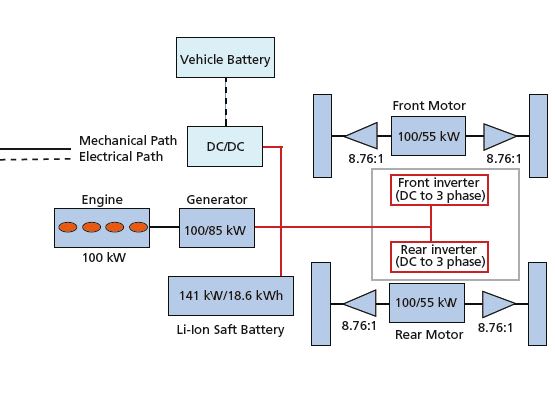
Three drive cycles were analyzed for fuel economy comparisons between the conventional HMMWV M1113 and the series hybrid XM1124. The HMMWV M1113 is equipped with a 6.5-L V8 turbo-charged diesel engine, a four-speed automatic transmission, and has a gross weight of 5216 kg. The XM1124 is a series-hybrid version of the M1113 with a PGU consisting of a 4- cylinder 100-kW diesel engine, coupled to a 100-kW PM brushless generator. The electric traction is provided by two 100-kW PM brushless motors. The XM1124 utilizes a 100-kW Li-Ion battery pack.
The fuel economy comparisons are based on HEVEA (Hybrid Electric Vehicle Experimentation and Assessment) data collected for both the XM1124 and the M1113 vehicles over the three drive cycles. In addition, only HEVEA data was analyzed that resulted in SOC (State of Charge) equalization, i.e. the battery SOC is equal at the beginning and end of the test cycle. The HEVEA data collected was comprised of time versus vehicle speed, front and rear motor current, generator current, battery current, battery pack voltage, battery pack SOC, fuel rate, and engine speed. The fuel economy was calculated from the fuel rate and vehicle speed.
The engine operation efficiency was analyzed by superimposing the engine operating speed-torque points over the engine efficiency map (which shows the speed-torque characteristics at different efficiencies of the engine). The XM1124 engine was shown to be more efficient than the older M1113 engine.
The engine torque was not directly measured during the HEVEA tests, since this was not available on the CAN (Controller Area Network) data bus for either the XM1124 or the M1113. As a result, the engine torque was derived from the other available data. In the case of the XM1124, generator electrical current, engine speed, and battery voltage were recorded. In the case of the M1113, the engine torque was known fuel map (engine speed and torque vs. fuel rate) and measured instantaneous fuel rate. The engine speed of the XM1124 is constrained over a narrow speed range, whereas the conventional M1113 engine speed is coupled to the vehicle speed.
The contribution of regenerative braking on overall fuel economy was determined from analyzing the braking events of the HEVEA test data for the XM1124. Once the braking events were identified, the total regenerative braking energy was computed. The total regenerative braking energy was converted to an equivalent fuel consumption using the minimum brake specific fuel consumption (BSFC) of the engine (220 g/kWh). This equivalent fuel consumption was added to the recorded fuel consumption for the cycle, and a new fuel economy was calculated. This new fuel economy represents the estimated fuel economy of the vehicle if regenerative braking was disabled.
The regenerative braking plays a very small role in the fuel economy improvements of the XM1124 over the M1113. The main reason for this is that the regenerative braking of the XM1124 is restricted to 10% of its full potential. As a result, most of the available braking energy is lost in the friction brakes of the XM1124. It can be concluded that the fuel economy benefits of the XM1124 over the M1113 are due to more efficient engine operation of the series hybrid powertrain over the conventional powertrain.
The analysis of the HEVEA data revealed that the hybrid XM1124 does not always produce better fuel economy than the conventional M1113. Factors that adversely affected fuel economy of the XM1124 include low vehicle speeds (<10 mph), resulting in the engine operating at lower efficiency; wet and cold road conditions, which affected fuel economy; and excessive charging of the battery using the PGU, resulting in an overall lower efficiency from fuel tank to wheel.
This work was done by Ashok Nedungadi and Robert Smith of Southwest Research Institute, and Abul Masrur of Army RDECOMTARDEC. ARL-0150
This Brief includes a Technical Support Package (TSP).
Quantitative Analysis of a Hybrid Electric Humvee for Fuel Economy Improvement
(reference ARL-0150) is currently available for download from the TSP library.
Don't have an account?
More From SAE Media Group
Automotive Engineering
Suppliers Prepare for a Drop in EV Market Share
Off-Highway Engineering
Truckin’ on Hydrogen
Off-Highway Engineering
Overcoming EV Drivetrain Testing Challenges
Off-Highway Engineering
JLG Reveals New Electric Telehandler
Automotive Engineering
Mercedes Doubles down on Electric Vans, Considers Fuel Cells
Off-Highway Engineering
Cummins Unveils PowerDrive Hybrid-Electrics, Euro 7 Diesel Concept
Automotive Engineering
Brunswick Launches All-Electric Marine Outboard
Automotive Engineering
Tuning the 2024 Corvette E-Ray for Exceptional Drivability

Automotive Engineering
Mercedes Proposes “In-Drive Brakes” for Better EVs
Off-Highway Engineering
Hybrid Powertrains in the Product Mix
Automotive Engineering
2025 Kia Carnival MPV Hybrid Brings Unplugged PHEV Power
Off-Highway Engineering
Hybrids Are Having a Moment
Off-Highway Engineering
Kalmar Launches 3rd-Gen Electric Terminal Tractor
Automotive Engineering
New IAAPS Powertrain R&D Center to Accelerate Development of Propulsion Systems
Automotive Engineering
Actuating Hybrid and EV Efficiency
Off-Highway Engineering
Detailing Kenworth’s Sleek SuperTruck 2
Automotive Engineering
Jeep Engineers a Wrangler EV with Manual Gearbox
Tech Briefs
Hyliion Trucks Onward
Automotive Engineering
TI Fluid Systems Opens Facility to Create Cooling Products for EVs
Off-Highway Engineering
Battery of Issues Surrounds Large-Vehicle Electrification
Automotive Engineering
Mahle Shows Urban Mobility Concept
Autonomous Vehicle Engineering
Extending EV Range with AV Programming
Off-Highway Engineering
Batteries Not the Only Route to EV Efficiency
Battery & Electrification Technology
Next-Generation Binder for Lithium-ion Batteries
Automotive Engineering
Kia’s 2024 EV9 Stands as First Mainstream 3-Row EV
Off-Highway Engineering
Regulatory Landscape Challenges Commercial-Vehicle Engine Development
Automotive Engineering
Mahle Reveals ‘Fits All’ Modular and Scalable Integrated Hybrid Powertrain
Automotive Engineering
Hyundai Reveals Market-Sized 2022 Tucson SUV
Off-Highway Engineering
Eaton and BAE Gear up a New Electrified Truck
Overview
The document is a report from the EVS26 International Battery, Hybrid and Fuel Cell Electric Vehicle Symposium, dated August 6, 2012. It focuses on a quantitative analysis of a hybrid electric High Mobility Multipurpose Wheeled Vehicle (HMMWV) aimed at improving fuel economy. The report outlines the methodologies employed to assess fuel economy gains and the performance of the hybrid system compared to conventional vehicles.
Key aspects of the analysis include the evaluation of regenerative braking efficiency, which is crucial for understanding how energy can be recaptured during braking events. The report discusses the relationship between braking duration and deceleration, highlighting how these factors influence the overall efficiency of the hybrid system. This analysis is essential for optimizing the design and operation of hybrid vehicles, particularly in military applications where the HMMWV is commonly used.
The document also emphasizes the importance of isolating the fuel economy improvements attributable to the hybrid technology from other variables. This involves a detailed examination of engine operation under different conditions, allowing for a clearer understanding of how the hybrid system performs in real-world scenarios.
In addition to the technical analysis, the report includes information about the authors and the distribution of the document, indicating that it has been approved for public release. The report is structured to provide a comprehensive overview of the research conducted, including the methodologies, findings, and implications for future hybrid vehicle development.
Overall, the document serves as a valuable resource for researchers, engineers, and policymakers interested in the advancements of hybrid electric vehicles, particularly in enhancing fuel efficiency and reducing environmental impact. It contributes to the ongoing discourse on sustainable transportation solutions and the role of hybrid technology in military and civilian applications.
Top Stories
INSIDERManufacturing & Prototyping
 How Airbus is Using w-DED to 3D Print Larger Titanium Airplane Parts
INSIDERManned Systems
 FAA to Replace Aging Network of Ground-Based Radars
NewsTransportation
 CES 2026: Bosch is Ready to Bring AI to Your (Likely ICE-powered) Vehicle
NewsSoftware
 Accelerating Down the Road to Autonomy
EditorialDesign
 DarkSky One Wants to Make the World a Darker Place
INSIDERMaterials
 Can This Self-Healing Composite Make Airplane and Spacecraft Components Last...
Webcasts
Defense
 How Sift's Unified Observability Platform Accelerates Drone Innovation
Automotive
 E/E Architecture Redefined: Building Smarter, Safer, and Scalable...
Power
 Hydrogen Engines Are Heating Up for Heavy Duty
Electronics & Computers
 Advantages of Smart Power Distribution Unit Design for Automotive...
Unmanned Systems
 Quiet, Please: NVH Improvement Opportunities in the Early Design...
