




Future-Proofing the Tactical Edge: Converging AI, Edge Processing, and Hybrid Cloud for Modern Battlefield Operations
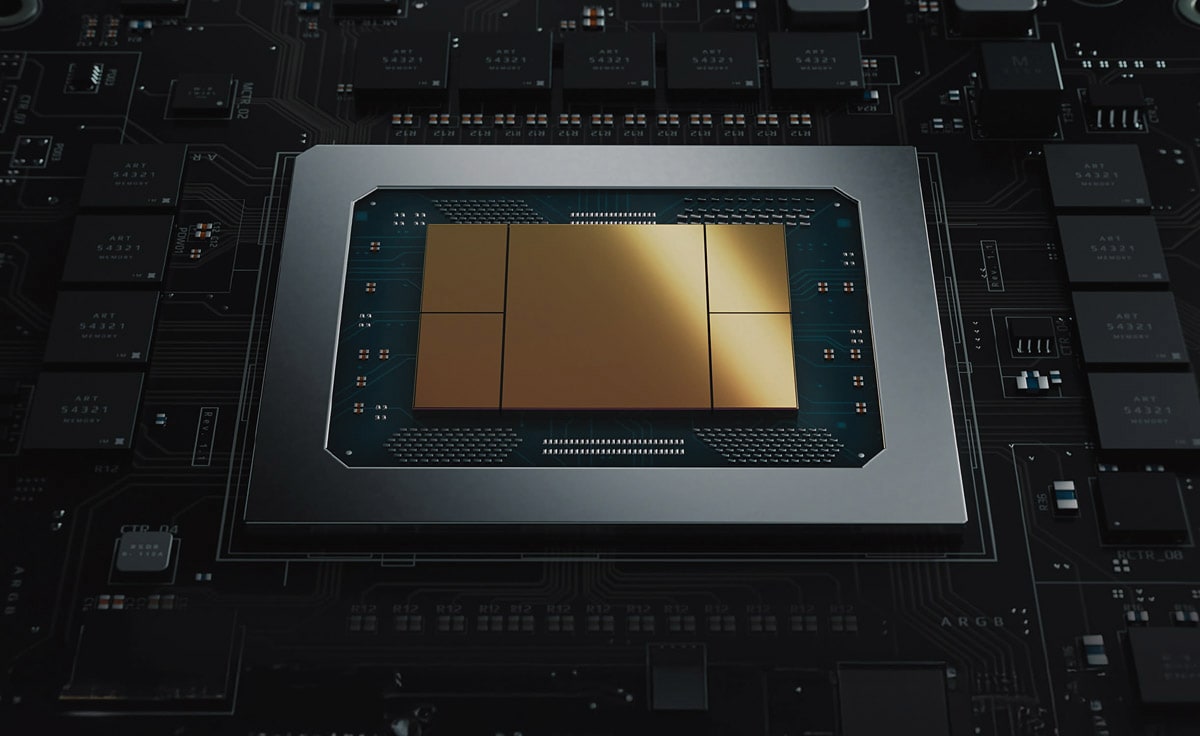
Modern warfare is defined as much by data dominance as by maneuver. From satellite-based intelligence, surveillance, and reconnaissance (ISR) platforms to dismounted soldiers’ handheld radios, operational success depends on the ability to move, process, and act on digital information in real time. Yet this dependence introduces a critical vulnerability: as the force becomes more data-centric, it becomes more susceptible to disconnection, jamming, and cyber denial.
In disconnected, intermittent, and limited (DIL) environments — where communications are degraded by terrain, adversarial interference, or limited infrastructure — traditional network architectures falter. Centralized command nodes and linear data pipelines cannot sustain the agility or resilience required at the tactical edge. The solution is a new design paradigm — one that integrates ruggedized hardware, edge computing, artificial intelligence (AI), and hybrid tactical-cloud architectures into a distributed, adaptive ecosystem.
This convergence is redefining command-and-control (C2) systems, enabling autonomous decision-making, real-time data fusion, and resilient connectivity across all domains — land, sea, air, space, and cyber — under any condition.
Evolving Demands of Tactical Communications
For decades, tactical communications relied on hierarchical, hub-and-spoke networks optimized for predictable connectivity and centralized authority. Today’s multi-domain operations (MDO) have flattened those hierarchies. Information must now flow laterally and dynamically between sensors, shooters, and decision-makers. A single brigade may operate hundreds of interconnected nodes — from unmanned systems to naval sensors — each producing mission-critical data.
This shift demands networks that are simultaneously high-performance, scalable, and resilient. Tactical systems must sustain operations while disconnected from higher-level infrastructure, self-recover from disruption, and adapt to variable bandwidth or electromagnetic conditions.
The emerging model is distributed, modular, and software-defined. Networking, computing, and analytics are merging into an intelligent, unified fabric. Software-defined radios (SDRs), adaptive routing, and AI-assisted data management enable self-healing and self-optimizing networks that preserve operational tempo in contested environments.
At the tactical edge, hardware must match mission complexity. Ruggedized computing systems now form the backbone of resilient edge networks, transforming forward-deployed nodes into autonomous micro-data centers.
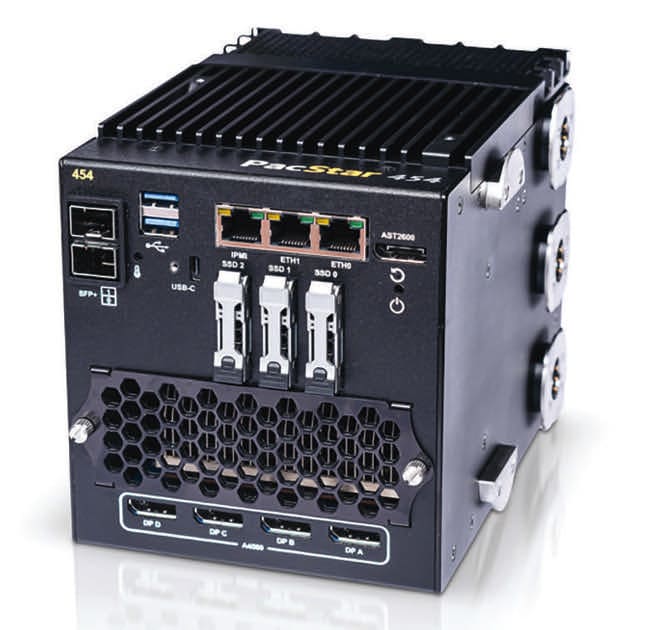
Unlike conventional servers, rugged systems are engineered to survive shock, vibration, dust, temperature extremes, and electromagnetic interference while maintaining deterministic performance. Deployed in armored vehicles, aircraft, ships, or mobile shelters, these systems perform on-site data collection, fusion, and analytics without constant backhaul to remote data centers.
Modern rugged platforms incorporate multi-core CPUs, FPGAs, and GPUs capable of executing AI inference workloads locally. This reduces latency, conserves bandwidth, and enables time-critical decision-making even when cloud access is disrupted. For instance, a forward AI node might ingest ISR feeds, run object-detection algorithms, and transmit only validated threat alerts to higher echelons —reducing data load while accelerating response time.
Ruggedization now extends beyond physical durability to include cyber and modular resilience. Systems must resist firmware tampering, support field-level upgrades, and comply with open standards such as C5ISR/EW Modular Open Suite of Standards (CMOSS) and Sensor Open Systems Architecture® (SOSA®). These frameworks ensure interoperability among vendors and coalition partners while enabling rapid technology refresh without full system redesign — vital for future-proofing defense networks.
Edge Computing: Bringing the Cloud Forward
Edge computing pushes the intelligence of the cloud closer to the fight. Rather than sending raw data to distant centers, edge architectures deploy compute, storage, and analytics in the tactical domain, delivering autonomy and faster decision cycles.
A modern military network uses a tiered compute model:
Tactical edge nodes perform initial filtering, AI inference, and sensor fusion
Local micro data centers aggregate and manage data across units
Strategic clouds conduct large-scale analytics, model training, and longterm storage
This hierarchy allows dynamic tasking. Time-critical data, such as targeting information, is processed locally, while bulk ISR data is compressed and sent to higher tiers when bandwidth allows. The result is a self-balancing compute ecosystem that sustains functionality even during intermittent connectivity.
Edge computing also introduces elasticity — processing that can extend into the cloud or retract into local clusters as mission conditions change — balancing autonomy, security, and performance in real time.
AI at the Tactical Edge
AI transforms data into decision advantage. At the tactical edge, AI augments human operators with real-time insight into complex, dynamic conditions.
AI-enabled analytics at the edge support:
Object and signal recognition – detecting vehicles, drones, or hostile emissions
Predictive maintenance – anticipating failures in vehicles or weapons
Dynamic spectrum management – detecting jamming and optimizing communications
Cognitive routing and bandwidth control – predicting link degradation and rerouting traffic
Deploying AI in DIL environments requires models that are lightweight, power-efficient, and secure. Advances in model compression, edge inference optimization, and federated learning enable AI operation on constrained hardware without exposing sensitive data. These techniques allow tactical AI to function reliably even when disconnected.
At the human level, AI supports human-machine teaming, automating data-intensive tasks and freeing commanders to focus on mission strategy, ethics, and decision-making.
Hybrid Tactical-Cloud Architectures: The Next Frontier
While edge computing provides local autonomy, enterprise-scale analytics and orchestration still reside in the cloud. The future lies in hybrid tactical-cloud architectures, where workloads shift fluidly between forward nodes and centralized infrastructure.
In this model, AI algorithms trained in the cloud deploy to the edge for inference, while field data flows back for retraining and synthesis. This creates a living, adaptive data ecosystem that evolves as operations unfold.
Hybrid architectures also enable mission partitioning, allowing sensitive data to remain local while aggregated or unclassified data flows across joint or coalition networks. The U.S. Department of War’s Joint All-Domain Command and Control (JADC2) initiative exemplifies this vision — connecting sensors, shooters, and decision-makers across all services through a unified, cloud-enabled fabric.
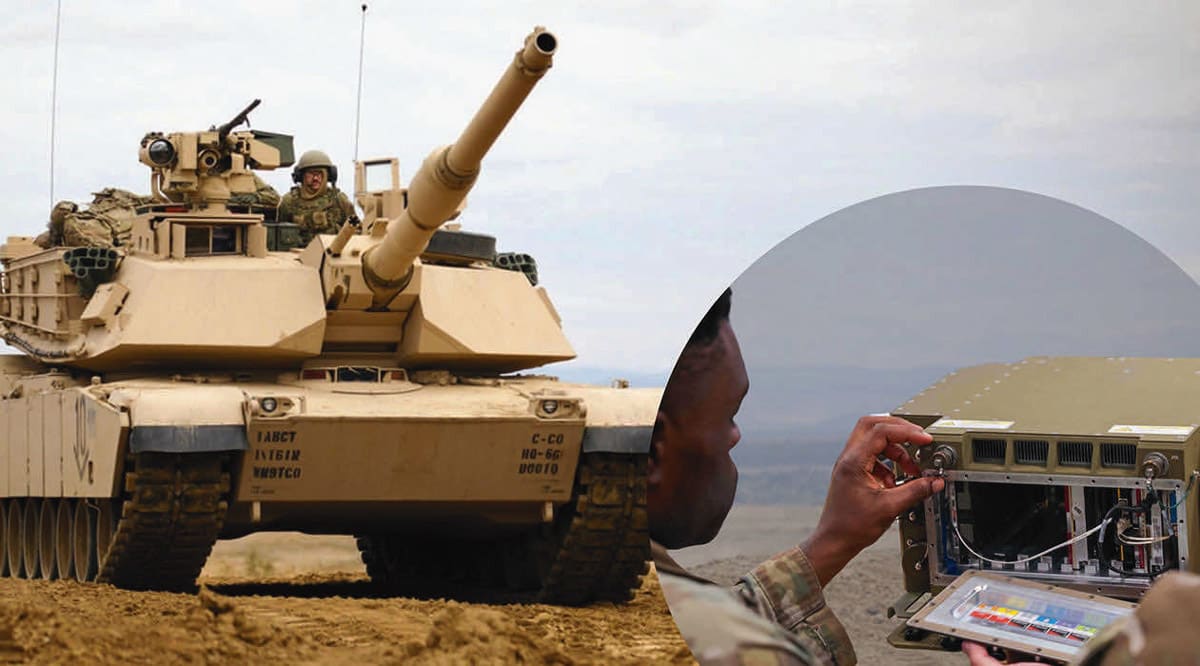
At the core of this approach are rugged edge devices and tactical clouds that operate independently yet integrate seamlessly when connectivity is restored.
As networks grow more interconnected, their attack surface expands. Cyber resilience must be built into every layer. Zero-trust architecture (ZTA) now forms the baseline posture, enforcing continuous authentication, access control, and data integrity across all nodes.
In coalition environments, data provenance and encryption at rest and in transit safeguard shared information. Technologies such as NSA Type 1 and CSfC-certified encryption, cross-domain solutions (CDS), and emerging quantum-resistant cryptography defend against interception and manipulation.
Physical survivability is equally essential. Edge systems must endure kinetic shock, electromagnetic pulse (EMP) exposure, and partial network degradation. Designing for graceful degradation—where partial functionality persists despite failure — ensures continuity of operations in extreme conditions.
The convergence of AI, edge computing, and resilient communications delivers real-time data fusion—integrating diverse sensor inputs into a unified operational picture. Commanders can correlate radar, imagery, and electronic emissions to predict adversary movement with high fidelity.
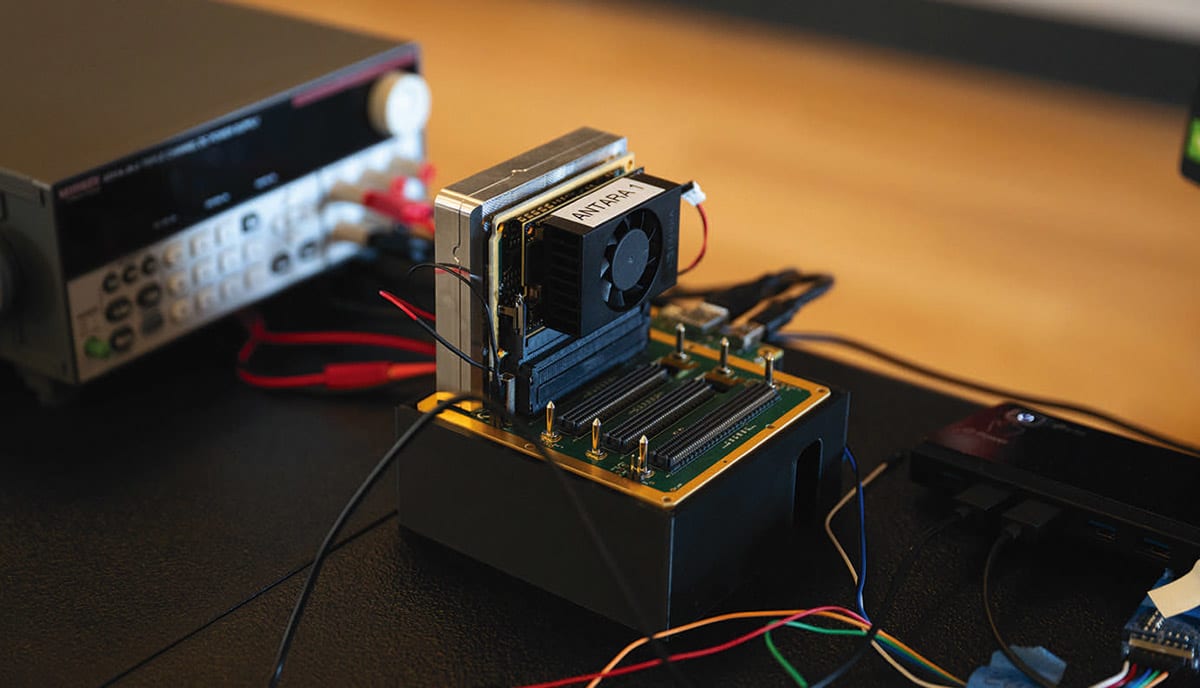
This integration compresses the observe–orient–decide–act (OODA) loop. Automated systems manage the data-heavy recognition and correlation tasks, enabling human operators to act faster and with greater precision. The result is decision superiority — the ability to outpace the adversary in both speed and accuracy.
Rather than replacing human judgment, AI amplifies it, providing predictive insight and situational clarity that strengthen human-machine collaboration.
Future-Proofing Through Open Standards and Modularity
To remain relevant through rapid technological change, defense systems must embrace open architecture and modularity. Standards such as NATO’s Federated Mission Networking (FMN) and the U.S. Army’s CMOSS/SOSA initiatives provide the framework for interoperability, scalability, and vendor neutrality.
Hardware modularity enables quick integration of new sensors, processors, and radios. At the software layer, containerization and DevSecOps support continuous updates, delivering new AI models, security policies, and analytics functions—even in austere environments.
This evolution transforms defense platforms into agile, adaptive ecosystems — essential in an era when threats and technologies evolve faster than traditional acquisition cycles.
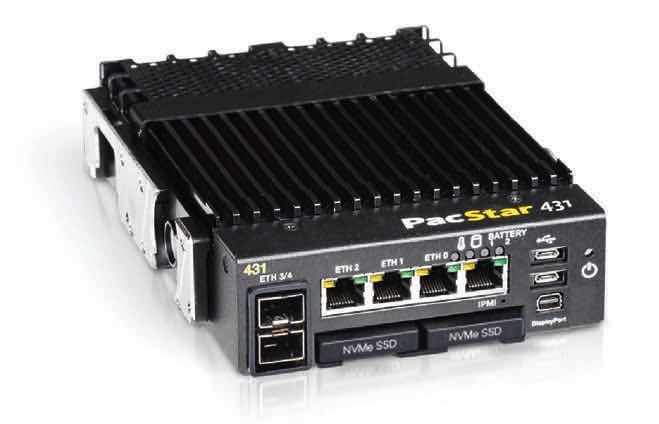
Within this landscape, Curtiss-Wright leads in rugged edge innovation. Curtiss-Wright develops SOSA- aligned OpenVPX plug-in cards (PICs), PacStar® small form factor (SFF) tactical communication modules, and mission-ready computing systems built for operations in DIL environments.
Conclusion: Toward the Cognitive Tactical Network
As the speed and complexity of warfare accelerate, connectivity, intelligence, and resilience have become inseparable. The future tactical network must be rugged, intelligent, and adaptive — merging cloud computational depth with edge autonomy and survivability.
Through the convergence of AI, edge processing, and hybrid architectures, forces can maintain C2 continuity and situational awareness even in contested conditions. Those who can connect, process, and act on information fastest — anywhere, anytime — will hold the decisive advantage.
In the emerging era of information warfare, the cognitive tactical network — a system that senses, learns, and adapts autonomously — will define victory. Future-proofing the tactical edge is not optional; it is the strategic imperative for achieving dominance across the multidomain battlespace of tomorrow.
This article was written by Mike Southworth, Senior Product Line Manager, Curtiss-Wright Defense Solutions (Ashburn, VA). For more information, visit here .
More From SAE Media Group
Aerospace & Defense Tech Briefs
New Products
Aerospace & Defense Tech Briefs
New Products
Aerospace & Defense Tech Briefs
New Products
Aerospace & Defense Tech Briefs
New Products
Aerospace & Defense Tech Briefs
New Products


Aerospace & Defense Tech Briefs
Deterministic and Modular Architecture for Embedded Vehicle Systems
Tech Briefs
Open Software Options for Automation
Aerospace & Defense Tech Briefs
New Products

Aerospace & Defense Tech Briefs
Adamant: A Soon-to-be Open Source, Mission-Critical Flight Software Framework Written in Ada
Photonics & Imaging Technology
Adding AI-Powered Inspection to Existing Machine Vision Systems

Aerospace & Defense Tech Briefs
New Products
NASA Spinoff
Software Accelerates Computing Time for Complex Math
Autonomous Vehicle Engineering
Making Data Logging, Replay, and Prototyping More Efficient
Aerospace & Defense Tech Briefs
Taking the Tactical Cloud with You Small Form Factor, Modular Data Centers at the Edge of the Battlefield
Autonomous Vehicle Engineering
Rewriting the Code
Tech Briefs
Streaming Software Speeds Apps

Automotive Engineering
New EEAs for the Connected, Autonomous Future
Electronics & Sensors INSIDER
This Chip Safeguards User Data While Enabling Efficient Computing on a Smartphone
Tech Briefs
How Much Do You Know About Cloud Computing?
Aerospace & Defense Tech Briefs
Embedded Processing Advancements Enable Smarter, SWAP-Optimized Avionics Displays and Computers
Aerospace & Defense Tech Briefs
A Supercomputer for Aerospace and Defense Systems Modeling and Simulation
Tech Briefs
Product of the Month
Software Tech Briefs
Cloud Computing for Science Data Processing in Support of Emergency Response
Aerospace & Defense Tech Briefs
Designing Transportable, High-Performance AI Systems for the Rugged Edge
Aerospace Manufacturing and Machining INSIDER
Army Launches CMOSS Prototyping Competition for Computer Chassis and Cards
Top Stories
INSIDERDefense
 New 3D-Printable Nanocomposite Prevents Overheating in Military Electronics
Technology ReportSoftware
 Talking SDVs and Zonal Architecture with TE Connectivity
NewsDesign
 2026 Nissan Sentra Review: Putting the Pieces Together
INSIDERDesign
 New Defense Department Program Seeks 300,000 Drones From Industry by 2027
INSIDERDefense
 Anduril Completes First Semi-Autonomous Flight of CCA Prototype
INSIDERDefense

Webcasts
Automotive
 SAE Automotive Podcast: Solid-State Batteries
Manufacturing & Prototyping
 SAE Automotive Engineering Podcast: Additive Manufacturing
Defense
 A New Approach to Manufacturing Machine Connectivity for the Air Force
Software
 Optimizing Production Processes with the Virtual Twin
Automotive
 EV and Battery Thermal Management Strategies
Aerospace
 How Packet Digital Is Scaling Domestic Drone Battery Manufacturing