




3D-Printing Trainer Drones and Munitions Leads to Cost Savings for Misawa Exercise
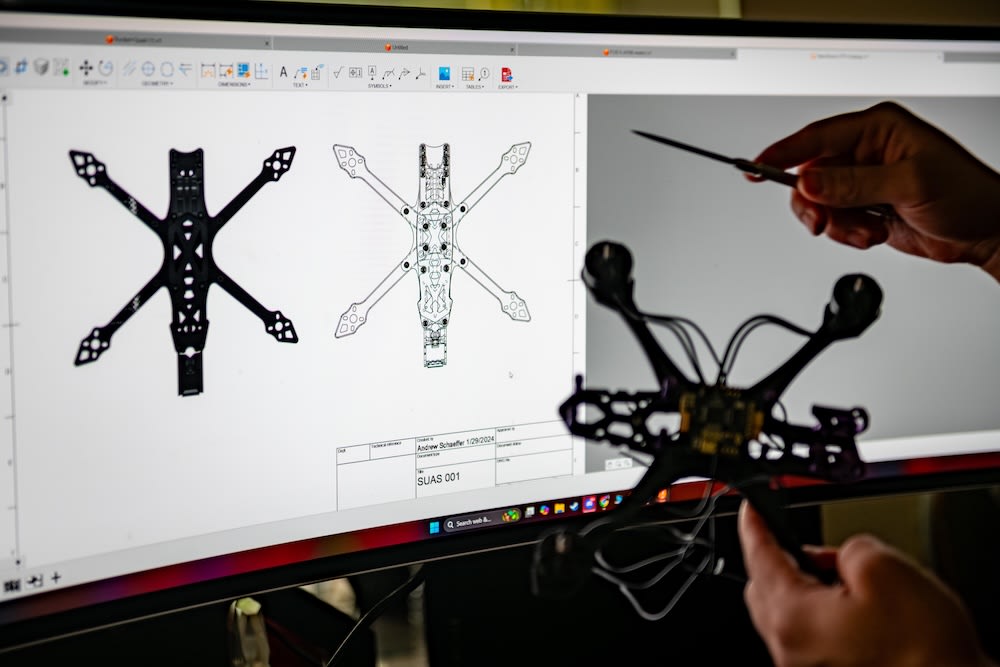
The Innovation Lab at Misawa Air Base in Japan is helping Explosive Ordnance Disposal (EOD) teams across the Indo-Pacific train smarter, faster and cheaper by providing custom 3D-printed training aids for exercise Operation Sentinel Samurai.
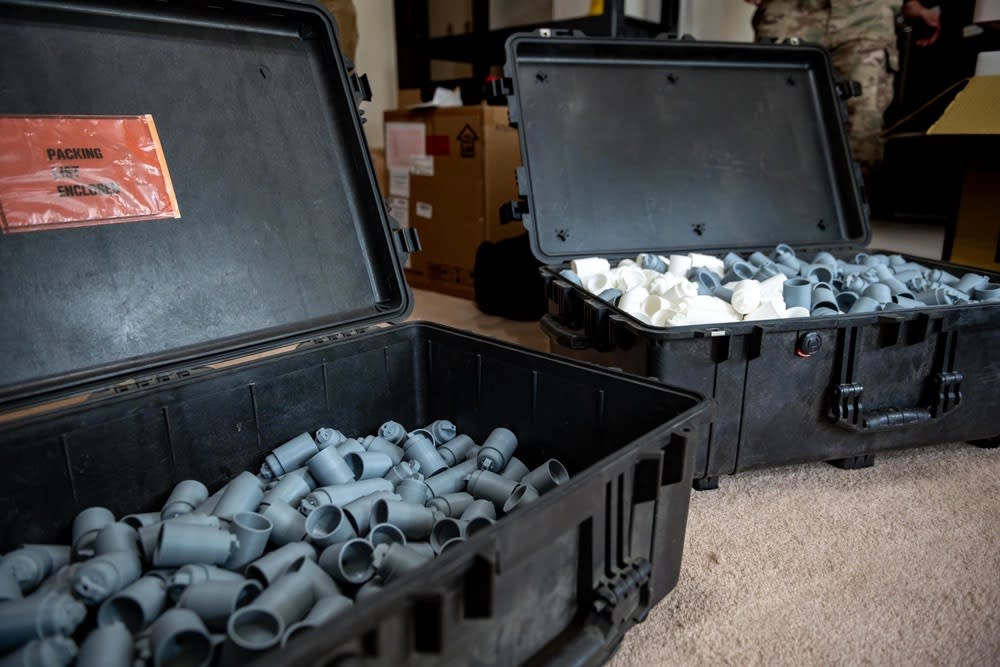
The trilateral exercise brings together EOD units from the U.S. Air Force, Marine Corps, Royal Australian Air Force and Polish Land Forces to sharpen their skills in identifying, handling and neutralizing explosive threats. To support the event, the Innovation Lab is printing 11 types of training aids, ranging from grenades to large munitions, designed to simulate real-world threats EOD teams might encounter. These tools will be used throughout the exercise to test how EOD technicians respond to explosive hazards and maintain airfield operations under pressure.
“Simply put, we couldn’t pull off an exercise of this scale without them,” said U.S. Air Force Master Sgt. Dale Janik, 35th Civil Engineer Squadron EOD logistics section chief. “They’ve printed around 1,500 unexploded ordnance training aids so far. That’s five times more than our current training aid inventory.”
The Innovation Lab delivers rapid, cost-efficient solutions that enhance training effectiveness and drive mission readiness across the 35th Fighter Wing. In one project, the team printed 1,000 grenade training aids for just $290, a 99.56 percent savings compared to the roughly $200,000 it would normally cost.
“The ability of the Air Force to rapidly prototype, test and go after new technology has been exciting,” said U.S. Air Force 1st Lt. Isaac Loring, lead Project Arc engineer assigned to the Innovation Lab. “We can create exactly what the unit needs, quickly and affordably, without relying on large, slow procurement processes.”
The lab also produces low-cost UAV shells for training, costing around $4 each compared to hundreds of dollars on the commercial market. For larger, more complex items, the lab designs unique versions in-house, giving EOD teams the ability to train with realistic, custom-built devices.
For larger, more complex items, the lab creates custom designs in-house, enabling EOD teams to train with highly realistic, mission-tailored devices. This approach allows rapid scaling of inventory when a design proves effective, minimizing cost and maximizing training value.
“I’m just excited to share this,” said Loring. “This really shows what the Innovation Lab can do. We’re here, and we’re ready to help however we can.”
Turning ideas into tools, the Innovation Lab is helping the 35th Fighter Wing keep its edge by improving readiness, building partnerships and preparing Airmen to win in any environment. Through efforts like exercise Operation Sentinel Samurai, the lab continues to deliver innovative, mission-focused solutions that enhance joint capabilities and strengthen the Indo-Pacific defense posture.
More From SAE Media Group
Aerospace INSIDER
New Drones and Software Selected for DoD's Replicator 1.2

Aerospace Manufacturing and Machining INSIDER
A New AI-Piloted VTOL Fighter Jet for Contested Environments
Aerospace INSIDER
Four Companies to Design Air Force Enterprise Test Drone Prototypes


Aerospace Manufacturing and Machining INSIDER
Army Seeks to Expand 3D Printing to the Tactical Edge
Aerospace INSIDER
Boeing to Develop Two New E-7 Variants for US Air Force
Aerospace Manufacturing and Machining INSIDER
Counter UAS Systems Tested Against Swarms of 50 Drones in Latest Yuma Exercise
Aerospace & Defense Tech Briefs
Airfield Matting System
Aerospace INSIDER
Two Startups Partner to Expand Hydrogen-Powered Drone Production
Aerospace Manufacturing and Machining INSIDER
3D Printing in Combat Zones: A Paradigm Shift for Marine Corps Logistics
Aerospace INSIDER
Anduril Completes First Semi-Autonomous Flight of CCA Prototype

Aerospace INSIDER
MQ-9 Reapers Demonstrate New Capabilities
Defense INSIDER
JPADS Brings New Sustainment Capability to Future Fight

Aerospace INSIDER
Air Force Researchers Design, Build and Fly Drone in 24 Hours
Aerospace INSIDER
Bombardier to Start Building New Army HADES Prototype Spy Plane
Aerospace & Defense Tech Briefs
Lasers Destroy Drones as Additive Manufacturing Builds Them


Aerospace INSIDER
Air Force Performs First Test of Microwave Counter Drone Weapon THOR
Aerospace INSIDER
F-22 Pilot Controls Drone With Tablet
Defense INSIDER
Japanese Army to Test First Unmanned Ground Vehicles
Defense INSIDER
In-Flight 3D Printing of Drone Parts on a Black Hawk Helicopter
Aerospace INSIDER
First F-15Es Equipped With EPAWSS Ready for Flight
Aerospace INSIDER
New UK Drone Strategy to Invest Billions in Unmanned Systems
Top Stories
NewsSensors/Data Acquisition
 Microvision Aquires Luminar, Plans Relationship Restoration, Multi-industry Push
INSIDERRF & Microwave Electronics
 A Next Generation Helmet System for Navy Pilots
INSIDERWeapons Systems
 New Raytheon and Lockheed Martin Agreements Expand Missile Defense Production
NewsAutomotive
 Ford Announces 48-Volt Architecture for Future Electric Truck
INSIDERAerospace
 Active Strake System Cuts Cruise Drag, Boosts Flight Efficiency
ArticlesTransportation

Webcasts
Aerospace
 Cooling a New Generation of Aerospace and Defense Embedded...
Energy
 Battery Abuse Testing: Pushing to Failure
Power
 A FREE Two-Day Event Dedicated to Connected Mobility
Automotive
 Quiet, Please: NVH Improvement Opportunities in the Early Design Cycle
Electronics & Computers
 Advantages of Smart Power Distribution Unit Design for Automotive &...
Unmanned Systems
 Sesame Solar's Nanogrid Tech Promises Major Gains in Drone Endurance