




Effects of High-Power Microwave Pulses on Electronic Systems
This research can be applied to designing electronic circuits to be less vulnerable to damage from radiation.
A five-year program comprising several coordinated research efforts was devoted to increasing understanding and developing capabilities for computational modeling of the effects of high-power microwave (HPM) radiation upon electronic circuits and upon systems that comprise or include electronic circuits. The HPM radiation of primary interest in
this program included both narrow-band and ultra-wide-band (UWB) pulsed radiation. Whether aimed at electronic equipment deliberately or inadvertently, either type of radiation can, potentially, cause damage and/or adversely affect operation. The knowledge gained from this program can help in designing future electronic circuits and systems to be less vulnerable to damage and disruption by incident HPM/UWB radiation.
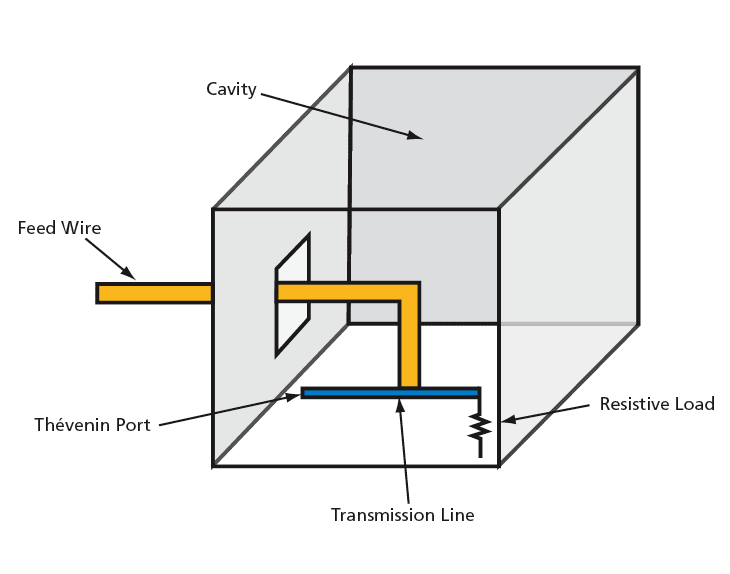
Key to the technical approach followed in this research is the concept of electromagnetic topology, according to which the problem of modeling a complex electromagnetic system is subdivided into smaller pieces that can be analyzed separately with high accuracy and efficiency. Each piece is treated as an N-port (where N is an integer) network and represented by a generalized scattering matrix. The electromagnetic coupling of all the pieces is modeled through the cascade of all the scattering matrices.
The major contributions of
this program include the following:
- Capabilities for computational simulation of penetration and coupling of HPM/UWB radiation from exterior or interior sources into electronic systems and into structures that contain such systems were developed and were applied in sample problems. Examples of such structures include aircraft, ground vehicles, and equipment boxes with cracks, doors, and/or other apertures that may accommodate wires and/or antennas (see figure). Exterior and interior features of systems and of apertures through which electromagnetic radiation penetrates systems are taken into account. Following the electromagnetic-topology approach, a system is divided into many sub-systems (pieces), each of which can be analyzed thoroughly by any of several computer programs that solve the applicable electromagnetic-field equations by, variously, a frequency- domain integral-equation moment method, a hybrid finite-element method, or a time-domain integral-equation method.
- Computer programs for simulating nonlinear and linear transient responses of digital circuits to penetrating HPM/UWB signals were developed. One of these programs is a network-oriented nonlinear- transient simulator based on a model that goes beyond the model embodied in the now-traditional Simulation Program with Integrated Circuit Emphasis (SPICE) general-purpose analog-integrated-circuit- simulating software. This program accounts for the distributed electromagnetic nature of coupling paths, and of components having sizes that are significant fractions of wavelengths, while fully accommodating both small-signal and large signal models of nonlinear electronics. Another program implements electrical- circuit models for coupling paths to be used in the nonlinear-transient simulator. A third program affords an electromagnetic- modeling capability for converting the radiated and conducted electromagnetic interference signals into a set of noise sources to be used in the nonlinear-transient simulator. An important feature of this development is separation of the electromagnetic-field analysis from the nonlinear-circuit analysis, with the understanding that the dimensions of electronically nonlinear components are much smaller than the smallest wavelengths of electromagnetic interference.
- Analyses of responses of selected digital circuits and systems to incident HPM/UWB signals, by means of nonlinear transient simulations, were performed in an effort to gain high-level understanding of the effects of HPM/UWB signals on the behaviors of such circuits and systems. Effects of interest included alterations of components of the circuits and alterations of digital logic states (bit errors). SPICE and the nonlinear- transient-simulating programs described above were used in these analyses.
- In recognition of the approximate nature of computational simulations, an effort was devoted to development of capabilities and methods for validation of the various models and simulation capabilities summarized above. This included efforts to develop theoretical, experimental, and computational capabilities for assessing the accuracy of numerical data from selected subsets of pieces of computationally modeled systems. The fruits of this effort include several exact solutions for penetration of signals into, and radiation and scattering of signals from, bodies having simple shapes.
This work was done by Piergiorgio L. E. Uslenghi, Erricolo, Danilo, Hung Yu David Yang, and Shantanu Dutt of the University of Illinois at Chicago; Michael A. Bridgwood, Chalmers M. Butler, Anthony Q. Martin, and Frederick M. Tesche of Clemson University; Donald R. Wilton and David R. Jackson of the University of Houston; John L. Volakis of Ohio State University; Andreas C. Cangellaris of the University of Illinois at Urbana Champaign; and Pinaki Mazumder, Eric Michielssen, and V. V. Liepa of the University of Michigan for the Air Force Office of Scientific Research.
AFRL-0094
This Brief includes a Technical Support Package (TSP).
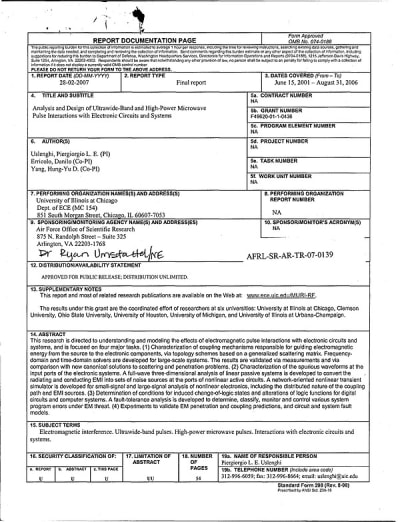
Effects of High-Power Microwave Pulses on Electronic Systems
(reference AFRL-0094) is currently available for download from the TSP library.
Don't have an account?
More From SAE Media Group

Aerospace & Defense Tech Briefs
Memory-Based, Structured, Application-Specific Integrated Circuit (ASIC)
Tech Briefs
Wireless, Wearable Transmitter
Tech Briefs
Small X-Band Oscillator Antennas
Aerospace & Defense Tech Briefs
Low-Power Circuit for an Electromagnetic Warning System Sensor
Tech Briefs
A Two-in-One Storage and Computing Device
Aerospace & Defense Tech Briefs
Reflected Signal Analysis
Tech Briefs
Hardware-Command-Decoding ASIC
Tech Briefs
Digital Receiver for Microwave Radiometry
Electronics & Sensors INSIDER
New Transmitter Could Make Wireless Devices More Energy-Efficient
Tech Briefs
Rad-Hard CMOS Crystal Oscillator


Embedded Computing INSIDER
Fast, Stretchy Circuits Could Yield New Wearable Electronics
Tech Briefs
Multimode Broad-Band Patch Antennas
Aerospace & Defense Tech Briefs
Progress in Canted Sector Antennas and Non-Periodic Arrays

Tech Briefs
Shaper Design in CMOS for High Dynamic Range
Tech Briefs
Submillimeter-Wave Image Sensor
Aerospace & Defense Tech Briefs
Software-Defined Analog Filters: A Paradigm Shift in Radio Filter Performance and Capability

Aerospace & Defense Tech Briefs
Reconfigurable Electronics and Non-Volatile Memory Research
Aerospace & Defense Tech Briefs
Benefits and Challenges of Direct-RF Sampling for Avionic Platforms


Embedded Technology INSIDER
Newly Discovered Property Could Help Keep Computer Chips Cool
Overview
The document is a final report detailing research conducted under a grant focused on understanding and modeling the effects of electromagnetic pulse (EMP) interactions with electronic circuits and systems. The research involved a collaborative effort from six universities: University at Illinois at Chicago, Clemson University, Ohio State University, University of Houston, University of Michigan, and University of Illinois at Urbana-Champaign. The project spanned from June 15, 2001, to August 31, 2006.
The research is structured around four major tasks. The first task involves characterizing the coupling mechanisms that guide electromagnetic energy from sources to electronic components. This includes developing frequency-domain and time-domain solvers for large-scale systems, validated through measurements and comparisons with canonical solutions to scattering and penetration problems.
The second task focuses on characterizing spurious waveforms at the input ports of electronic systems. A full-wave three-dimensional analysis of linear passive systems is developed to convert radiating and conducting electromagnetic interference (EMI) into noise sources affecting nonlinear active circuits. A network-oriented nonlinear transient simulator is also created for analyzing both small-signal and large-signal behaviors of nonlinear electronics, considering the distributed nature of coupling paths and EMI sources.
The third task aims to determine conditions for induced changes in logic states and alterations of logic functions in digital circuits and computer systems. This includes a fault-tolerance analysis to classify, monitor, and control various program errors under electromagnetic threats.
The fourth task consists of experiments to validate predictions regarding electromagnetic penetration and coupling, as well as circuit and system fault models. The report highlights significant progress made over the past 30 years in understanding and mitigating the effects of nuclear electromagnetic pulse (NEMP) fields on electrical systems, including the development of guidelines for protection methods and designs for hardening systems against such threats.
The document also notes the publication of 238 research papers, including technical reports and journal articles, and the completion of an advanced graduate course on electromagnetic compatibility (EMC) and EMI. A total of 47 students received MS and PhD degrees related to the project, showcasing its impact on education and research in the field. Overall, the report emphasizes the importance of addressing the challenges posed by ultrawide-band and high-power microwave sources in modern electronic systems.
Top Stories
INSIDERDefense
 New Raytheon and Lockheed Martin Agreements Expand Missile Defense Production
NewsAutomotive
 Ford Announces 48-Volt Architecture for Future Electric Truck
INSIDERManufacturing & Prototyping
 Active Strake System Cuts Cruise Drag, Boosts Flight Efficiency
ArticlesTransportation
 Accelerating Down the Road to Autonomy
INSIDERMaterials
 How Airbus is Using w-DED to 3D Print Larger Titanium Airplane Parts
Road ReadyTransportation

Webcasts
Electronics & Computers
 Cooling a New Generation of Aerospace and Defense Embedded...
Power
 Battery Abuse Testing: Pushing to Failure
Connectivity
 A FREE Two-Day Event Dedicated to Connected Mobility
Automotive
 Quiet, Please: NVH Improvement Opportunities in the Early Design Cycle
Transportation
 Advantages of Smart Power Distribution Unit Design for Automotive &...
Aerospace
 Sesame Solar's Nanogrid Tech Promises Major Gains in Drone Endurance