




11 Companies to Develop New Space Exploration 'Tipping Point' Technologies
A total of 11 U.S.-based companies will develop new technologies ranging from lunar surface power systems to tools for in-space 3D printing under NASA's sixth annual "Tipping Point" research initiative. Tipping Point is an annual research initiative lead by NASA’s Space Technology Mission Directorate (STMD) to benefit future NASA missions.
"A technology is considered at a tipping point if an investment in a demonstration will significantly mature the technology, increase the likelihood of infusion into a commercial space application, and bring the technology to market for both government and commercial applications," according to NASA STMD's description of the initiative. Last year, NASA began funding Tipping Point proposals as Space Act Agreements.
The selected technologies support infrastructure and capabilities in space and at the Moon. The companies selected for this year's Tipping Point opportunities, their projects, and the approximate value of NASA’s contribution to them are listed below:
Astrobotic Technology of Pittsburgh, $34.6 million
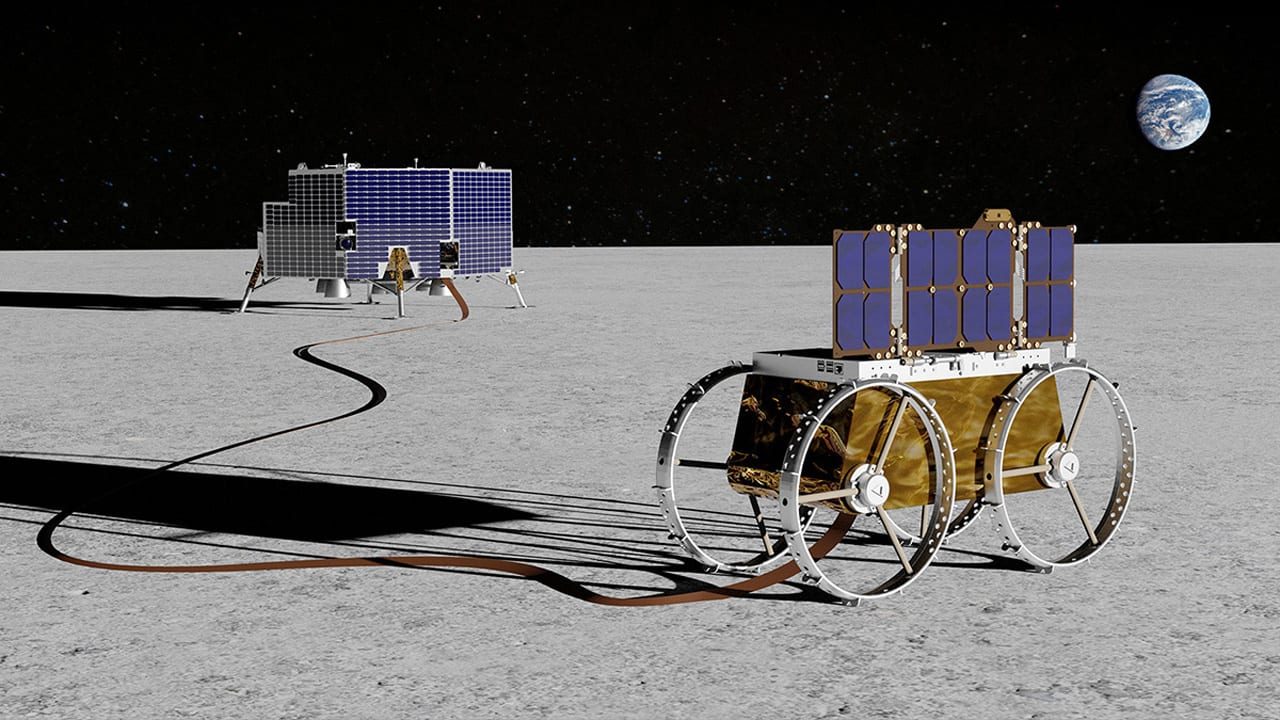
Astrobotic will demonstrate the robotic deployment of one kilometer of cable and power transmission through that cable across the lunar surface. A CubeRover delivered by Astrobotic’s Griffin lander will deploy the power line. The demonstration will advance power generation and distribution technologies, including – a high-voltage power converter, cable, and cable reel system.
Big Metal Additive of Denver, $5.4 million
The company will advance materials, manufacturing processes, equipment, and facilities for metal hybrid additive manufacturing. The project aims to increase technology readiness and reduce lead time, material waste, and cost to enable a range of structural products, including space habitats.
Blue Origin of Kent, Washington, $34.7 million
The company will advance an end-to-end in-situ resource utilization (ISRU) system that can extract oxygen, iron, silicon, and aluminum from lunar regolith simulant and use the extracted materials to produce solar cells and wire.
Freedom Photonics of Santa Barbara, California, $1.6 million
Freedom Photonics will develop a novel direct diode laser sour that could enable more efficient lidar systems. The system could better detect methane in Earth’s atmosphere and improve scientists’ understanding of climate change.
Lockheed Martin of Littleton, Colorado, $9.1 million
The company will demonstrate in-space component joining and inspection technologies for structural, electrical, and fluid systems. The capability would reduce risk and advance the maturity and reliability of in-space assembly architectures.
Redwire of Jacksonville, Florida, $12.9 million
The company will develop a grader, compactor, and microwave emitter into a scalable platform that removes rocks, compacts loose regolith, and melts or sinters regolith into a solid surface. This technology could enable dust mitigation areas, habitat foundations, roads, and landing pads.
Protoinnovations of Pittsburgh, Pennsylvania $6.2 million
Protoinnovations will advance modular, flight-ready mobility control software for future lunar rovers and robots.
Psionic of Hampton, Virginia, $3.2 million
Partnering with Draper Laboratory in Cambridge, Massachusetts, Psionic will conduct a flight demonstration of its latest generation Navigation Doppler Lidar and terrain contour matching system. Crewed and robotic missions could utilize the high-precision navigation system to land at various planetary destinations, including the Moon.
United Launch Alliance (ULA) of Centennial, Colorado, $25 million
The company will continue to evolve a proven Hypersonic Inflatable Aerodynamic Decelerator (HIAD) technology design. ULA will develop a larger 10-meter HIAD that leverages a two-piece structure to enable effective load distribution for even larger inflatable decelerators.
Varda Space Industries of El Segundo, California, $1.9 million
Varda will mature Conformal Phenolic Impregnated Carbon Ablator (C-PICA), a cost-effective and mass-efficient thermal protection system material developed by NASA. The project will flight test C-PICA and start commercial production of the material.
Zeno Power Systems of Washington, D.C., $15 million
The company will develop a Stirling engine-enabled radioisotope power system that utilizes a long-lived, thermally constant heat source – Americium 241. This technology could be used for space and surface power systems, offering an alternative to plutonium-based power systems.
"Our partnerships with industry could be a cornerstone of humanity's return to the Moon under Artemis," said Dr. Prasun Desai, Acting Associate Administrator for STMD at NASA. "By creating new opportunities for streamlined awards, we hope to push crucial technologies over the finish line so they can be used in future missions. These innovative partnerships will help advance capabilities that will enable sustainable exploration on the Moon."
More From SAE Media Group

Aerospace INSIDER
Assembly and Testing Milestone for Artemis II Spacecraft
Aerospace & Defense Tech Briefs
NASA Demonstrates a First-of-Its-Kind Space Communications


Aerospace INSIDER
NASA Seeks Space Technologies for Suborbital and Orbital Flight Tests
Tech Briefs
A Next-Generation Space Suit for Artemis III
Aerospace INSIDER
Blue Ghost Arrives in Lunar Orbit, Prepares for Landing
Aerospace INSIDER
Boeing's New Approach to 3D Printing Solar Arrays for Satellites

Tech Briefs
A Turning Point in Space Exploration

Aerospace INSIDER
ESA’s Future Low Earth Orbit Cargo Return Service Spacecraft
Aerospace INSIDER
Three Companies to Build New Multi-Orbit Logistics Prototype Spacecraft
Aerospace INSIDER
Blue Origin Rocket Reaches Intended Orbit on First Launch

Aerospace & Defense Tech Briefs
Blue Origin Tests Gravity-Independent Fuel Cells for Lunar Lander Program

Aerospace INSIDER
Airbus Demonstrates Very High-Speed Optical Link Between Space and Earth
Aerospace & Defense Tech Briefs
Pushing the Boundaries of Rapid Production of Spacecraft: Flight Results from NearSpace Launch’s TROOP and ThinSat Platforms
Aerospace Manufacturing and Machining INSIDER
Ball Aerospace Starts Final Assembly of Space Force's Next Generation Operational Weather Satellite
Tech Briefs
Lunar Landing Pads

Aerospace & Defense Tech Briefs
What Does NASA Do with a Space Station Originally Developed for a Now-Cancelled Mission?
Tech Briefs
Robotic Arm Will Head to the Moon

Top Stories
INSIDERDefense
 New Raytheon and Lockheed Martin Agreements Expand Missile Defense Production
NewsAutomotive
 Ford Announces 48-Volt Architecture for Future Electric Truck
INSIDERManufacturing & Prototyping
 Active Strake System Cuts Cruise Drag, Boosts Flight Efficiency
ArticlesTransportation
 Accelerating Down the Road to Autonomy
INSIDERMaterials
 How Airbus is Using w-DED to 3D Print Larger Titanium Airplane Parts
Road ReadyTransportation

Webcasts
Electronics & Computers
 Cooling a New Generation of Aerospace and Defense Embedded...
Power
 Battery Abuse Testing: Pushing to Failure
Connectivity
 A FREE Two-Day Event Dedicated to Connected Mobility
Automotive
 Quiet, Please: NVH Improvement Opportunities in the Early Design Cycle
Transportation
 Advantages of Smart Power Distribution Unit Design for Automotive &...
Aerospace
 Sesame Solar's Nanogrid Tech Promises Major Gains in Drone Endurance