




Thermal Design and Analysis of a Rocket-Engine TAN Injector
Predicted and measured temperature rises were found to be in approximate agreement.
A subscale thrust-augmented-nozzle (TAN) rocket engine was designed, built, and hot-fire tested to demonstrate the validity of the TAN concept. As described in more detail in the immediately preceding article, in a TAN, during operation at sea level, thrust is augmented through injection and burning of secondary propellants (a fuel and an oxidizer) within the nozzle, downstream of the nozzle throat. The secondary propellants can be the same as, or different from, the primary propellants (the fuel and oxidizer burned during operation, in a near vacuum, in the absence of thrust augmentation).
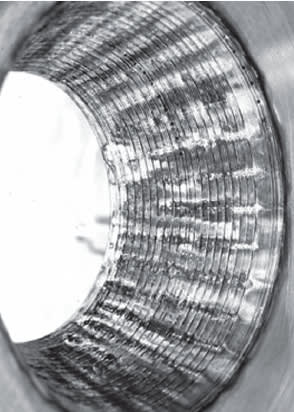
In this demonstration effort, emphasis was placed on the design and analysis of the TAN injector, which is a cooled nozzle section, downstream of the throat, through which the secondary propellants are injected. The issues involved in designing the TAN injector are similar to those involved in designing conventional primary propellant injectors, with additional design challenge posed by the flow of combustion products over the TAN injector.
The subscale engine was designed to burn gaseous hydrogen and gaseous oxygen as the primary propellants and RP-1 (essentially, kerosene) and liquid oxygen (LOX) as the secondary propellants. The TAN injector was designed and built following a platelet approach, according to which flow passages are etched into thin metal sheets, which are then bonded together to form a monolithic structure. In addition to passages for RP-1 and LOX, the TAN injector contained passages that were parts of a water cooling circuit used during main (primary)- injector operation without TAN propellant flow. A water-cooled nozzle was attached downstream of the TAN injector to enable acquisition of performance data at an area ratio more representative of that of a launch rocket engine.
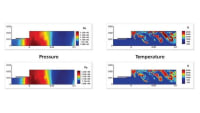
A thermal model of the TAN, implemented by use of commercial finite-element software, was used to perform a thermal analysis to determine whether the water cooling circuit afforded adequate cooling margin to ensure the thermal integrity of the TAN injector. Another thermal analysis was conducted to ensure that the RP-1-propellant-injection circuit maintained a wall temperature below its design coking-temperature limit. Temperature predictions were made to enable evaluation of pressure and of cycle life of the TAN injector structure based on low cycle fatigue criteria. The gas-side boundary conditions for the thermal analysis were based on a combination of test data and results of computational fluid dynamics simulations. The coolant-side boundary conditions were based on conventional correlations for the secondary propellants.
The subscale TAN rocket engine was subjected to a total of 28 tests at various combinations of operational parameters that included the main chamber pressure, propellant mixture ratios, and relative flow rates of the TAN (secondary) and main (primary) propellants. The TAN injector was found to be in excellent condition after the tests (see figure). Thermal data gathered during the tests consisted primarily of heat-load data for the main chamber, the TAN injector, and the portions of the nozzle other than the TAN injector. The calculated water flow rate for each component was based on data from a pre-hot-fire water-flow test of that component.
The bulk temperature rise of each component was calculated from readings of thermocouples located at the coolant inlet and outlet of the component. The bulk temperature rises of the water coolant for the main chamber (the chamber wherein the primary propellants are burned, upstream of the nozzle throat) were found to be fairly close to pre-test-predicted values because the main injector had been previously characterized. TAN operation was found to exert only a minimal effect on the main chamber. The heat load in the TAN injector and the non-tan-injector parts of the nozzle was found to be as much as 40 percent higher during TAN operation than during non-TAN operation. The increases in heat loads associated with TAN operation were found to depend on such parameters as the ratio of TAN flow to main-chamber flow and the main-chamber mixture ratio.
This work was done by Fred A. Ferrante and Felix F. Chen of GenCorp Aerojet for the Air Force Research Laboratory. For further information, download the free white paper at www.defensetechbriefs.com under the Mechanics/Machinery category. AFRL-0010
This Brief includes a Technical Support Package (TSP).
Thermal Design and Analysis of a Rocket-Engine TAN Injector
(reference AFRL-0010) is currently available for download from the TSP library.
Don't have an account?
More From SAE Media Group
Aerospace & Defense Tech Briefs
Variable-Thrust, Multiple-Start Hybrid Motor Solutions
Aerospace & Defense Tech Briefs
Thrust-Augmented Nozzles for Rocket Engines


Aerospace & Defense Tech Briefs
Rotating Detonation-Wave Engines
Tech Briefs
Hybrisol Rocket Engines



Off-Highway Engineering
Garrett Two-Stage Turbos Ramp up Off-Highway
Aerospace & Defense Tech Briefs
SAE International Extends Call for Abstracts, Seeks Submissions for AeroTech Conference
Motion Control Technology
Exhaust Nozzle for a Multitube Detonative Combustion Engine
Tech Briefs
Self-Adjusting Liquid Injectors for Combustors

Automotive Engineering
Extending a Wankel Future on Hydrogen Fuel
Off-Highway Engineering
Cummins’ X15 Is a Model of Design Efficiency
Off-Highway Engineering
In Pursuit of a Dedicated Hydrogen ICE for Heavy-Duty Vehicles
Tech Briefs
UCF’s Hypersonic Technology Advances

Tech Briefs
Process Enables Machines to Thermally “Breathe”
Aerospace & Defense Tech Briefs
Sensing for Controls and Propulsion Health Management in Turbine Engines
Aerospace & Defense Tech Briefs
Zwick Roell Provides Flexible Materials Testing over a Wide Temperature Range
Tech Briefs
Using 3D Printing to Strengthen Jet Engines

Sensor Technology
Sensing Hazardous Gases Can Save Lives
Tech Briefs
Servo Motors Help Launch Vehicles Optimize Fuel

Off-Highway Engineering
Cummins Spools up New Turbo Tech
Overview
The document presents a technical paper on the Thermal Design and Analysis of the Thrust Augmented Nozzle (TAN) Injector, a novel rocket engine design concept developed by Aerojet. The TAN concept aims to enhance rocket performance by combusting a portion of the propellant flow within the nozzle section, which allows for higher thrust at takeoff and optimizes the nozzle design to avoid flow separation under sea level conditions.
The TAN injector is a cooled nozzle section located downstream of the throat, where additional propellants are injected and combusted to generate extra thrust. This design introduces unique challenges, as it must manage the combustion products flowing over the injector while maintaining thermal integrity. The paper details the thermal analysis conducted to ensure the TAN injector's performance and safety, particularly focusing on the cooling systems employed.
The propellant combination used in the subscale demonstration was Liquid Oxygen (LOX) and RP-1, a refined form of kerosene. The TAN injector features a water cooling circuit that operates during main injector operation, even without TAN propellant flow. This cooling system is critical to prevent overheating and potential damage due to film boiling, which could occur if the heat flux exceeds critical limits. The document emphasizes Aerojet's extensive experience in designing water-cooled devices for high heat flux environments, ensuring the TAN injector's reliability.
The test hardware includes four major components: the main injector, main combustion chamber, TAN injector, and a cooled nozzle extension. The main combustion chamber is designed with a gun-drilled, water-cooled copper structure, while the TAN injector incorporates advanced platelet technology to achieve its intricate design. The paper also discusses the thermal design process, including the derivation of gas side boundary conditions based on test data and Computational Fluid Dynamics (CFD) analysis.
Overall, the paper provides insights into the innovative TAN injector design, its thermal management strategies, and the results of the subscale hot fire tests. The findings contribute to the understanding of advanced rocket propulsion systems and highlight the potential for improved performance in future rocket engine applications. The research was presented at the 42nd AIAA/ASME/SAE/ASEE Joint Propulsion Conference in July 2006, showcasing its relevance to ongoing advancements in aerospace technology.
Top Stories
INSIDERDesign
 How Airbus is Using w-DED to 3D Print Larger Titanium Airplane Parts
NewsAutomotive
 Microvision Aquires Luminar, Plans Relationship Restoration, Multi-industry Push
INSIDERRF & Microwave Electronics
 A Next Generation Helmet System for Navy Pilots
ArticlesDesign
 CES 2026: Bosch is Ready to Bring AI to Your (Likely ICE-powered) Vehicle
Road ReadyAutomotive
 2026 Nissan Sentra Review: Putting the Pieces Together
NewsUnmanned Systems

Webcasts
Power
 Hydrogen Engines Are Heating Up for Heavy Duty
Electronics & Computers
 Advantages of Smart Power Distribution Unit Design for Automotive...
Transportation
 Quiet, Please: NVH Improvement Opportunities in the Early Design...
Energy
 Battery Abuse Testing: Pushing to Failure
Connectivity
 A FREE Two-Day Event Dedicated to Connected Mobility
Aerospace
 SiPhog Technology: Enabling GPS‑Independent Flight for Uncrewed Aerial...