




Variable-Thrust, Multiple-Start Hybrid Motor Solutions
Hybrid propulsion devices are much less sensitive to adverse situations including exposure to external fires, bullet/fragment impact, electrostatic discharge, and inadvertent drop/impacts.
Interceptor boost propulsion has traditionally been dominated by solid rocket systems due to their responsiveness and high mass fraction capabilities. However, increased costs of handling these flammable motors, the need to evolve more and more insensitive munitions, the static thrust profile created at propellant casting, and the inherent performance limitations of solid propellants have motivated the interest in exploring alternate technologies.

The objectives of this work were to assess throttling capabilities and novel fuel concepts for hybrid motors. Experimental studies were conducted using 90% hydrogen peroxide (HP) with a variety of unique fuels in both direct injection and catalytic bed injection approaches. Performance efficiencies ranged from 91% to 100%, and the combustion in all tests was smooth with the highest level of combustion roughness reaching only 0.6% of the steady-state pressure.
These hybrid motor tests also displayed the expected connection between the oxidizer flux level and the time required to ignite the fuel grain, with higher flux levels resulting in lower ignition delays. Substantial throttling capabilities were demonstrated. Throttle-down tests analogous to a powered vertical landing exhibited a 10:1 throttling ratio with stable combustion across the entire range.
Boost/Sustain/Boost thrust profiles representative of tactical solid rocket motors were tested with 75%, 50%, and lower sustain-to-boost chamber pressure ratios with rapid throttle-up achieved following the sustain period. To add multiple-start capability to a hybrid motor without reliance on a catalyst bed or separate ignition system, fuel grains catalytic with the oxidizer were investigated. Test fires of these fuel grains in the hybrid motor test article exhibited regression rates 2.5 times higher than the highest regression rates realized with the uncatalyzed polyethylene fuel grains.
Two test series were conducted as part of this effort. In the first series of tests, a catalyst bed was placed upstream of the fuel section to directly feed decomposed HP gases to the fuel. The high decomposition temperature of rocket-grade HP permits for direct ignition of the fuel grain in this instance without the use of a separate ignition source. In the second series of tests, catalytic fuel grains were manufactured such that ignition could be attained with direct injection of liquid HP into the combustion chamber. Both approaches yielded successful ignition and reliable combustion.
Experimental studies successfully demonstrated restartability and throttleability for hybrid rockets utilizing hydrogen peroxide as an oxidizer. Both catalytic bed and catalytic fuel grain alternatives produced excellent combustion characteristics. Testing has also verified that a slow throttle-up from the nominal flow rate is possible to maintain the optimum mixture ratio, providing higher specific impulse performance as the fuel grain burns back.
This work was done by B. Austin of IN Space LLC; S. Heister, E. Dambach, and S. Meyer of Purdue University; and E. Wernimont of General Kinetics for the Air Force Research Laboratory. AFRL-0186
This Brief includes a Technical Support Package (TSP).
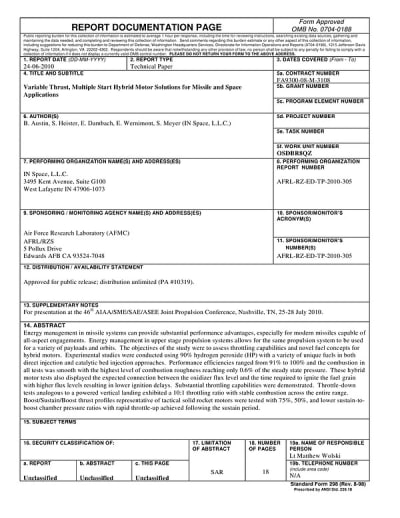
Variable Thrust, Multiple Start Hybrid Motor Solutions for Missile and Space Applications
(reference AFRL-0186) is currently available for download from the TSP library.
Don't have an account?
More From SAE Media Group
Tech Briefs
Hybrisol Rocket Engines
Aerospace & Defense Tech Briefs
Thermal Design and Analysis of a Rocket-Engine TAN Injector
Aerospace & Defense Tech Briefs
Rotating Detonation-Wave Engines
Tech Briefs
Self-Adjusting Liquid Injectors for Combustors
Aerospace & Defense Tech Briefs
Thrust-Augmented Nozzles for Rocket Engines
Off-Highway Engineering
Isuzu Simplifies Fuel Changeovers
Aerospace Manufacturing and Machining INSIDER
New Defense Department Contract to Expand Domestic Rocket Motor Manufacturing

Aerospace & Defense Tech Briefs
SAE International Extends Call for Abstracts, Seeks Submissions for AeroTech Conference
Aerospace & Defense Tech Briefs
Sensing for Controls and Propulsion Health Management in Turbine Engines
Automotive Engineering
Extending a Wankel Future on Hydrogen Fuel
Tech Briefs
UCF’s Hypersonic Technology Advances
Tech Briefs
Products of Tomorrow

Automotive Engineering
Mercedes-AMG Extracts World-Record Power from New Four-Cylinder Engine
Off-Highway Engineering
Cummins Spools up New Turbo Tech
Tech Briefs
Chemically Driven Wheels “Morph” Into Gears
Off-Highway Engineering
Garrett Two-Stage Turbos Ramp up Off-Highway
Off-Highway Engineering
Could This Infinitely Variable Compression Mechanism Be the Next Piston Engine Game-Changer?
Aerospace & Defense Tech Briefs
Pulsed Microwave Plasma Instrumentation for Investigation of Plasma-Tuned Multiphase Combustion
Aerospace & Defense Tech Briefs
Thrust in Space - The Nuances of Thruster Valve Design
Automotive Engineering
Designing for 200 BMEP and 22,000 Rpm

Off-Highway Engineering
Westport Awarded LNG Development Program

Off-Highway Engineering
JCB Debuts Clean-Sheet Hydrogen Combustion Engine
Motion Design
Valves for Pneumatic Cylinders and Actuators
Overview
The document is a technical paper titled "Variable Thrust, Multiple Start Hybrid Motor Solutions for Missile and Space Applications," authored by B. Austin, S. Heister, E. Dambach, E. Wernimont, and S. Meyer from IN Space, L.L.C. It was prepared under the sponsorship of the Air Force Research Laboratory and discusses advancements in hybrid rocket motor technology, particularly focusing on variable thrust and multiple start capabilities.
The primary objective of the research is to experimentally determine the combustion performance, ignitability, and throttling capability of hybrid motors utilizing concentrated hydrogen peroxide (HP) and a catalyst bed. The paper outlines two series of tests conducted to explore these capabilities. The first series involved placing a catalyst bed upstream of the fuel section, allowing for the direct feeding of decomposed HP gases to the fuel, which enabled direct ignition without a separate ignition source. The second series focused on manufacturing catalytic fuel grains that allowed ignition through direct injection of liquid HP into the combustion chamber. Both approaches demonstrated successful ignition and reliable combustion.
The document also discusses the reactivity of various formulations tested, noting that while ignition events were less common, low splatter delays indicated good reactivity, suggesting potential for inclusion in motor tests. The splatter observed was attributed to peroxide decomposition, which releases heat and can enhance combustion when droplets contact additional catalytic propellant.
Acknowledgments in the document highlight the support from the Office of the Secretary of Defense and the U.S. Air Force, as well as funding from the State of Indiana 21st Century Research and Technology Fund. The references section includes various studies and patents related to liquid propellants and hybrid rocket technology, indicating a comprehensive background in the field.
Overall, the paper presents significant findings in hybrid motor technology, emphasizing the importance of ignition and combustion performance in enhancing missile and space applications. The research aims to contribute to the development of more efficient and versatile propulsion systems, which are crucial for modern aerospace missions.
Top Stories
NewsRF & Microwave Electronics
 Microvision Aquires Luminar, Plans Relationship Restoration, Multi-industry Push
INSIDERAerospace
 A Next Generation Helmet System for Navy Pilots
INSIDERDesign
 New Raytheon and Lockheed Martin Agreements Expand Missile Defense Production
INSIDERMaterials
 How Airbus is Using w-DED to 3D Print Larger Titanium Airplane Parts
NewsPower
 Ford Announces 48-Volt Architecture for Future Electric Truck
ArticlesAR/AI

Webcasts
Electronics & Computers
 Cooling a New Generation of Aerospace and Defense Embedded...
Automotive
 Battery Abuse Testing: Pushing to Failure
Power
 A FREE Two-Day Event Dedicated to Connected Mobility
Unmanned Systems
 Quiet, Please: NVH Improvement Opportunities in the Early Design Cycle
Automotive
 Advantages of Smart Power Distribution Unit Design for Automotive &...
Energy
 Sesame Solar's Nanogrid Tech Promises Major Gains in Drone Endurance