




Thrust-Augmented Nozzles for Rocket Engines
The afterburner concept is adapted from turbojet to rocket engines.
The thrust-augmented nozzle (TAN) has been invented as a means of obtaining high performance from a rocket engine both during liftoff at sea-level atmospheric pressure and later during flight under near-vacuum conditions. In effect, the TAN rocket engine amounts to a booster rocket engine contained entirely within a sustainer rocket engine, and very little weight is associated with the incorporation of the TAN portion. Heretofore, it has been difficult or impossible to design the same rocket engine to perform well at both extremes of ambient pressure.
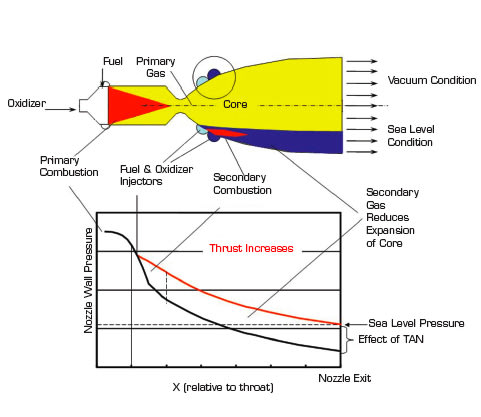
These requirements are in conflict in that at sea-level pressure, the large-area-ratio nozzle is less efficient in producing thrust. The reduction in efficiency occurs because the radially outermost part of the exhaust gas expands to a pressure below ambient pressure, thereby causing a portion of the nozzle to generate negative thrust. At an extreme area ratio, the exhaust jet becomes separated from the nozzle, causing destructive forces.
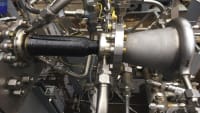
The concept of the TAN is related to the concept of the turbojet- engine afterburner: In the TAN, during operation at atmospheric pressure, thrust is augmented through injection and burning of fuel and oxidizer within the nozzle, downstream of the nozzle throat (see figure). Moreover, the thrustaugmenting propellants can be different from those burned in the primary combustion in the core of the engine, making it possible to obtain the benefits of dual-fuel operation. In a turbojet- engine afterburner, the amount of thrust augmentation is limited by the amount of unburned oxygen available in the exhaust from the main combustor. In the TAN, the thrust augmentation is not so limited because both the fuel and oxidizer are injected in the required amounts. The increase in thrust in TAN operation is nearly proportional to the nozzle area ratio. In a high-area-ratio nozzle, it is imperative to use high augmentation to fill the nozzle with exhaust flow without separation.
In TAN operation, the increase in thrust can be attributed to two effects: One effect is the secondary flow of gases generated by combustion of the TAN propellants. The other effect is the displacement of the flow of primary combustion gases (core flow) by this secondary flow. The TAN exhaust gases flowing in the nozzle reduce the exit flow area available to the core flow, thereby reducing overexpansion and thereby further reducing the core-thrust loss associated with overexpansion.
This work was done by Melvin J. Bulman of GenCorp Aerojet for the Air Force Research Laboratory. For further information, download the free white paper at www.defensetechbriefs.com under the Mechanics/Machinery category. AFRL-0009
This Brief includes a Technical Support Package (TSP).
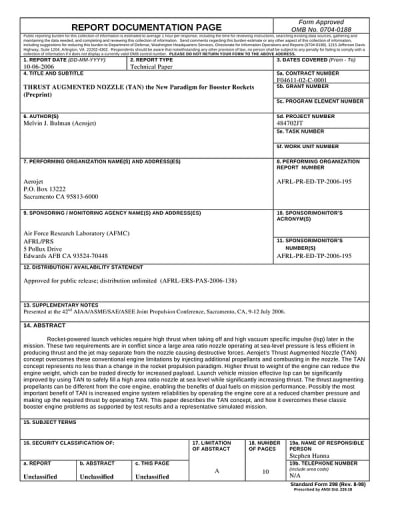
Thrust-Augmented Nozzles for Rocket Engines
(reference AFRL-0009) is currently available for download from the TSP library.
Don't have an account?
More From SAE Media Group
Aerospace & Defense Tech Briefs
Thermal Design and Analysis of a Rocket-Engine TAN Injector
Aerospace & Defense Tech Briefs
Variable-Thrust, Multiple-Start Hybrid Motor Solutions
Tech Briefs
UCF’s Hypersonic Technology Advances
Tech Briefs
Hybrisol Rocket Engines
Aerospace & Defense Tech Briefs
SAE International Extends Call for Abstracts, Seeks Submissions for AeroTech Conference
Aerospace & Defense Tech Briefs
Thrust in Space - The Nuances of Thruster Valve Design
Aerospace & Defense Tech Briefs
Rotating Detonation-Wave Engines
Aerospace & Defense Tech Briefs
Lightcraft Propulsion for Launching a Small Satellite
Aerospace Manufacturing and Machining INSIDER
New Defense Department Contract to Expand Domestic Rocket Motor Manufacturing
Aerospace & Defense Tech Briefs
Industry Invited to Participate in AeroTech Aerospace and Defense Technical Program
Motion Control Technology
Exhaust Nozzle for a Multitube Detonative Combustion Engine
Aerospace & Defense Tech Briefs
Water Mist System for Shipboard Machinery Space Fires
Automotive Engineering
Extending a Wankel Future on Hydrogen Fuel

Aerospace & Defense Tech Briefs
Sensing for Controls and Propulsion Health Management in Turbine Engines

Motion Design
Gear Bearings
Off-Highway Engineering
Cummins Spools up New Turbo Tech
Tech Briefs
Chemically Driven Wheels “Morph” Into Gears
Tech Briefs
Products of Tomorrow
Motion Design
Valves for Pneumatic Cylinders and Actuators
Automotive Engineering
New Ampere EV Motor Aims for Power, Torque Benchmarks
Tech Briefs
Self-Adjusting Liquid Injectors for Combustors
Motion Design
Soft Mate Lifting Device
Off-Highway Engineering
Garrett Two-Stage Turbos Ramp up Off-Highway
Aerospace & Defense Tech Briefs
Approximating the Material Stresses and System Requirements for Hypersonic Flight

Overview
The document presents a technical paper on the Thrust Augmented Nozzle (TAN), a revolutionary concept in rocket propulsion developed by Aerojet. The TAN aims to address the conflicting requirements of high thrust during launch and high vacuum specific impulse (Isp) during flight. Traditional rocket engines struggle to optimize performance for both conditions, but the TAN concept overcomes these limitations by injecting additional propellants into the nozzle, allowing for enhanced thrust without compromising efficiency.
The paper outlines the feasibility of the TAN using liquid oxygen (LOX) and RP-1 propellants, demonstrating significant thrust augmentation—up to 77%—through extensive testing. A total of 28 tests were conducted, accumulating over 206 seconds of operation at a thrust level of 2K. The results indicate that TAN-powered vehicles can achieve higher performance with reduced payload delivery costs for expendable vehicles and can potentially deliver 2 to 3 times the payload for reusable vehicles. This increased payload capacity is particularly beneficial for single-stage-to-orbit (SSTO) vehicles, as it allows for greater flexibility in design and performance trade-offs.
The document also includes a mission analysis comparing a baseline vehicle powered by traditional engines to one utilizing the TAN concept. The analysis highlights the sensitivity of payload capacity to engine performance, emphasizing the advantages of the TAN in maintaining payload even under less-than-ideal conditions.
In the recommendations section, the author suggests conducting mid-scale hot-fire demonstrations to further explore the TAN's capabilities and initiate large-scale prototype engine development. Collaboration with engine and vehicle integrators is encouraged to incorporate TAN technology into existing and future systems, maximizing its benefits.
Overall, the TAN represents a significant advancement in rocket propulsion technology, promising improved reliability, reduced engine operating conditions, and lower costs. The paper concludes with acknowledgments to the supporting organizations and personnel involved in the research and development of the TAN test hardware. This innovative approach to rocket propulsion could reshape the future of space exploration and launch vehicle design.
Top Stories
INSIDERManufacturing & Prototyping
 How Airbus is Using w-DED to 3D Print Larger Titanium Airplane Parts
INSIDERManned Systems
 FAA to Replace Aging Network of Ground-Based Radars
NewsTransportation
 CES 2026: Bosch is Ready to Bring AI to Your (Likely ICE-powered) Vehicle
NewsSoftware
 Accelerating Down the Road to Autonomy
EditorialDesign
 DarkSky One Wants to Make the World a Darker Place
INSIDERMaterials
 Can This Self-Healing Composite Make Airplane and Spacecraft Components Last...
Webcasts
Defense
 How Sift's Unified Observability Platform Accelerates Drone Innovation
Automotive
 E/E Architecture Redefined: Building Smarter, Safer, and Scalable...
Power
 Hydrogen Engines Are Heating Up for Heavy Duty
Electronics & Computers
 Advantages of Smart Power Distribution Unit Design for Automotive...
Unmanned Systems
 Quiet, Please: NVH Improvement Opportunities in the Early Design...
