




Deceiving the Enemy: These Are the Drones You Are Looking For
By developing UAVs for physical deception roles to shape an adversary’s ability to visually observe and orient to situations, the US military can decrease risk to air and ground combatants during mission execution by causing adversaries to expend resources, delay their reactions, or react incorrectly to tactical situations.

In August 2011, a US CH-47 Chinook helicopter began its descent in a remote corner of Afghanistan to insert elite Special Forces soldiers at an important objective. Unseen by the aircrew or US reconnaissance drones, a Taliban operative fired a Rocket Propelled Grenade (RPG) at the landing Chinook aircraft, causing it to lose control and crash, killing all 38 service members on board.
This situation could be prevented through the use of creative tactical deception relying on UAVs. In this scenario, the Taliban operative—still unknown to US forces—remains hidden. He watches multiple helicopters overfly his position and start decelerating to land in areas near him, in numerous directions. A more vulnerable helicopter catches his eye as it attempts to land. With deadly accuracy, he fires his RPG and destroys it with a single rocket shot. Yet not a single life is lost. The enemy has only destroyed an unmanned, half-size variant of an actual Chinook helicopter.
This drone helicopter was one of twelve drone helicopters accompanying three manned helicopters, which successfully deployed the US soldiers at the desired objective. This is an example of a UAV, or drone, performing a physical deception role in combat by deceiving an adversary’s “eyes and ears” at an opportune time. Unfortunately, on the actual night in 2011 in Afghanistan, these types of deception drones had not been envisioned.
To date, the primary deceptive role of UAVs has been in electronic deception, such as deceiving the radar of an adversary’s integrated air defenses into believing the unmanned aircraft were manned attack aircraft during the opening of an air campaign. This was exemplified by the Israeli Air Force in 1982 as well as the United States Air Force in 1991. These tactics caused the adversary to expend surface-to-air missiles against deceiving drones. While electronic deception will continue to be an important role for UAVs in future conflicts, the maturation of UAV deception is warranted.
One aspect of deception for which modern UAVs have not been developed or used effectively is in the physical realm of deception. As described in the scenario above, this entails fooling the actual human “eyes and ears” of an adversary, rather than their electronic radar and tracking systems. UAVs can operate in hostile environments with minimal risk to personnel and can deceive and increase the “fog of war” against opponents of the US military with innovative and effective physical deception methods. Since 2001, the US has mostly faced opponents lacking any air defense capability beyond small arms and unguided rockets. Still, these “technologically-limited” opponents in Iraq and Afghanistan inflicted losses against many US aircraft.
Operations that require an enemy individual’s direct visual observation and orientation to perform, such as aiming a weapon by eyesight, are ideal targets for physical deception UAVs. In particular, two areas related to air combat missions will benefit. One is increasing the survival rate of combat aircraft, such as helicopters, that conduct low-altitude operations in the range of the enemy and are susceptible to low-technology weapons such as small arms. Another is increasing the probability of recovering downed aircrew in enemy controlled areas by enhancing the confusion and reaction of enemy individuals and their command structure.
UAVs can perform deception by fooling sensors operated by an adversary and, regardless of modern-day defenses, a UAV might still effectively penetrate them directly to a target. Likewise, UAVs could be used to disrupt the enemy’s reaction and understanding during tactical operations, thereby increasing the enemy’s “fog of war.” UAVs could also be used to jam fire-control radars and be employed as decoys emulating the radar, infrared, and radio signatures of fighter aircraft to increase manned aircraft survivability.
By developing UAVs for physical deception roles to shape an adversary’s ability to visually observe and orient to situations, the US military can better execute combat missions against future adversaries and decrease risk to air and ground combatants during mission execution by causing adversaries to expend resources, delay their reactions, or react incorrectly to tactical situations. This can ensure higher success rates for both air and ground combat missions by confusing adversaries and causing them to expend resources, delay their reactions, or react incorrectly.
This work was done by Phyllis Nixon for the Air University Air and Staff College. For more information, download the Technical Support Package below. (AFRL-0302)
This Brief includes a Technical Support Package (TSP).
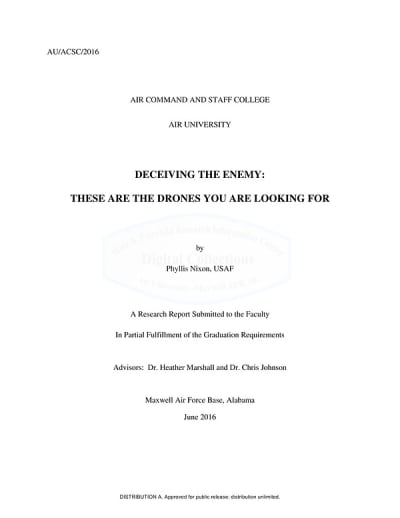
Deceiving the Enemy: These Are the Drones You Are Looking For
(reference AFRL-0302) is currently available for download from the TSP library.
Don't have an account?
More From SAE Media Group
Aerospace & Defense Tech Briefs
Autonomous Collaborative Platform
Aerospace & Defense Tech Briefs
Foreign Counter-Unmanned Aerial Systems: Developments in the International Arms Markets
Aerospace & Defense Tech Briefs
A New Approach to Counter-UAS Technology
Aerospace & Defense Tech Briefs
MUSHER Demonstrates Manned-Unmanned Aircraft Teaming Applications

Aerospace & Defense Tech Briefs
PHASA-35 Stratospheric Flight
Aerospace & Defense Tech Briefs
Fighter Jet Armaments
Aerospace & Defense Tech Briefs
Multispectral Airborne Reconnaissance System
Aerospace & Defense Tech Briefs
Autonomous Air Defense Production
Aerospace & Defense Tech Briefs
Remotely Piloted Air Systems
Aerospace & Defense Tech Briefs
Feasibility Analysis of UAV Technology to Improve Tactical Surveillance in South Korea’s Rear Area Operations
Aerospace & Defense Tech Briefs
Military Aircraft Systems Technology
Aerospace & Defense Tech Briefs
The New Airbus Wingman Aircraft
Aerospace & Defense Tech Briefs
Unmanned Aerial System
Aerospace & Defense Tech Briefs
sUAS-Based Payload Development and Testing for Quantifying Optical Turbulence
Aerospace Manufacturing and Machining INSIDER
Counter UAS Systems Tested Against Swarms of 50 Drones in Latest Yuma Exercise
Aerospace INSIDER
New Drones and Software Selected for DoD's Replicator 1.2
Aerospace Manufacturing and Machining INSIDER
A New AI-Piloted VTOL Fighter Jet for Contested Environments
Aerospace & Defense Tech Briefs
Leveraging COTS Products for Maneuverable Aerial Identification
Tech Briefs
Anti-Phase Noise Suppression Rotor Technologies
Aerospace & Defense Tech Briefs
Unmanned Aerial Vehicle
Aerospace & Defense Tech Briefs
Tactical Combat Missiles
Aerospace & Defense Tech Briefs
Customizable Rocket Launchers
Aerospace & Defense Tech Briefs
Experimental Design of a UCAV-Based High-Energy Laser Weapon
Aerospace & Defense Tech Briefs
Mobile Counter Unmanned Aircraft System

Aerospace INSIDER
Air Force Performs First Test of Microwave Counter Drone Weapon THOR

Overview
The document titled "Deceiving the Enemy: These Are the Drones You Are Looking For" by Phyllis Nixon, USAF, is an academic research paper that explores the strategic use of unmanned aerial vehicles (UAVs) in modern warfare, particularly focusing on deception tactics. The paper is structured into several sections, each addressing different aspects of UAV capabilities and their implications for combat.
The introduction sets the stage for the discussion on deception in military operations, emphasizing its critical role in gaining a tactical advantage over adversaries. The background section provides an overview of UAV development and capabilities, highlighting how these technologies have evolved to enhance military effectiveness. It discusses various forms of deception, including physical deception and psychological tactics aimed at confusing the enemy.
Key issues are examined in subsequent sections, such as the challenges posed by low-altitude aircraft and the risks associated with downed aircrew capture. The analysis section delves into the concept of perception deception, exploring how UAVs can manipulate an adversary's understanding of the battlefield. Scenarios are presented to illustrate the practical applications of these tactics, including special operations infiltration and air campaigns.
The paper also outlines alternatives for employing UAVs in combat, categorizing them into different mission types, such as "Wingmen" UAVs and "Shootdown" UAVs. Each category is analyzed for its potential effectiveness in achieving desired military outcomes.
In the recommendations section, the author suggests strategies for optimizing UAV deployment to enhance deception efforts and improve operational success. The conclusion summarizes the findings and reiterates the importance of integrating deception into UAV operations to outmaneuver adversaries.
Overall, the document underscores the significance of UAVs in contemporary military strategy, particularly their ability to deceive and disrupt enemy decision-making processes. It advocates for continued research and development in this area to maintain a competitive edge in future conflicts. The paper is a valuable resource for understanding the intersection of technology, strategy, and deception in modern warfare.
Top Stories
INSIDERDefense
 New 3D-Printable Nanocomposite Prevents Overheating in Military Electronics
Technology ReportSoftware
 Talking SDVs and Zonal Architecture with TE Connectivity
NewsDesign
 2026 Nissan Sentra Review: Putting the Pieces Together
INSIDERDesign
 New Defense Department Program Seeks 300,000 Drones From Industry by 2027
INSIDERDefense
 Anduril Completes First Semi-Autonomous Flight of CCA Prototype
INSIDERDefense

Webcasts
Automotive
 SAE Automotive Podcast: Solid-State Batteries
Manufacturing & Prototyping
 SAE Automotive Engineering Podcast: Additive Manufacturing
Defense
 A New Approach to Manufacturing Machine Connectivity for the Air Force
Software
 Optimizing Production Processes with the Virtual Twin
Automotive
 EV and Battery Thermal Management Strategies
Aerospace
 How Packet Digital Is Scaling Domestic Drone Battery Manufacturing