




Feasibility Analysis of UAV Technology to Improve Tactical Surveillance in South Korea’s Rear Area Operations
Using experimentation and analysis to determine the optimum characteristics of an improved unmanned aerial vehicle (UAV) that can cost-effectively be used as a battalion-level countermeasure to solve problems in the Korean rear area operations caused by the Republic of Korea’s military structure reform.
The Republic of Korea’s (ROK) Defense Reform Plan addressed the transformation of the ROK military structure by a significant military personnel reduction. The decreased number of forces in the ROK Army (ROKA) will cause significant issues in covering the force’s area of responsibility. In particular, the ROK rear area forces will have more difficulties in carrying out ROKA’s rear area operations (RAO).
As part of the efforts to address these problems, the Korea Ministry of National Defense decided to strengthen the battlefield visualization capability of each echelon by distributing the new hand-launched Remoeye-002B to battalion-level units and division-level KUS-9 to division-level units. However, the distribution of these unmanned aerial vehicles (UAV) is limited to the frontline forces; distribution to the rear area forces has still not been achieved due to the Korean military’s budget constraints.
This feasibility analysis allows the ROK to determine the optimum required operational capability (ROC) of the UAVs for the Korean RAO. Since there is an insufficient amount of information and studies related to the utilization of UAVs in the ROK military, insights from this research will serve as a guide to acquisition strategies of future UAVs for supporting Korean RAO.
In order to get the proper ROC, this research uses Map Aware Non-Uniform Automata (MANA), an agent-based simulation software platform. It first examines the effects of deploying Remoeye-002B at the battalion level in the Korean rear area. Applying computer experimentation in a terminal high-altitude area defense (THAAD) scenario provides insights to the intelligence, surveillance, and reconnaissance (ISR) capabilities that the force requires. Advanced experimental designs efficiently explore single and combined characteristics of a UAV that can best improve the surveillance mission. Regression analysis and partitioning tree analysis assist in examining 260 options. In addition, a relative cost analysis identifies the most cost-effective design option.
The simulation results of the scenario with no UAVs show that there is a need to strengthen the ISR capabilities of the ROKA rear area forces. The deployment of Remoeye-002Bs to rear area forces results in significant improvements on RAO, but Remoeye-002B capabilities are insufficient to support Korean RAO. Thus, the need was found for procuring a more capable UAV than Remoeye-002B.
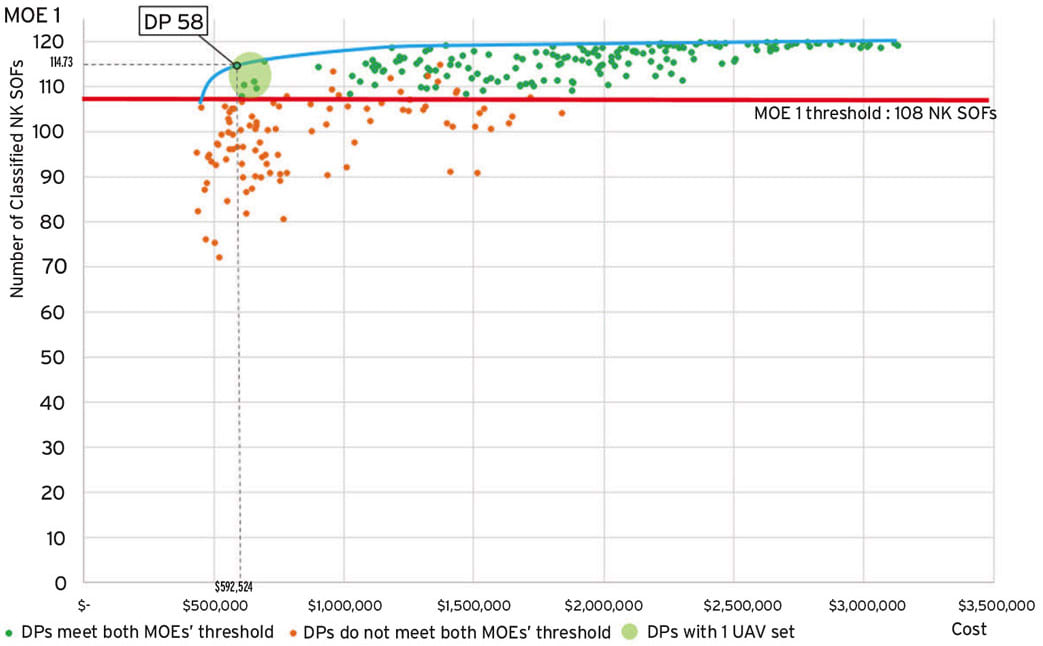
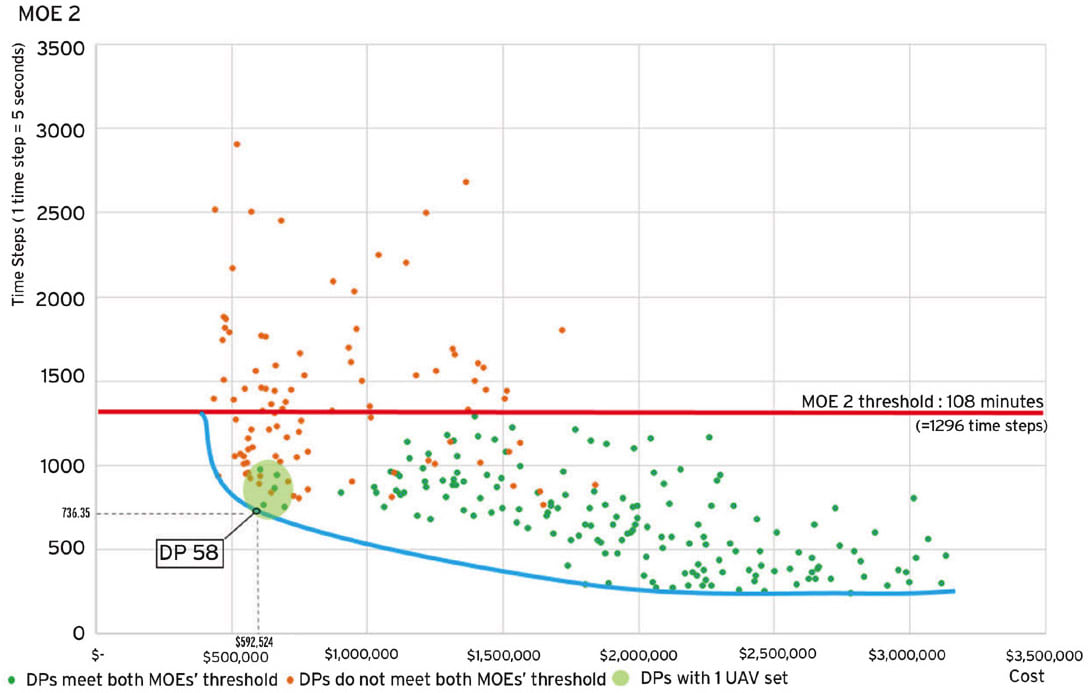
To get the proper ROC, more computer experimentation results were analyzed. The linear regression indicated the number of UAV sets has the largest impact on the Korean RAO. The contour plot showed that purchasing just one set of UAVs with a higher sensor capability could result in the same performance as two or more sets of UAVs with lower sensor capabilities. The partition tree analysis identifies that there are six design options, which meet the operational goals by using a single UAV set. In addition, a cost estimation on the total price of the system represented for all 260 options was performed. A relative cost analysis found that these six design options are the most cost-effective options. Among them, design point (DP) 58 is the cheapest at $592,524. It also has high mission success probability of 98.8%. Therefore, it can be concluded that DP 58 is the best design option for rear area forces ( Figure 1and Figure 2).
This work was done by Sangbum Kim for the Naval Postgraduate School. For more information, download the Technical Support Package (free white paper) below. NPS-0017
This Brief includes a Technical Support Package (TSP).
Feasibility Analysis of UAV Technology to Improve Tactical Surveillance in South Korea’s Rear Area Operations
(reference NPS-0017) is currently available for download from the TSP library.
Don't have an account?
More From SAE Media Group
Aerospace & Defense Tech Briefs
Optimal UAS Assignments and Trajectories for Persistent Surveillance and Data Collection from a Wireless Sensor Network
Aerospace & Defense Tech Briefs
Impact of Satellite Intelligence, Surveillance and Reconnaissance on Modern Naval Operations
Aerospace & Defense Tech Briefs
All Environment (AE) Unmanned Aircraft System

Aerospace & Defense Tech Briefs
Multi-Drone System
Aerospace & Defense Tech Briefs
Low-Impact CUAS System
Aerospace & Defense Tech Briefs
Counter-Drone Technology
Aerospace & Defense Tech Briefs
Nano-Unmanned Aerial Vehicle
Aerospace & Defense Tech Briefs
Counter-Drone Technology
Aerospace & Defense Tech Briefs
Tactical Data Link Software
Aerospace & Defense Tech Briefs
Unmanned Hover Plane
Aerospace & Defense Tech Briefs
Nano-UAV Systems
Automotive Engineering
Logos Technologies Redkite Airborne, Wide-Area Sensor Takes Flight in the Netherlands
Aerospace & Defense Tech Briefs
Drone Swarms: A Transformational Technology
Aerospace & Defense Tech Briefs
Remotely Piloted Air Systems
Aerospace & Defense Tech Briefs
Autonomous Collaborative Platform
Aerospace & Defense Tech Briefs
Counter UAS Defense System
Aerospace & Defense Tech Briefs
Armored Vehicle Mission Management System
Aerospace & Defense Tech Briefs
Report on Human Factors Issues Likely to Affect Air-Launched Effects
Aerospace & Defense Tech Briefs
Integrated Underwater Security System
Aerospace & Defense Tech Briefs
Multi-Mission UAS (MMU) Systems
Aerospace & Defense Tech Briefs
Adding Context to Full-Motion Video for Improved Surveillance and Situational Awareness
Aerospace & Defense Tech Briefs
Multispectral Airborne Reconnaissance System
Aerospace & Defense Tech Briefs
DDDAMS-based Urban Surveillance and Crowd Control via UAVs and UGVs
Aerospace & Defense Tech Briefs
Quantifying Autonomous Soaring on a Surveillance and Communications Relay Mission
Aerospace & Defense Tech Briefs
Counter-UAS Technology
Aerospace & Defense Tech Briefs
Cutting-Edge Drone Killer Radio Wave Weapon Developing at Pace
Aerospace & Defense Tech Briefs
Deceiving the Enemy: These Are the Drones You Are Looking For
Aerospace & Defense Tech Briefs
Defeating Commercial Drone Threats with Software Defined Radio
Aerospace & Defense Tech Briefs
Foreign Counter-Unmanned Aerial Systems: Developments in the International Arms Markets
Overview
The document titled "Feasibility Analysis of UAV Technology to Improve Tactical Surveillance in South Korea’s Rear Area Operations" by Sangbum Kim, completed in March 2017 at the Naval Postgraduate School, investigates the potential integration of unmanned aerial vehicles (UAVs) into South Korea's military operations, particularly focusing on enhancing tactical surveillance capabilities.
The research begins by outlining the strategic context of South Korea's military environment, emphasizing the need for improved surveillance in rear area operations due to evolving threats and the changing nature of warfare. The study highlights the importance of timely and accurate intelligence in military operations, which can significantly influence decision-making and operational effectiveness.
Kim conducts a thorough analysis of existing UAV technologies, assessing their capabilities, limitations, and potential applications within the South Korean military framework. The study examines various UAV models, their operational ranges, payload capacities, and sensor technologies, providing a comprehensive overview of how these systems can be utilized for surveillance purposes.
The document also addresses the challenges associated with integrating UAVs into existing military structures, including logistical considerations, training requirements, and the need for robust command and control systems. Kim emphasizes the importance of developing a cohesive strategy that incorporates UAVs into broader military operations, ensuring that they complement traditional surveillance methods rather than replace them.
Furthermore, the research includes a feasibility analysis that evaluates the cost-effectiveness of implementing UAV technology in South Korea's military operations. This analysis considers factors such as procurement costs, maintenance, and operational expenses, ultimately concluding that the benefits of enhanced surveillance capabilities justify the investment in UAV technology.
In conclusion, Kim's thesis advocates for the strategic adoption of UAVs to bolster South Korea's tactical surveillance capabilities. By leveraging advanced UAV technologies, the South Korean military can improve its situational awareness, enhance operational efficiency, and better respond to emerging threats. The study serves as a foundational resource for military planners and decision-makers, providing insights into the practical applications of UAVs in modern warfare and the potential for significant improvements in surveillance operations.
Top Stories
INSIDERDefense
 New Raytheon and Lockheed Martin Agreements Expand Missile Defense Production
NewsAutomotive
 Ford Announces 48-Volt Architecture for Future Electric Truck
INSIDERManufacturing & Prototyping
 Active Strake System Cuts Cruise Drag, Boosts Flight Efficiency
ArticlesTransportation
 Accelerating Down the Road to Autonomy
INSIDERMaterials
 How Airbus is Using w-DED to 3D Print Larger Titanium Airplane Parts
Road ReadyTransportation

Webcasts
Electronics & Computers
 Cooling a New Generation of Aerospace and Defense Embedded...
Power
 Battery Abuse Testing: Pushing to Failure
Connectivity
 A FREE Two-Day Event Dedicated to Connected Mobility
Automotive
 Quiet, Please: NVH Improvement Opportunities in the Early Design Cycle
Transportation
 Advantages of Smart Power Distribution Unit Design for Automotive &...
Aerospace
 Sesame Solar's Nanogrid Tech Promises Major Gains in Drone Endurance