




Optimizing Radiation Detection for Homeland Security, DoD
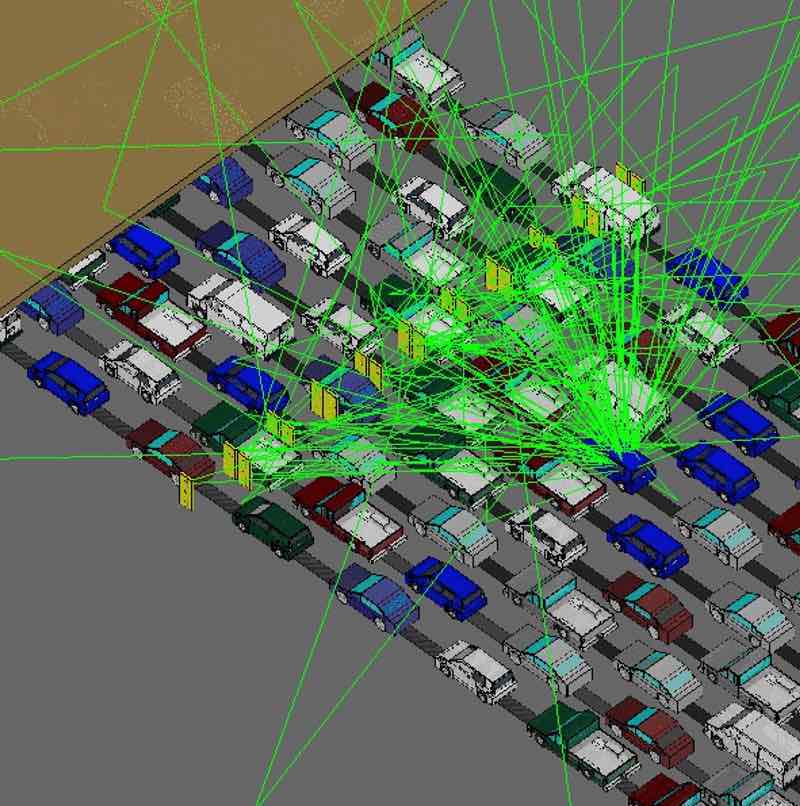
Researchers at the U.S. Naval Research Laboratory (NRL) integrated an accurate and efficient model of nuclear fission into a new software suite to give users a powerful and flexible tool to quickly and accurately model new and highly complex nuclear detection scenarios. SoftWare for Optimization of Radiation Detectors (SWORD) is an integrated software package that offers an interface to radiation transport codes, allowing users to design and optimize radiation detectors, which results in the faster development and evaluation of radiation detection equipment.
“Our sponsors and end users are focused on preventing nuclear weapons and other radiological devices from being smuggled into the country or into areas where the Department of Defense operates,” Wade Duvall, Ph.D., an NRL research physicist said. “SWORD uses one of several standard radiation transport codes to simulate a scenario, from a medical isotope being transported to a legitimate background source.”
Program users, like the Department of Homeland Security and the Defense Threat Reduction Agency, currently evaluate complex particle interactions by Monte Carlo techniques designed to track particle types over broad ranges of energies. The Monte Carlo uses a number of simulation libraries that have a variety of adjustable parameters; however, these parameters require significant expertise to configure appropriately for the scenario to be modeled.
“These difficulties motivated us to make a tool that could be used by a person without any nuclear physics expertise to quickly build complex scenarios and simulate them,” Duvall said. “Now, with fission, SWORD 7 allows the Navy and users to model scenarios involving active interrogation, space-based and ship-based nuclear reactors and shielding.”
The SWORD implementation was a threefold effort. First, the SWORD simulation engine was updated to accommodate a new physics library and increase performance. Then, a new fission physics library was integrated into SWORD. After the integrated library was validated to ensure it had been properly incorporated and that fission physics was accurately modeled, Duvall said they are now working on getting SWORD 7 ready for release.
More From SAE Media Group
Aerospace & Defense Tech Briefs
5 Startups Developing AI for Defense Application
Defense INSIDER
A Quantum Leap for Defense Computing Applications
Aerospace & Defense Tech Briefs
Digitally Transforming the Future of Defense: Collaborative Combat Aircraft
Tech Briefs
Supercomputer's Asteroid Simulations
Defense INSIDER
Experimental Box Could Track Nuclear Activity by Rogue Nations


Photonics & Imaging Technology INSIDER
Ignition Achievement Gives US New Opportunity to Lead World's IFE Research

Software Tech Briefs
Qualifying Software for Nuclear-Safety-Related Calculations
Tech Briefs
Product of the Month
Automotive Engineering
Simulating Forward Motion at VI-Grade’s Zero Prototypes Day
Motion Design
The Impact of AI Across the Industrial Value Chain
Aerospace & Defense Tech Briefs
Analyzing Aircraft Antenna Placement and Performance with Unified Modeling and Simulation
Tech Briefs
New on the Market


Aerospace & Defense Tech Briefs
Digitalization in the Aerospace Sector
NASA Spinoff
AURA Software Tackles Uncertainty in Complex Systems
Sensor Technology
Digital Twins for Industry

Defense INSIDER
Detecting Radioactive Material from a Remote Distance
Aerospace & Defense Tech Briefs
Assessment of Non-Traditional Isotopic Ratios by Mass Spectrometry for Analysis of Nuclear Activities
Off-Highway Engineering
TE Connectivity Enhances Digital Platform with CT Data Analysis
Aerospace INSIDER
AFMC Completes First Ever Flight of F-35 with F-22 Software

Top Stories
NewsRF & Microwave Electronics
 Microvision Aquires Luminar, Plans Relationship Restoration, Multi-industry Push
INSIDERAerospace
 A Next Generation Helmet System for Navy Pilots
INSIDERDesign
 New Raytheon and Lockheed Martin Agreements Expand Missile Defense Production
INSIDERMaterials
 How Airbus is Using w-DED to 3D Print Larger Titanium Airplane Parts
NewsPower
 Ford Announces 48-Volt Architecture for Future Electric Truck
ArticlesAR/AI

Webcasts
Electronics & Computers
 Cooling a New Generation of Aerospace and Defense Embedded...
Automotive
 Battery Abuse Testing: Pushing to Failure
Power
 A FREE Two-Day Event Dedicated to Connected Mobility
Unmanned Systems
 Quiet, Please: NVH Improvement Opportunities in the Early Design Cycle
Automotive
 Advantages of Smart Power Distribution Unit Design for Automotive &...
Energy
 Sesame Solar's Nanogrid Tech Promises Major Gains in Drone Endurance