




Detecting Radioactive Material from a Remote Distance
In 2004 British national Dhiren Barot was arrested for conspiring to commit a public nuisance by the use of radioactive materials, among other charges. Authorities claimed that Barot had researched the production of “dirty bombs,” and planned to detonate them in New York City, Washington DC, and other cities.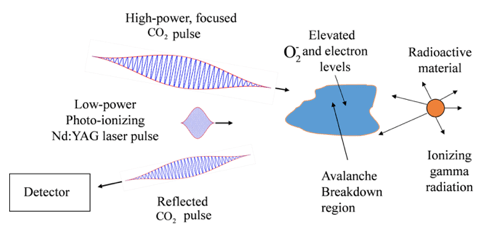
A dirty bomb combines conventional explosives with radioactive material. Although Barot did not build the bombs, national security experts believe terrorists continue to be interested in such devices for terror plots. Now researchers from the University of Maryland have proposed a new technique to remotely detect the radioactive materials in dirty bombs or other sources. While the explosion of a dirty bomb would likely cause more damage than the radioactive substances it spreads, the bombs could create fear and panic, contaminate property, and require potentially costly cleanup, according to the U.S. Nuclear Regulatory Commission.
Radioactive materials are routinely used at hospitals for diagnosing and treating diseases, at construction sites for inspecting welding seams, and in research facilities. Cobalt-60, for example, is used to sterilize medical equipment, produce radiation for cancer treatment, and preserve food, among many other applications. In 2013 thieves in Mexico stole a shipment of cobalt-60 pellets used in hospital radiotherapy machines, although the shipment was later recovered intact.
Cobalt-60 and many other radioactive elements emit highly energetic gamma rays when they decay. The gamma rays strip electrons from the molecules in the surrounding air, and the resulting free electrons lose energy and readily attach to oxygen molecules to create elevated levels of negatively charged oxygen ions around the radioactive materials. It’s the increased ion density that the University of Maryland researchers aim to detect with their new method. They calculate that a low-power laser aimed near the radioactive material could free electrons from the oxygen ions. A second, high-power laser could energize the electrons and start a cascading breakdown of the air. When the breakdown process reaches a certain critical point, the high-power laser light is reflected back. The more radioactive material in the vicinity, the more quickly the critical point is reached.
“We calculate we could easily detect 10 milligrams [of cobalt-60] with a laser aimed within half a meter from an unshielded source, which is a fraction of what might go into a dirty bomb” said Joshua Isaacs, a graduate student working with University of Maryland physics and engineering professors Phillip Sprangle and Howard Milchberg. Lead could shield radioactive substances, but most ordinary materials like walls or glass do not stop gamma rays.
The lasers themselves could be located up to a few hundred meters away from the radioactive source, Isaacs said, as long as line-of-sight was maintained and the air was not too turbulent or polluted with aerosols. He estimated that the entire device, when built, could be transported by truck through city streets or past shipping containers in ports. It could also help police or security officials detect radiation without being too close to a potentially dangerous gamma ray emitter.
The proposed remote radiation detection method is not the first, but it has advantages over other approaches. For example, terahertz radiation has also been proposed as a way to breakdown air in the vicinity of radioactive materials, but producing terahertz radiation requires complicated and costly equipment. Another proposed method would use a high-power infrared laser to both strip electrons and break down the air, but the method requires the detector be located in the opposite direction of the laser, which would make it impractical to create a single, mobile device.
More From SAE Media Group
Aerospace & Defense Tech Briefs
Electrical Characterization of Crystalline UO2, THO2 and U0.71TH0.29O2
Medical Design Briefs
Photonic Radiation Sensors Survive Huge Doses Undamaged


Tech Briefs
Radiation Detection with Plastic Scintillators
Tech Briefs
Nuclear Radiation-Detecting Device
Sensor Technology
Tamper Sensor for Safeguarding Radiological Sources
Aerospace & Defense Tech Briefs
New Diamond Super-Material Enhances Aircraft Survivability
Electronics & Sensors INSIDER
New Atom-Based Thermometer Measures Temperature More Accurately
Tech Briefs
Handheld Camera Detects Gamma Ray Radiation
Electronics & Sensors INSIDER
Hardy Transistor Material Could be a Game-Changer for Nuclear Reactor Safety Monitoring
Aerospace & Defense Tech Briefs
Nominal High-Altitude Electromagnetic Pulse (HEMP) Waveforms
Tech Briefs
High-Power, Portable Terahertz Laser
Tech Briefs
Lighter Radiation Shielding for Electronics
Defense INSIDER
NIF Experiments Support Warhead Life Extension
Defense INSIDER
Alternative Found for Nuclear Weapon Detection
Aerospace & Defense Tech Briefs
MOVPE Growth of LWIR AlInAs/GaInAs/InP Quantum Cascade Lasers: Impact of Growth and Material Quality on Laser Performance

Aerospace & Defense Tech Briefs
Directed-Energy System to Defeat Small Unmanned Aircraft System Swarms
Aerospace & Defense Tech Briefs
Playing Defense — Uncertain Regulations Stall the Implementation of Counter-UAS Technology in The U.S.
Aerospace & Defense Tech Briefs
Nonlinear Effects in Transformation Optics-Based Metamaterial Shields for Counter Directed Energy Weapon Defense

Aerospace & Defense Tech Briefs
Matrix-Free Assisted Laser Desorption Ionization Using Metal-Organic Frameworks
Defense INSIDER
How to Dismantle a Nuclear Bomb

Aerospace & Defense Tech Briefs
Modular Biosensor Patch
Defense INSIDER
Optimizing Radiation Detection for Homeland Security, DoD
Defense INSIDER
DoD Funds ‘Hostile Environment’ Control Technology Research
Top Stories
NewsRF & Microwave Electronics
 Microvision Aquires Luminar, Plans Relationship Restoration, Multi-industry Push
INSIDERAerospace
 A Next Generation Helmet System for Navy Pilots
INSIDERDesign
 New Raytheon and Lockheed Martin Agreements Expand Missile Defense Production
INSIDERMaterials
 How Airbus is Using w-DED to 3D Print Larger Titanium Airplane Parts
NewsPower
 Ford Announces 48-Volt Architecture for Future Electric Truck
ArticlesAR/AI

Webcasts
Electronics & Computers
 Cooling a New Generation of Aerospace and Defense Embedded...
Automotive
 Battery Abuse Testing: Pushing to Failure
Power
 A FREE Two-Day Event Dedicated to Connected Mobility
Unmanned Systems
 Quiet, Please: NVH Improvement Opportunities in the Early Design Cycle
Automotive
 Advantages of Smart Power Distribution Unit Design for Automotive &...
Energy
 Sesame Solar's Nanogrid Tech Promises Major Gains in Drone Endurance