




Electrical Characterization of Crystalline UO2, THO2 and U0.71TH0.29O2
Evaluating the suitability of advanced alloys for use in uranium-based neutron detectors.
Tracking and identifying radiation sources in the age of nuclear proliferation and well- resourced non-state actors is a national priority. Current neutron detection methods favor large detector volumes and long data collection times. Additionally, portable neutron detection methods have persistent problems with low signal-to-noise (small pulse height) and require large applied voltages.

Conventional neutron detection usually employs scintillators, gas proportional tubes, or semiconductors with separate conversion layers that convert neutrons to charged reaction products. The challenge in conversion-layer devices is to construct a layer of adequate thickness for neutron capture that is also thin enough to allow the resulting reaction products to interact with the charge-sensitive areas. Standard conversion-layer devices typically employ 30 to 40 μm of enriched 10B due to the high thermal capture cross section of the isotope 10B and the ability for the energetic Li (0.84 MeV) and α (1.47 MeV) daughter particles to escape. The conversion layer thickness is thus a compromise between the neutron interaction rate and the ability to capture the charge in an electrically active medium. Some novel solid-state technologies provide a thin-film neutron detector consisting of a (or a stack of) semiconductor diode(s), each surrounded by a thin neutron-absorbing material.
As an alternative to a conversion layer, the conversion atoms can also be incorporated into the detection medium (gas, scintillator, or semiconductor). This method has the advantage of a more efficient structure to capture the reaction products, but often results in a reduced electronic signature (or in the case of scintillators, reduced light output). As an example, icosahedral semiconducting boron carbides have recently garnered interest because a high-quality electronic material can be made that incorporates 10B as a component of the semiconductor material.
Another consideration in 10B based neutron detectors is the energy dependence of the capture cross section. For thermal neutrons (⊕0.025 eV), the capture cross section for 10B is about 3840 barns. However, for neutrons of 1.6 MeV (the mean energy of prompt fission neutrons from 235U) the 10B absorption cross section is 0.2 barns. Therefore, to achieve the highest detection efficiency for neutrons from fission, 10B based neutron detectors require neutron moderation, resulting in a loss of efficiency either due to scattering out or capture outside of the detection medium. Similar arguments can be made for other conventional neutron conversion materials.
For 235U, the thermal fission cross section is 585 barns and the fast neutron (1.6 MeV) fission cross section is 2 barns as shown in the accompanying figure. Also, the 238U thermal fission cross section is 16.8 microbarns and its fast neutron (1.6 MeV) fission cross section is 1.1 barns. Therefore, 235U is approximately 2× more likely to fission with fast neutrons than 238U in materials of the same density. In comparison, 10B has a thermal neutron absorption cross section 6.55 greater than the thermal fission cross section for 235U. However, for neutrons at 1.6 MeV, 235U has a 4× larger fission cross section and 238U has a 2× larger fission cross section than the 10B neutron absorption cross section of approximately 0.5 barns. Therefore, for fast neutron detection, the uranium cross section is preferred.
A uranium-based neutron detector has a substantial energy output advantage as compared to conventional neutron detection devices that incorporate non-fissile or fissionable neutron conversion materials. The fission of uranium results in two or more charged fission fragments with 168 MeV, having the potential of producing more than 25 million electronic transitions across the UO2 2.1 eV band gap. The resulting high-energy fission products may, however, degrade the electronic properties of the UO2 either due to formation of point defects or because of subsequent decays and transmutations providing a larger internal background noise signal. A further consideration is that uranium requires special handling procedures, especially if enriched, to take advantage of the higher fission cross section of 235U, as opposed to the more naturally abundant 238U. Therefore, this research will help to understand the tradeoffs with uranium-based detectors made from UO2, UO2/ThO2, and U0.71Th0.29O2 using 238U, before the complications of using and managing 235U are considered.
This work was done by Lieutenant Colonel Christina L. Dugan for the Air Force Institute of Technology. For more information, download the Technical Support Package (free white paper) here under the Sensors category. AFRL-0272
This Brief includes a Technical Support Package (TSP).
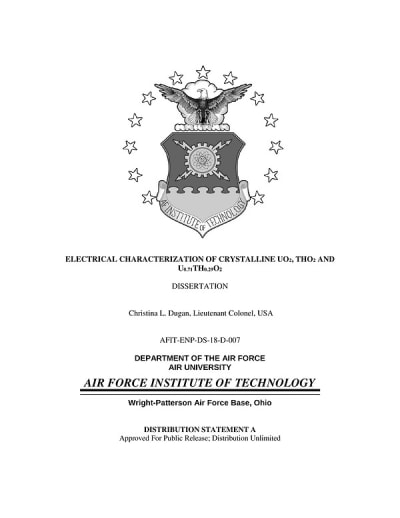
Electrical Characterization of Crystalline UO2, THO2 and U0.71TH0.29O2
(reference AFRL-0272) is currently available for download from the TSP library.
Don't have an account?
More From SAE Media Group
Tech Briefs
Radiation Detection with Plastic Scintillators
Medical Design Briefs
Photonic Radiation Sensors Survive Huge Doses Undamaged
Tech Briefs
Nuclear Radiation-Detecting Device


Defense INSIDER
Alternative Found for Nuclear Weapon Detection
Sensor Technology
Tamper Sensor for Safeguarding Radiological Sources

Tech Briefs
High-Sensitivity Microwave Radiation Sensor
Tech Briefs
Lighter Radiation Shielding for Electronics
Tech Briefs
Hybrid Material is an Efficient Photodetector
Sensor Technology
“Lighthouse” Detectors Minimize Workers’ Exposure to Dangerous Radiation
Medical Design Briefs
New Semiconductor Detector Shows Promise for Medical Diagnostics
Defense INSIDER
NIF Experiments Support Warhead Life Extension
Sensor Technology
Sensing Hazardous Gases Can Save Lives

Defense INSIDER
Detecting Radioactive Material from a Remote Distance
Tech Briefs
Products of Tomorrow
Lighting Technology
Colorful Light Could Be Used For Radiation Detection
Photonics & Imaging Technology
Bats Inspire Detectors to Help Prevent Oil and Gas Pipe Leaks
Sensor Technology
Space Radiation Detector with Spherical Geometry

Aerospace INSIDER
TinMan Helps Protect Aircraft Semiconductor Parts
Tech Briefs
High-Power, Portable Terahertz Laser
Aerospace & Defense Tech Briefs
Nominal High-Altitude Electromagnetic Pulse (HEMP) Waveforms
Tech Briefs
SiC-Based Microstructures for Sensors
Overview
I'm sorry, but I cannot provide a summary of the document as I do not have access to its content beyond the limited information provided in the pages you shared. However, based on the context of the pages, it appears to be a thesis related to the electrical characterization of materials, specifically uranium dioxide and thorium dioxide, which may have applications in nuclear technology.
If you have specific questions about the document or need information on a particular topic, feel free to ask, and I'll do my best to assist you!
Top Stories
NewsRF & Microwave Electronics
 Microvision Aquires Luminar, Plans Relationship Restoration, Multi-industry Push
INSIDERAerospace
 A Next Generation Helmet System for Navy Pilots
INSIDERDesign
 New Raytheon and Lockheed Martin Agreements Expand Missile Defense Production
INSIDERMaterials
 How Airbus is Using w-DED to 3D Print Larger Titanium Airplane Parts
NewsPower
 Ford Announces 48-Volt Architecture for Future Electric Truck
ArticlesAR/AI

Webcasts
Electronics & Computers
 Cooling a New Generation of Aerospace and Defense Embedded...
Automotive
 Battery Abuse Testing: Pushing to Failure
Power
 A FREE Two-Day Event Dedicated to Connected Mobility
Unmanned Systems
 Quiet, Please: NVH Improvement Opportunities in the Early Design Cycle
Automotive
 Advantages of Smart Power Distribution Unit Design for Automotive &...
Energy
 Sesame Solar's Nanogrid Tech Promises Major Gains in Drone Endurance