




Army Partners with Marine Corps on 3-D Printed Drones
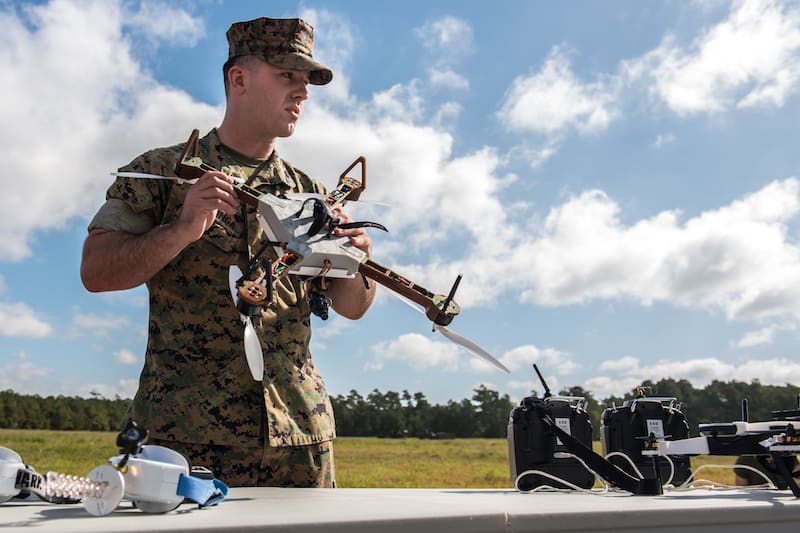
Army researchers are working with the Marines to develop 3-D printed drones as materials science, aviation technology and software development merge to deliver new capabilities.
"Several years ago when we were collaborating with our academic partner, Georgia Tech, we had this project where we were focusing on design engineering of small unmanned aircraft systems," said Eric Spero, a team lead within the laboratory's Vehicle Technology Directorate.
Spero and his team brought their idea to fruition at the U.S. Army Training and Doctrine Command's annual event at Fort Benning, Georgia in 2016. The Army Expeditionary Warrior Experiment (AEWE) puts new technologies in the hands of soldiers.
Researchers at the U.S. Army Research Laboratory first envisioned on-demand printing with a suite of tools that would allow for soldiers to enter mission parameters and then get a 3-D printed aviation asset within 24 hours. They then reached out to the U.S. Marine Corps and started working with them to provide a software catalog that marines could use to select and print an unmanned aircraft system for a specific mission.
Additive manufacturing, or 3-D printing, is maturing as a viable means to produce mission-essential parts or equipment at the point of need, said ARL engineer Larry "LJ" R. Holmes Jr. "We have interacted with marines who have never touched an unmanned system before to marines who are experts in unmanned aerial flight," Holmes said. "Across the board they all seemed to be very interested in the topic of being able to manufacture a tool that they can use that was mission specific and has a turnaround."
Holmes said the marines expected the turnaround to be days or weeks, and the ARL team showed them that the turnaround time can be anywhere from minutes to hours. Researchers said they plan to streamline their processes based on feedback received from the marines in order to enable unprecedented situational awareness.
"Things like additive manufacturing with materials, artificial intelligence and machine learning, unmanned systems technologies, these will enable us to bring together the capabilities that will allow the future soldiers and sarines the decisive edge that they need in the battlefield," said Elias Rigas, a division chief in ARL's Vehicle Technology Directorate.
The capability to print something from a spool of plastic that flies off on a military mission is something that captures the imagination, Holmes said.
More From SAE Media Group
Aerospace INSIDER
GA-ASI Announces Gray Eagle 25M for Multi-Domain Operations
Aerospace & Defense Tech Briefs
Autonomous Collaborative Platform
Defense INSIDER
In-Flight 3D Printing of Drone Parts on a Black Hawk Helicopter
Aerospace & Defense Tech Briefs
Vertical Takeoff and Landing Drone
Aerospace & Defense Tech Briefs
Counter-Drone Technology
Aerospace INSIDER
Navy Completes 73-Hour Nonstop Flight of Solar-Powered UAS

Aerospace INSIDER
Bombardier to Start Building New Army HADES Prototype Spy Plane
Defense INSIDER
Conference to Focus on Counter-Drone Technology
Aerospace & Defense Tech Briefs
Effectiveness of Inter-Vehicle Communications and On-Board Processing for Close Unmanned Autonomous Vehicle Flight Formations
Aerospace INSIDER
Two Startups Partner to Expand Hydrogen-Powered Drone Production
Aerospace & Defense Tech Briefs
Maritime Unmanned Aircraft System
Aerospace & Defense Tech Briefs
Remotely Piloted Air Systems

Aerospace & Defense Tech Briefs
Autonomous Air Defense Production
Aerospace Manufacturing and Machining INSIDER
Army Seeks to Expand 3D Printing to the Tactical Edge
Aerospace & Defense Tech Briefs
Rising Star Awards: Women in Engineering Aerospace Winner - Heather Cummings
Aerospace & Defense Tech Briefs
Key Reasons to Attend the UAV Technology USA Conference 2022
Aerospace & Defense Tech Briefs
XPONENTIAL 2019 – An AUVSI Experience
Aerospace & Defense Tech Briefs
3D-Printed NACA Inlet
Aerospace & Defense Tech Briefs
Enabling Off-the-Shelf Autonomous Naval Warfare
Aerospace & Defense Tech Briefs
Mobile Counter Unmanned Aircraft System
Podcasts
A.I. in the Air
Aerospace & Defense Tech Briefs
Drone Control System

Aerospace & Defense Tech Briefs
101st Combat Aviation Brigade Makes History with First MUOS Connectivity in a Helicopter
Aerospace & Defense Tech Briefs
GOKBERK C-UAS Testing
Defense INSIDER
Sky Devils Provide Critical Link to Soldiers
Top Stories
NewsSensors/Data Acquisition
 Microvision Aquires Luminar, Plans Relationship Restoration, Multi-industry Push
INSIDERRF & Microwave Electronics
 A Next Generation Helmet System for Navy Pilots
INSIDERWeapons Systems
 New Raytheon and Lockheed Martin Agreements Expand Missile Defense Production
NewsAutomotive
 Ford Announces 48-Volt Architecture for Future Electric Truck
INSIDERAerospace
 Active Strake System Cuts Cruise Drag, Boosts Flight Efficiency
ArticlesTransportation

Webcasts
Aerospace
 Cooling a New Generation of Aerospace and Defense Embedded...
Energy
 Battery Abuse Testing: Pushing to Failure
Power
 A FREE Two-Day Event Dedicated to Connected Mobility
Automotive
 Quiet, Please: NVH Improvement Opportunities in the Early Design Cycle
Electronics & Computers
 Advantages of Smart Power Distribution Unit Design for Automotive &...
Unmanned Systems
 Sesame Solar's Nanogrid Tech Promises Major Gains in Drone Endurance