




Additive Manufacturing
 The NanoSteel® Company (Providence, RI) has announced the expansion of its additive manufacturing (AM) material capabilities to support metal 3D printing of complex high-hardness parts and the ability to customize properties layer-by-layer through gradient material design. The company leveraged its 2014 breakthrough in AM wear materials to print a bearing and impeller using the powder bed fusion process. These parts were measured to be fully dense and crack-free, with hardness levels >1000 HV.
Building on this milestone, the company used a combination of high-hardness and ductile alloys to create a part featuring a gradient design. NanoSteel worked with Connecticut Center for Advanced Technology to generate part samples using freeform direct laser deposition. This single additive manufacturing process achieved a seamless transition between the hard and ductile properties without subsequent heat treatment. These gradient material designs offer the equivalent of “digital case hardening™” —delivering impact resistance and overall robustness in addition to high hardness and wear resistance in a single part.
For Free Info Click Here
More From SAE Media Group

Aerospace & Defense Tech Briefs
Industrial-Scale Metal 3D Printer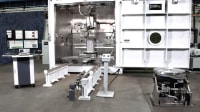
Aerospace & Defense Tech Briefs
High-Strength Aluminum Powder Developed for Additive Manufacturing in Aerospace, Automotive


Automotive Engineering
Brunel Pursues Ultrasound for ‘Greener’ Production of Aluminum Alloys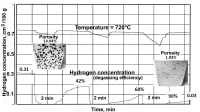
Aerospace & Defense Tech Briefs
Cold Spray Technology

Aerospace Manufacturing and Machining INSIDER
Can This Self-Healing Composite Make Airplane and Spacecraft Components Last for Centuries?
Aerospace & Defense Tech Briefs
Silicon Carbide Foam
Aerospace & Defense Tech Briefs
Equispheres Accelerates Additive Manufacturing Innovation with $5M from Lockheed Martin
Aerospace INSIDER
High-Power Contacts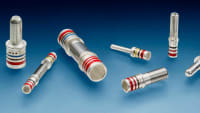
Aerospace & Defense Tech Briefs
3-D Manufacturing of Titanium Components Takes Off

Aerospace Manufacturing and Machining INSIDER
Cracking in Harsh Environments Needs Both Stress and Corrosion
Aerospace & Defense Tech Briefs
Portable 3D Printing Factory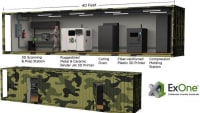
Aerospace Manufacturing and Machining INSIDER
Researchers Push Limits in High-Temp, Polymer Additive Manufacturing

Aerospace Manufacturing and Machining INSIDER
Superstrong Al Alloys May Change Aerospace Manufacturing Processes
Aerospace INSIDER
Lightweight Compression Latch
Aerospace & Defense Tech Briefs
Laser Wire Additive Manufacturing System

Aerospace & Defense Tech Briefs
Hardide Coatings to Construct Two Additional U.S.-Based Reactors
Aerospace & Defense Tech Briefs
3D Printing Parts for Ships, Submarines and Underwater Vehicles

Aerospace & Defense Tech Briefs
Chemical Agent Resistant Coating

Tech Briefs
Self-Healing, Recyclable, Shape Memory Polymers

Top Stories
INSIDERManufacturing & Prototyping
 How Airbus is Using w-DED to 3D Print Larger Titanium Airplane Parts
INSIDERManned Systems
 FAA to Replace Aging Network of Ground-Based Radars
NewsTransportation
 CES 2026: Bosch is Ready to Bring AI to Your (Likely ICE-powered) Vehicle
NewsSoftware
 Accelerating Down the Road to Autonomy
EditorialDesign
 DarkSky One Wants to Make the World a Darker Place
INSIDERMaterials
 Can This Self-Healing Composite Make Airplane and Spacecraft Components Last...
Webcasts
Defense
 How Sift's Unified Observability Platform Accelerates Drone Innovation
Automotive
 E/E Architecture Redefined: Building Smarter, Safer, and Scalable...
Power
 Hydrogen Engines Are Heating Up for Heavy Duty
Electronics & Computers
 Advantages of Smart Power Distribution Unit Design for Automotive...
Unmanned Systems
 Quiet, Please: NVH Improvement Opportunities in the Early Design...
