




Cracking in Harsh Environments Needs Both Stress and Corrosion
Alloys (metals combining two or more metallic elements) are typically stronger and less susceptible to cracking than pure metals. Yet when alloys are subjected to stress and a harsh chemical environment, the alloy can fail.
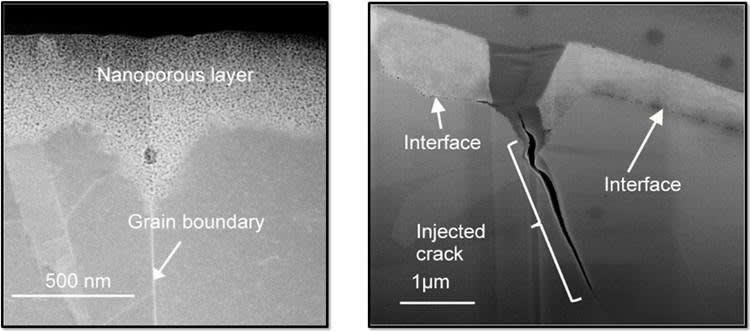
The reason? Cracks caused by corrosion. The cracks are generally thought to propagate slowly by the simultaneous, parallel actions of stress and corrosion where the tip of the crack never proceeds beyond the corroded area. Now, researchers revealed that the cracking proceeds more quickly than they originally thought. That is, stress can inject a crack far into the un-corroded region.
The research team studied a form of corrosion called intergranular stress-corrosion cracking (IGSCC). Caused by environmental conditions, this type of corrosion causes cracks to propagate through alloys. It leads to the degradation of materials often used in bridges, airplanes, and power-generating stations. The research shows that the structure that forms where tiny grains of two metals meet in an alloy can lead to cracks in an area previously unaffected by corrosion. This insight is critical to designing new alloys that deter stress corrosion-induced failures and to better assessing the lifetime of existing alloys in service.
Scientists believed IGSCC requires the simultaneous presence of tensile stress and corrosion; however, the exact nature of this synergy has eluded experimental identification. The team examined the behavior of a laboratory model silver-gold alloy. The alloy mimics the corrosion behavior of important engineering alloys, such as stainless steels and nickel-based alloys used in nuclear power plants. Corrosion in these engineering alloys, as in the model silver-gold alloy, results in nanometer-sized holes within the corroded layer.
A key parameter determining the occurrence of rapid IGSCC is the adhesion between the corroded layer and the un-corroded alloy. To study the alloy, the team used atomic-scale techniques, together with statistical characterizations. They determined that the apparent requirement for the simultaneous presence of stress and corrosion exists because of time-dependent morphology changes that affect adhesion. As long as adequate adhesion between the layers is maintained, a crack that starts with the corroded layer may penetrate into the un-corroded alloy. If the nanoporous corroded layer breaks away from the un-corroded alloy, the local stress drops and the crack only grows slowly. This means that there can be a significant mechanical component to stress-corrosion cracking that cannot be identified by any measurement of corrosion.
It also means that the crack can progress even if the stress is applied after the corrosion stops. The result is that a corrosion measurement can underestimate the rate of stress-corrosion cracking by multiplicative factors of 10 or more. The research clearly shows that the roles of stress and corrosion can be decoupled, but there is synergy in these effects that leads to material failure. The results provide a path forward for obtaining a more complete understanding of IGSCC of alloys that are currently used. The new understanding also provides a foundation for designing new materials with improved properties for harsh energy and industrial environments.
More From SAE Media Group

Aerospace Manufacturing and Machining INSIDER
Superstrong Al Alloys May Change Aerospace Manufacturing Processes
Aerospace & Defense Tech Briefs
Evaluation of Additively Manufactured Ultrahard Steels
Aerospace Manufacturing and Machining INSIDER
Can This Self-Healing Composite Make Airplane and Spacecraft Components Last for Centuries?
Aerospace & Defense Tech Briefs
Improving the Surface Finish of Additive Manufactured Parts
Tech Briefs
Method 3D-Prints Marine-Grade Stainless Steel
Aerospace & Defense Tech Briefs
Multifunctional Shear Pressed CNT Sheets for Strain Sensing and Composite Joint Toughening
Aerospace Manufacturing and Machining INSIDER
Riveting Technology Enables Lightweight Magnesium Fasteners for Fuel Efficiency
Aerospace & Defense Tech Briefs
Remanufacturing Reimagined: How Selective Electroplating Extends Service Life and Reduces the Cost of Aerospace Components
Aerospace INSIDER
A New Platform for Developing Advanced Aerospace Metals at Scale

Aerospace & Defense Tech Briefs
SAE International Issues First Technical Standards for Aerospace Additive Manufacturing
Aerospace & Defense Tech Briefs
Unlocking the Potential of 3D-Printed Polymers in Aerospace and Defense

Aerospace & Defense Tech Briefs
Plasma Electrolytic Oxidation: The Future of Lightweight Designs in Aerospace and Defense
Aerospace & Defense Tech Briefs
Robotic Rotational Molding Creates New Opportunities for Military and Aerospace Applications
Aerospace & Defense Tech Briefs
Metal-Plated, High-Temperature Plastics

Off-Highway Engineering
Churning Toward Stronger, More Uniform Aluminum Casts
Aerospace INSIDER
Nylon Shapes and Custom Parts
Aerospace & Defense Tech Briefs
Cold Spray Technology
Aerospace & Defense Tech Briefs
Designing for Space and Other Extreme Environments
Aerospace & Defense Tech Briefs
Additive Manufacturing Adoption Up, Growing Rapidly in Aerospace
Tech Briefs
Using 3D Printing to Strengthen Jet Engines
Photonics & Imaging Technology
Deformation Fingerprints Will Help Researchers Identify, Design Better Metallic Materials
Aerospace Manufacturing and Machining
Aerospace Work Platforms — More than Meets the Eye

Aerospace & Defense Tech Briefs
The Rapid Rise of Beryllium-Aluminum Alloys in Aerospace

Top Stories
INSIDERManufacturing & Prototyping
 How Airbus is Using w-DED to 3D Print Larger Titanium Airplane Parts
INSIDERManned Systems
 FAA to Replace Aging Network of Ground-Based Radars
NewsTransportation
 CES 2026: Bosch is Ready to Bring AI to Your (Likely ICE-powered) Vehicle
NewsSoftware
 Accelerating Down the Road to Autonomy
EditorialDesign
 DarkSky One Wants to Make the World a Darker Place
INSIDERMaterials
 Can This Self-Healing Composite Make Airplane and Spacecraft Components Last...
Webcasts
Defense
 How Sift's Unified Observability Platform Accelerates Drone Innovation
Automotive
 E/E Architecture Redefined: Building Smarter, Safer, and Scalable...
Power
 Hydrogen Engines Are Heating Up for Heavy Duty
Electronics & Computers
 Advantages of Smart Power Distribution Unit Design for Automotive...
Unmanned Systems
 Quiet, Please: NVH Improvement Opportunities in the Early Design...
