




Automotive Engineering - November/December 2018
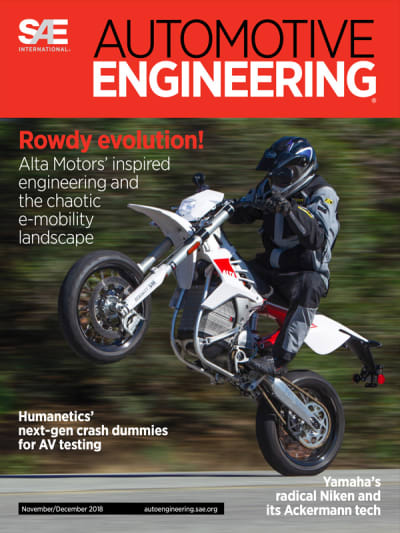
Inside this issue
Overview
The November/December 2018 issue of Automotive Engineering delves into the evolving landscape of the automotive industry, highlighting key themes such as the disconnect between original equipment manufacturers (OEMs) and suppliers, the challenges faced by electric vehicle startups, and the impact of advanced technologies on vehicle design and safety.
OEM-Supplier Disconnect
A significant focus of this issue is the ongoing disconnect between OEMs and their suppliers. Several contributors express frustration over the lack of recognition for suppliers' contributions during vehicle launches. Hari N. Agrawal, President of Hari Engineering Services, emphasizes that while OEMs acknowledge their suppliers at annual awards, they often neglect to highlight their roles during vehicle launches. This omission not only limits visibility for suppliers but also undermines the collaborative nature of automotive innovation. Agrawal argues that including supplier contributions in vehicle launch materials could enhance their visibility and credibility, particularly in the eyes of investors.
Eric Tingwall, Technical Director at Car and Driver, echoes this sentiment, noting that the automotive media often overlooks the expertise of suppliers when reporting on new technologies. He advocates for a more transparent approach that acknowledges the critical role suppliers play in developing advanced automotive technologies. Philip Li and Pearce Hughes also contribute to this discussion, calling for a shift in how the industry presents its innovations, suggesting that a model akin to "Intel Inside" could benefit both OEMs and suppliers.
Challenges in the Electric Vehicle Market
The issue also touches on the challenges faced by electric vehicle manufacturers, particularly startups like Alta Motors. The editorial note mentions that Alta Motors halted production of its battery-electric motorcycles without issuing a public statement, highlighting the precarious nature of establishing a sustainable vehicle OEM. The story of Alta Motors serves as a cautionary tale for other startups in the electrified mobility space, illustrating the significant risks involved in bringing new technologies to market.
Technological Advancements and Safety
In addition to discussions about industry dynamics, the magazine explores the integration of advanced technologies in vehicle design. The use of capacitive touchscreens is highlighted as a key trend in modern vehicles, with simulation tools like COMSOL Multiphysics® being utilized to enhance touchscreen design and functionality. These tools allow engineers to create more intuitive and responsive interfaces, improving the overall user experience.
Furthermore, the issue addresses the role of thermal imaging technology in enhancing automotive safety. The use of FLIR thermal cameras is discussed as a means to improve visibility and awareness for drivers, particularly in low-light conditions. As the industry moves towards greater automation, the integration of such technologies is seen as essential for ensuring safety and reliability in autonomous vehicles.
The ACES Hype
Another critical theme in this issue is the hype surrounding Automated, Connected, Electrified, and Shared (ACES) systems. Michael Robinet's column critiques the industry's focus on ACES at the expense of traditional vehicle systems. He warns that while significant investments are being made in ACES technologies to satisfy market demands, there may be a corresponding decline in funding for essential hardware systems like powertrains and chassis. Robinet advocates for a balanced approach that prioritizes both innovative technologies and the foundational components that ensure vehicle performance and safety.
Conclusion
Overall, the November/December 2018 issue of Automotive Engineering provides a comprehensive overview of the current state of the automotive industry, emphasizing the importance of collaboration between OEMs and suppliers, the challenges faced by electric vehicle startups, and the need for a balanced approach to technological advancement. As the industry continues to evolve, the insights shared in this issue serve as a valuable resource for understanding the complexities and opportunities that lie ahead in automotive engineering.
Features
-
Articles
New 2019 Yamaha Niken Steers a Radical Path
Regulars
-
Editorial
-
SAE Standards News
-
Supplier Eye
-
The Navigator
-
What We're Driving
2018 Hyundai Kona Ultimate AWD
-
Technology Reports
New Four-Chamber Rotary Engine Could Supplant Wankel and Piston Engines for UAV Applications
Mazda Details Electrification Strategy, Confirms Rotary Engine’s Return
Nexteer Readies Steering Technologies for Autonomous and Mixed-Mode Driving
Stories
-
News
ACM President and Michigan DOT Director Steudle Keynote Kicks off SAE ADAS Event
Intel’s New U.S. Study Claims Autonomous Vehicles Expected to Be Common in 50 Years
Air- or Water-Cooling Resistors for EVs: The Case for H2O
Gordon Murray Calls New IStream Superlight Chassis Concept a Paradigm Shift
Automotive Manufacturing & Machining
-
Tech Reports
Siemens Software Gets Weekly NASCAR Workout with Hendrick Motorsports
Atlas Copco Takes Smart-Manufacturing Tools and Systems on Tour
Top Stories
NewsSensors/Data Acquisition
 Microvision Aquires Luminar, Plans Relationship Restoration, Multi-industry Push
INSIDERRF & Microwave Electronics
 A Next Generation Helmet System for Navy Pilots
INSIDERWeapons Systems
 New Raytheon and Lockheed Martin Agreements Expand Missile Defense Production
NewsAutomotive
 Ford Announces 48-Volt Architecture for Future Electric Truck
INSIDERAerospace
 Active Strake System Cuts Cruise Drag, Boosts Flight Efficiency
ArticlesTransportation

Webcasts
Aerospace
 Cooling a New Generation of Aerospace and Defense Embedded...
Energy
 Battery Abuse Testing: Pushing to Failure
Power
 A FREE Two-Day Event Dedicated to Connected Mobility
Automotive
 Quiet, Please: NVH Improvement Opportunities in the Early Design Cycle
Electronics & Computers
 Advantages of Smart Power Distribution Unit Design for Automotive &...
Unmanned Systems
 Sesame Solar's Nanogrid Tech Promises Major Gains in Drone Endurance