




Aerospace & Defense Technology - October 2017
Inside this issue
Overview
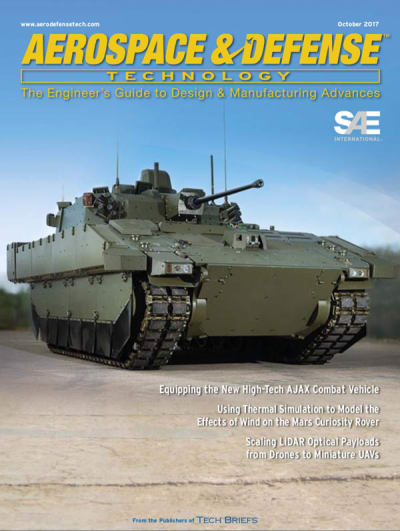
The October 2017 issue of Aerospace & Defense Technology presents a comprehensive overview of the latest advancements and innovations in the aerospace and defense sectors. This edition features a variety of articles that delve into cutting-edge technologies, simulation techniques, and applications relevant to military and aerospace operations.
Key Features:
-
Robotics and Thermal Simulation: One of the standout articles discusses the use of thermal simulation to model the effects of wind on the Mars Curiosity Rover. This research is crucial for understanding how environmental factors can impact the performance of robotic systems in extraterrestrial environments. The findings can help improve the design and functionality of future missions to Mars and other planets.
-
Software and Simulation: The issue highlights the importance of quality and validation in digital designs for aerospace and defense applications. As the industry increasingly relies on digital models and simulations, ensuring their accuracy and reliability is paramount. This article explores methodologies for validating these designs, which can lead to safer and more effective aerospace systems.
-
Avionics and Flight Controls: Another significant feature focuses on scaling LiDAR optical payloads from drones to miniature UAVs. This technology is essential for various applications, including surveillance, mapping, and environmental monitoring. The article discusses the challenges and solutions associated with miniaturizing these systems while maintaining performance and accuracy.
-
Acoustic Attenuation: The magazine also covers the use of sintered fiber metal composites for aircraft acoustic attenuation. This innovative material can significantly reduce noise levels in aircraft, enhancing passenger comfort and meeting regulatory requirements. The article details the properties of these composites and their potential applications in the aerospace industry.
-
RF & Microwave Technology: The issue features a discussion on Gallium Nitride (GaN) technology, which is breaking barriers in RF and microwave applications. GaN devices offer higher efficiency and power density compared to traditional materials, making them ideal for military and aerospace applications. The article outlines the advantages of GaN technology and its impact on the future of RF systems.
-
Test Systems for Military RF Devices: Ensuring the flawless performance of military RF devices is critical for mission success. The magazine presents a test system designed to validate the performance of these devices under various conditions. This system is essential for maintaining the reliability and effectiveness of communication and radar systems used in defense operations.
Tech Briefs: The issue includes several tech briefs that provide insights into specific technologies and research findings:
-
Video Compression and Cardiac Pulse Measurement: This brief discusses the impact of video compression on remote cardiac pulse measurement using imaging photoplethysmography, highlighting advancements in medical imaging technology.
-
Sensitivity Simulation in Electronic Warfare: Another brief focuses on the sensitivity simulation of a compressed sensing-based electronic warfare receiver using the orthogonal matching pursuit algorithm, showcasing innovations in electronic warfare technologies.
-
Ballistic Shock Accelerometers: The initial validation of ballistic shock accelerometers is covered, emphasizing their importance in measuring shock and vibration in military applications.
-
Custom Data Logger: A custom data logger for real-time remote field data collection is introduced, which can enhance data acquisition in various aerospace and defense scenarios.
-
Dust-Emission Sources Mapping: The magazine also features a study on subjective mapping of dust-emission sources using MODIS imagery, which can aid in environmental monitoring and management.
-
Topology Control in Aerial Networks: The issue concludes with a brief on topology control in aerial multi-beam directional networks, which is vital for improving communication and data transfer in UAV operations.
Departments: The magazine includes various departments such as application briefs, new products, and an advertisers index, providing readers with additional resources and information on the latest offerings in the aerospace and defense industry.
Conclusion: Overall, the October 2017 issue of Aerospace & Defense Technology serves as a valuable resource for professionals in the aerospace and defense sectors. It highlights significant technological advancements, innovative research, and practical applications that are shaping the future of these industries. With a focus on robotics, simulation, avionics, and materials science, this edition provides insights that can inform and inspire ongoing developments in aerospace and defense technology.
Features
-
Application Briefs
-
Articles
Scaling LiDAR Optical Payloads from Drones to Miniature UAVs
Quality and Validation of Digital Designs for Aerospace and Defense
Test System Ensures Flawless Performance of Military RF Devices
Using Sintered Fiber Metal Composites for Aircraft Acoustic Attenuation
Using Thermal Simulation to Model the Effects of Wind on the Mars Curiosity Rover
Tech Briefs
-
Electronics & Computers
-
Test & Measurement
Subjective Mapping of Dust-Emission Sources by Using MODIS Imagery
Custom Data Logger for Real-Time Remote Field Data Collections
Products
Top Stories
INSIDERDefense
 New Raytheon and Lockheed Martin Agreements Expand Missile Defense Production
NewsAutomotive
 Ford Announces 48-Volt Architecture for Future Electric Truck
INSIDERManufacturing & Prototyping
 Active Strake System Cuts Cruise Drag, Boosts Flight Efficiency
ArticlesTransportation
 Accelerating Down the Road to Autonomy
INSIDERMaterials
 How Airbus is Using w-DED to 3D Print Larger Titanium Airplane Parts
Road ReadyTransportation

Webcasts
Electronics & Computers
 Cooling a New Generation of Aerospace and Defense Embedded...
Power
 Battery Abuse Testing: Pushing to Failure
Connectivity
 A FREE Two-Day Event Dedicated to Connected Mobility
Automotive
 Quiet, Please: NVH Improvement Opportunities in the Early Design Cycle
Transportation
 Advantages of Smart Power Distribution Unit Design for Automotive &...
Aerospace
 Sesame Solar's Nanogrid Tech Promises Major Gains in Drone Endurance