




Initial Validation of Ballistic Shock Accelerometers
A Test Operations Procedure (TOP) describing methods and instrumentation used in the initial validation of accelerometers to be used in both Ballistic Shock testing and crew/vehicle survivability Live Fire Test and Evaluation (LFT&E).
Method 522.2 of MIL-STD-810G CN1 defines ballistic shock as “a high-level shock that generally results from the impact of projectiles or ordnance on armored combat vehicles”. Typical engagements of interest also include Kinetic Energy projectiles, land mines, and improvised explosive devices. For the purposes of this TOP, ballistic shock is generally referred to as the sudden high-rate loading resulting from under body blast (UBB) testing designed to assess the crew-survivability of military vehicles. Historical testing conducted in both areas have proven the relative similarities between the two environments.
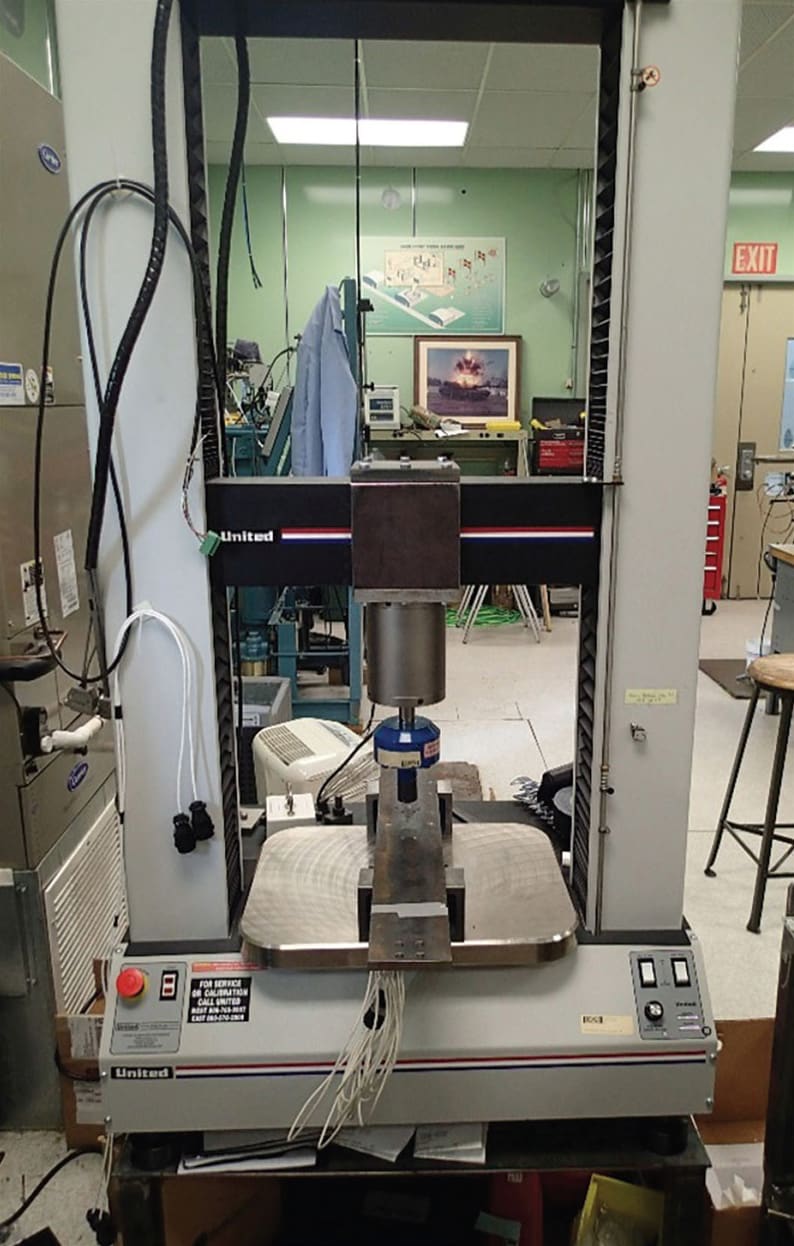
Live-fire and other ground tests conducted with modern instrumentation have proven that the damage potential of ballistic shock is not only to the test item, but also to the instrumentation used to quantify the severity of the event. One of the primary interests of ballistic shock studies is to ensure that armored vehicles and their occupants survive the encounter while retaining their mission capabilities. To help assess this, the instrumentation used to quantify the survivability of the event must itself survive the test and provide accurate data.
One of the primary means of collecting ballistic shock data is through the use of accelerometers. Capturing valid acceleration data in this environment can be particularly challenging. Many preparations must be taken to ensure the highest likelihood of obtaining a valid record. For example, data acquisition systems must be placed several hundred feet from the test pad in a hardened bomb-proof enclosure, and instrumentation cabling must be protected from fragmentation with underground troughs, steel beams, and flexible ballistic wrapping. Care must be taken to ensure that instrumentation cabling isn't susceptible to triboelectric effects resulting from blast overpressure exposure. Proper strain relief techniques must be used on accelerometer cabling to ensure cable “whip” is reduced as much as possible. Mounting surfaces must be prepped according to manufacturer's recommendations and the proper mounting torque must be used to mount the accelerometer. Data acquisition systems must also be configured to eliminate data aliasing and out-of-band energy contamination.
Even if all of the necessary preparatory steps are followed, it can still prove difficult to capture accurate acceleration data in the ballistic shock environment. This is because most, if not all, high-g accelerometers used in this environment are vulnerable to errors and damage from the broad frequency and high amplitude of the mechanical input. Most high-g silicon MEMS accelerometers commercially available have two main vulnerabilities: base-strain sensitivity and resonance susceptibility. High-g accelerometers have been produced that can measure upwards of 200,000g but are oftentimes undamped and have high resonant frequencies (hundreds of Kilohertz (kHz)). Their high-resonant frequency, low-damping design also means there will be a large amplification at the resonance of the seismic mass. Q-Factors of up to 1,000X have been identified.
The broad spectrum of ballistic shock almost guarantees some magnitude of frequency content at or near the resonant frequency of the accelerometer. This leaves the accelerometer extremely susceptible to resonance during a ballistic shock event as little power is required to excite the resonant frequency. Large deflections of vehicle subfloors subjected to underbody blast load can create a strain at the base of the sensor that can cause a DC acceleration output from the accelerometer. Though brief, these DC offsets can accumulate to significant error when integrating acceleration data to obtain velocity information.
For these reasons, it is often necessary to perform an “initial validation” of accelerometers to qualify their performance in the ballistic shock test environment before being utilized in a test for record.
This work was done by the Ballistics Instrumentation Division (TETD-AT-SLB) for the Army Test and Evaluation Command. ARL-0205
This Brief includes a Technical Support Package (TSP).
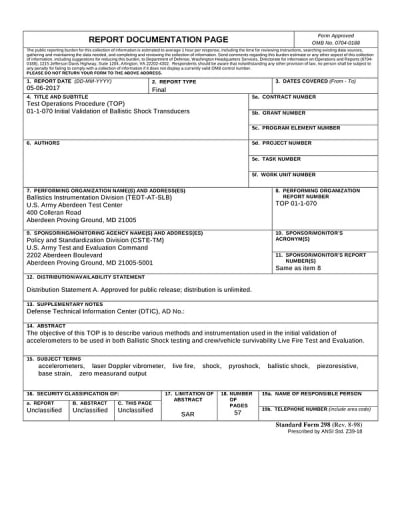
Test Operations Procedure (TOP) 01-1-070 Initial Validation of Ballistic Shock Transducers
(reference ARL-205) is currently available for download from the TSP library.
Don't have an account?
More From SAE Media Group
Tech Briefs
Laser-Light-Based Accelerometer
Motion Design
Inductive Non-Contact Position Sensor
Aerospace & Defense Tech Briefs
WIAMan
Tech Briefs
Drones Use Machine Learning to Detect Landmines
Tech Briefs
System Helps Drones Detect and Avoid Power Lines
Aerospace & Defense Tech Briefs
Data Collection Using the MetalMapper in Dynamic Data Acquisition and Cued Modes
Aerospace & Defense Tech Briefs
Using Turbine Flow Meters for Aerospace Test and Measurement Applications
Aerospace & Defense Tech Briefs
Investigation of Flight Dynamics and Controls for a Solar-Tracker-Mounted UAV
Aerospace & Defense Tech Briefs
Bore Elevation and Azimuth Measurement System (Beams)

Motion Design
Insect-Inspired Motion Sensing
Aerospace & Defense Tech Briefs
Designing for the Connected Battlespace
Aerospace & Defense Tech Briefs
Angular Random Walk Estimation of a Time-Domain Switching Micromachined Gyroscope

Aerospace & Defense Tech Briefs
Ka-Band Front-End Monolithic Microwave Integrated Circuits (MMICs) and Transmit/Receive (T/R) Modules Testing
Aerospace & Defense Tech Briefs
Inter-Laboratory Combat Helmet Blunt Impact Test Method Comparison
Motion Design
High-Sensitivity, Low-Noise MEMS Accelerometer
Aerospace & Defense Tech Briefs
Five Missile-Tracking Satellites Launched
Aerospace & Defense Tech Briefs
Electronic Warfare: Vying for Control of the Electromagnetic Spectrum
Aerospace & Defense Tech Briefs
Drift Improvement with Reinforcement Training of Inertial Sensors

Aerospace & Defense Tech Briefs
Calculating Electrical Requirements for Direct Current Electric Actuators
Motion Design
Built-In Vibration Control to Soundproof Spaces
Tech Briefs
Split-Ring Torque Sensor
Aerospace & Defense Tech Briefs
Unmanned Aerial Systems Electromagnetic Induction Sensor Development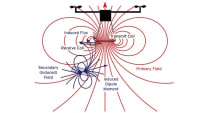
Aerospace & Defense Tech Briefs
sUAS-Based Payload Development and Testing for Quantifying Optical Turbulence
Aerospace & Defense Tech Briefs
Determining Detection and Classification Potential of Munitions Using Advanced EMI Sensors in the Underwater Environment
Tech Briefs
Drone Zips Through Narrow Windows On Its Own
Tech Briefs
Thin Film Sensor for Ultra High-Temp Measurement
Overview
The document titled "TOP 01-1-070," dated 5 June 2017, serves as a Test Operations Procedure (TOP) focused on the validation of ballistic shock transducers, specifically accelerometers used in military applications. The primary aim of this document is to establish standardized methods for testing and validating the performance of these transducers under conditions that simulate ballistic shock environments.
The document outlines the necessary procedures for conducting tests, including the setup of instrumentation, calibration of equipment, and the specific methodologies to be employed during testing. It emphasizes the importance of ensuring that the accelerometers can accurately measure the high-frequency shock waves generated during ballistic events, which is critical for assessing the survivability of military personnel and equipment.
Key sections of the document include detailed descriptions of the testing environment, the types of equipment required, and the protocols for data collection and analysis. It also addresses the need for compliance with military standards, specifically referencing Military Standard 810G, which provides guidelines for environmental testing of equipment. This ensures that the accelerometers meet the rigorous demands of military operations.
The document also highlights the significance of proper documentation and reporting of test results, which are essential for validating the performance of the transducers. It outlines the responsibilities of personnel involved in the testing process and the importance of adhering to safety protocols during live fire tests.
Overall, "TOP 01-1-070" is a critical resource for military engineers and technicians involved in the testing and validation of ballistic shock transducers. By providing a clear framework for testing procedures, it aims to enhance the reliability and effectiveness of these instruments, ultimately contributing to the safety and survivability of military operations. The document underscores the necessity of rigorous testing to ensure that equipment can withstand the extreme conditions encountered in combat scenarios.
In summary, this document is a comprehensive guide that plays a vital role in the military's efforts to ensure that accelerometers used in ballistic shock testing are validated and reliable, thereby supporting the overall mission of enhancing crew and vehicle survivability.
Top Stories
INSIDERManufacturing & Prototyping
 How Airbus is Using w-DED to 3D Print Larger Titanium Airplane Parts
INSIDERManned Systems
 FAA to Replace Aging Network of Ground-Based Radars
NewsTransportation
 CES 2026: Bosch is Ready to Bring AI to Your (Likely ICE-powered) Vehicle
NewsSoftware
 Accelerating Down the Road to Autonomy
EditorialDesign
 DarkSky One Wants to Make the World a Darker Place
INSIDERMaterials
 Can This Self-Healing Composite Make Airplane and Spacecraft Components Last...
Webcasts
Defense
 How Sift's Unified Observability Platform Accelerates Drone Innovation
Automotive
 E/E Architecture Redefined: Building Smarter, Safer, and Scalable...
Power
 Hydrogen Engines Are Heating Up for Heavy Duty
Electronics & Computers
 Advantages of Smart Power Distribution Unit Design for Automotive...
Unmanned Systems
 Quiet, Please: NVH Improvement Opportunities in the Early Design...
