




Sensitivity Simulation of Compressed Sensing Based Electronic Warfare Receiver Using Orthogonal Matching Pursuit Algorithm
Calculate the sensitivity of a CS based EW receiver using two modulation schemes.
Electronic Intelligence Receiver (ELINT) is an important component in electronic warfare (EW) and layer sensing. The information it provides by constant surveillance can be used to detect, track and classify signals across the electromagnetic spectrum. The proper identification and reaction to the threat can avoid disaster and assure spectrum dominance for Air Force systems.

To meet the challenges in today's and tomorrow's EW environment where signals are increasingly sophisticated, more dynamic, and more crowded in radio frequency (RF) spectrum than before, digital wideband receivers are being developed. The current state-of the-art for digital receiver bandwidth coverage is reaching multi-GHz. The conventional wideband digital ELINT receiver design is based on the Nyquist information theory, whereby, bandwidth coverage is limited by the Nyquist sampling rate. Performance, therefore, depends on current high-speed ADC technology and computation hardware such as field-programmable gate arrays (FPGA).
While these technologies are advancing, the progress may not keep up with the demand of ELINT requirements driven by next generation cognitive and broadband EW capability needs. One potential leap-ahead is to apply compressed sensing (CS) to ELINT receiver development.
CS technique has received significant attention since the fundamental theory was proven in 2006. That research indicated that the band limited by the Nyquist sampling rate is too restrictive. It is particularly true when the signal is sparse, i.e., the signal can be represented by only a few significant components in an orthogonal basis. Under the sparse condition, one can devise a sampling scheme that takes a much-reduced data rate compared to a Nyquist sampling rate and still covers the same bandwidth. The sampling scheme usually involves modulating the incoming signal and sampling data after summing the modulated signal over an interval of several chips. The Nyquist waveform can be reconstructed using the reduced sampling if the measurement matrix representing the sampling scheme has the restrictive isometric property (RIP).
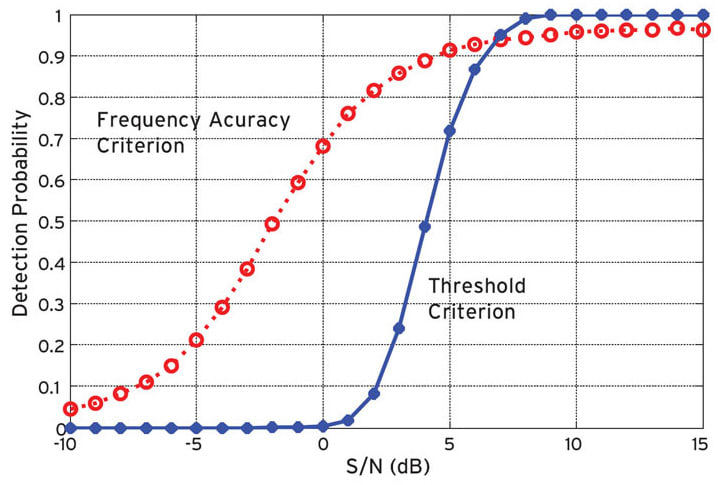
This study investigates two measurement matrices that exhibit high probability of RIP. One is the pseudorandom chip (PRC) and the other is non-uniform sampling (NUS). The PRC's measurement matrix element is a pseudorandom bit of +1 and -1 with equal probability. The scheme was proposed for image processing using a single pixel camera, where the field of view was masked by a grid structure of a random +1 and -1 pattern.
The NUS scheme was proposed and fabricated by the Defense Advanced Research Projects Agency's (DARPA) analog-to-information (A-to-I) program. In this scheme, an internal Nyquist rate (i.e., chip rate of modulation) of 4.8 GHz is applied. The sampling time is a pseudorandom integer number within a certain range of time grid determined by the internal Nyquist rate. The average sampling rate is about 300 MHz and the average down sampling rate is about 16.
Many reconstruction algorithms have been proposed to restore the original Nyquist waveform of sparse signal from the reduced sampling data set. These reconstruction algorithms have a range of complexity and accuracy. Orthogonal matching pursuit (OMP) was applied to assess the sensitivity of the receiver. OMP is a restoration algorithm developed at an early stage that locates and calculates the signal's component iteratively. There are two major computation steps in every iteration. One is to correlate the residual measurement data with the measurement basis to locate and update the signal component. The other is to update the signal's components using a least square fit scheme.
This work was done by Lihyeh Liou and David Lin of the Air Force Research Laboratory and Ethan Lin and Chien-In Chen of Wright State University. AFRL-0248
This Brief includes a Technical Support Package (TSP).
SENSITIVITY SIMULATION OF COMPRESSED SENSING BASED ELECTRONIC WARFARE RECEIVER USING ORTHOGONAL MATCHING PURSUIT ALGORITHM
(reference AFRL-0248) is currently available for download from the TSP library.
Don't have an account?
More From SAE Media Group
Tech Briefs
Test Strategies to Track Hypersonic Threats
Aerospace & Defense Tech Briefs
Co-Prime Frequency and Aperture Design for HF Surveillance, Wideband Radar Imaging, and Nonstationary Array Processing
Aerospace & Defense Tech Briefs
New Pulse Analysis Techniques for Radar and EW
Aerospace & Defense Tech Briefs
Advanced Satellite Communications Research
Aerospace & Defense Tech Briefs
Defeating Commercial Drone Threats with Software Defined Radio
Aerospace & Defense Tech Briefs
How to Test a Cognitive EW System
Aerospace & Defense Tech Briefs
Delta-Sigma UHF Digital Waveform Generator
Aerospace & Defense Tech Briefs
How to Specify and Select RF Filters
Aerospace & Defense Tech Briefs
Development of a 94 GHz Radar System for Dedicated Bird Detection at Airports and Airfields
Aerospace & Defense Tech Briefs
Defeating Commercial Drone Threats with Open-Source SDR
Aerospace & Defense Tech Briefs
Pathfinder Radar ISR and SAR Systems: Tactical Eyes for the Warfighter
Tech Briefs
Wireless, Wearable Transmitter
Aerospace & Defense Tech Briefs
Making Fully Digital Beamforming for Radar and Electronic Warfare Applications a Reality
Aerospace & Defense Tech Briefs
New Products
Aerospace & Defense Tech Briefs
Software-Defined Analog Filters: A Paradigm Shift in Radio Filter Performance and Capability


Electronics & Sensors INSIDER
Wi-Fi Signals Can Measure Heart Rate — No Wearables Needed
Aerospace & Defense Tech Briefs
An Integrated Framework for Complex Radar System Design
Electronics & Sensors INSIDER
New Transmitter Could Make Wireless Devices More Energy-Efficient

Aerospace & Defense Tech Briefs
SDR Interface for the NeXtRAD Multistatic Radar System


Aerospace & Defense Tech Briefs
EW: New Challenges, Technologies, and Requirements
Aerospace & Defense Tech Briefs
Quantifying Autonomous Soaring on a Surveillance and Communications Relay Mission
Aerospace & Defense Tech Briefs
Ka-Band Front-End Monolithic Microwave Integrated Circuits (MMICs) and Transmit/Receive (T/R) Modules Testing
Aerospace & Defense Tech Briefs
Digital Radar Warning Receiver
Aerospace & Defense Tech Briefs
Communications in Space: A Deep Subject
Aerospace & Defense Tech Briefs
The Next Generation of Mission-Critical Communications Infrastructure is Here
Overview
The document presents a study on the sensitivity of a compressed sensing (CS)-based electronic warfare (EW) receiver, which is being developed to enhance the processing of wideband sparse signals at reduced sampling rates. Traditional fast Fourier transform (FFT)-based EW receivers are limited by the sampling frequency of analog-to-digital converters (ADCs), which restricts their wideband coverage. The research aims to address these limitations by employing CS techniques.
The study focuses on two modulation schemes: pseudorandom chip (PRC) and non-uniform sampling (NUS). The orthogonal matching pursuit (OMP) algorithm is utilized to process the data obtained from these modulation schemes. The findings indicate that the insufficient sparsity of the signals negatively impacts the signal detection probability for both PRC and NUS schemes. To mitigate this issue, the authors propose methods to improve signal detection and enhance the sensitivity performance of the CS-based receiver.
The document is structured into several sections, including an abstract, introduction, results, and a summary of future work. The introduction outlines the motivation behind using CS for EW applications and the challenges faced with traditional methods. The results section discusses the performance of the CS-based receiver under different conditions and modulation schemes, providing insights into the effectiveness of the proposed solutions.
The report emphasizes the importance of improving signal detection capabilities in electronic warfare, where the ability to accurately detect and process signals can significantly impact operational effectiveness. The authors highlight the potential of CS techniques to revolutionize EW systems by allowing for more efficient data processing and improved performance in complex signal environments.
In conclusion, this document contributes to the ongoing research in electronic warfare by exploring innovative approaches to enhance receiver sensitivity through compressed sensing. The findings suggest that with further development and refinement, CS-based receivers could offer substantial advantages over traditional methods, paving the way for more advanced and capable EW systems. The report is unclassified and approved for public release, making it accessible for further study and application in the field.
Top Stories
INSIDERManufacturing & Prototyping
 How Airbus is Using w-DED to 3D Print Larger Titanium Airplane Parts
NewsAutomotive
 Microvision Aquires Luminar, Plans Relationship Restoration, Multi-industry Push
INSIDERAerospace
 A Next Generation Helmet System for Navy Pilots
INSIDERDesign
 New Raytheon and Lockheed Martin Agreements Expand Missile Defense Production
ArticlesAR/AI
 CES 2026: Bosch is Ready to Bring AI to Your (Likely ICE-powered) Vehicle
Road ReadyDesign

Webcasts
Semiconductors & ICs
 Advantages of Smart Power Distribution Unit Design for Automotive...
Unmanned Systems
 Quiet, Please: NVH Improvement Opportunities in the Early Design...
Electronics & Computers
 Cooling a New Generation of Aerospace and Defense Embedded...
Power
 Battery Abuse Testing: Pushing to Failure
AR/AI
 A FREE Two-Day Event Dedicated to Connected Mobility
