




Delta-Sigma UHF Digital Waveform Generator
The Delta-Sigma modulation technique meets the demanding requirements of future radar applications.
A prototype Digital Waveform Generator (DWG) in the ultra-high-frequency (UHF) range uses Delta-Sigma (Δ−Σ) modulation techniques, which permit arbitrary and accurate waveform generation. The DWG meets the demanding and diverse waveform requirements of future radar applications, including linear-FM (LFM) and continuous wave (CW) signals. This DWG also allows for the generation of waveforms at other frequencies by up-conversion or down-conversion.
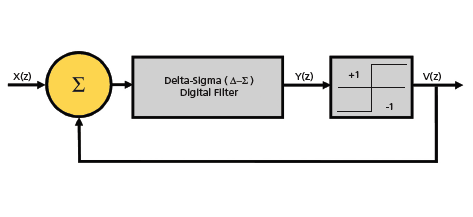
The Δ-Σ filter algorithm or Δ−Σ modulator is used to generate a single-bit waveform from the digital input data with a CW center frequency between 406 and 450 MHz, both with and without a 4 MHz bandwidth LFM, with a nominal pulsewidth of 10 μs and an available filter bandwidth of 50 MHz.
A simple, first-order modulator is shown in the figure. The output of the comparator, V(z), is also the output of the loop, which is full-scale ±1 V. At the summation, either +1 V or -1 V is added to the input voltage. The result is the input to the Δ−Σ digital filter. The digital filter can implement the filter equation using the two fundamental arithmetic operations, multiplication and addition (or accumulation). If the output of the digital filter, Y(z), is greater than 0 V, V(z) becomes +1 V; if it is less than 0 V, V(z) becomes -1 V. A no-change condition causes the modulated signal to remain at the same ±1 V state of the previous sample. Each operation occurs once during each clock cycle. The output of the loop, either +1 V or -1 V, will be saved in a single-bit data file as either a 1 or 0, respectively. Then the digital single-bit data series is converted to an analog signal by using a high-speed single-bit DAC. In general, first- and second-order modulators are stable, but stability must be considered in higher-order units.
Both transposed and hybrid Δ−Σ approaches were considered. The approaches included a comparison of transposed filters of various orders. The transposed filter quantization error in higher-order (e.g., M = 8) filters was considered and hybrid filters of various orders were compared. The transposed filter has a short critical path of two full additions and one multiply. It thus has the advantage of a short critical path and an efficient finite-impulse response (FIR) implementation. It is, however, extremely sensitive to coefficient quantization accuracy. Transposed filters were analyzed for three orders (M = 2, 4, 8). In particular, the sensitivity of quantization error vs signal-to-noise ratio (SNR) was investigated.
The Δ−Σ hybrid filter has the same critical path as the transposed filter. With the use of higher-order filters such as with M = 16, coefficient quantization reduces the SNR to an unacceptable level.
This work was done by Dr. Lawrence M. Leibowitz of SFA, Inc., and Sukomal Talapatra and Jimmy O. Alatishe of the Surveillance Technology Branch Radar Division of the Naval Research Laboratory.
NRL-0030
This Brief includes a Technical Support Package (TSP).
Delta-Sigma UHF Digital Waveform Generator
(reference NRL-0030) is currently available for download from the TSP library.
Don't have an account?
More From SAE Media Group
Aerospace & Defense Tech Briefs
Development of a 94 GHz Radar System for Dedicated Bird Detection at Airports and Airfields
Aerospace & Defense Tech Briefs
Co-Prime Frequency and Aperture Design for HF Surveillance, Wideband Radar Imaging, and Nonstationary Array Processing
RF & Microwave Technology
Spectrally Compliant Waveforms for Wideband Radar
Aerospace & Defense Tech Briefs
Advanced Satellite Communications Research
Tech Briefs
Architecture of an Autonomous Radio Receiver
Embedded Technology
Designing Versatile COTS Data Acquisition Systems
Aerospace & Defense Tech Briefs
Software-Defined Analog Filters: A Paradigm Shift in Radio Filter Performance and Capability

Tech Briefs
Radio Signals Image Hidden and Speeding Objects
Aerospace & Defense Tech Briefs
SDR Interface for the NeXtRAD Multistatic Radar System
Aerospace & Defense Tech Briefs
FPGAs and HPC
Aerospace & Defense Tech Briefs
An Integrated Framework for Complex Radar System Design
Aerospace & Defense Tech Briefs
New Pulse Analysis Techniques for Radar and EW
Aerospace & Defense Tech Briefs
New Products
Tech Briefs
Customizable Digital Receivers for Radar
Aerospace & Defense Tech Briefs
Sensitivity Simulation of Compressed Sensing Based Electronic Warfare Receiver Using Orthogonal Matching Pursuit Algorithm
Tech Briefs
Loss-Tolerant Speech Codec
Aerospace & Defense Tech Briefs
Qualification of Multi-Channel Direction Finding Radar Receivers in The Lab
Embedded Technology
16-Bit Data Acquisition Board
Tech Briefs
Digital Receiver for Microwave Radiometry


Aerospace & Defense Tech Briefs
Designing for Compressive Sensing: Compressive Art, Camouflage, Fonts, and Quick Response Codes
Overview
The document titled "Delta-Sigma UHF Digital Waveform Generator" is an interim report authored by Sukomal Talapatra, Jimmy O. Alatishe, and Dr. Lawrence M. Leibowitz from the Naval Research Laboratory, dated September 26, 2006. It focuses on the development and implementation of a digital waveform generator (DWG) utilizing Delta-Sigma (Δ-Σ) modulation techniques, which are significant in the field of radar and surveillance technology.
The report begins with an introduction to the Delta-Sigma algorithm, detailing its filter topologies and the principles behind Δ-Σ modulation. This modulation technique is known for its ability to convert analog signals into high-resolution digital signals, making it particularly useful in applications requiring precise waveform generation.
A significant portion of the document is dedicated to the system hardware description, emphasizing the use of Field Programmable Gate Arrays (FPGAs). The FPGA technology allows for a flexible and programmable logic environment, which is crucial for generating complex waveforms efficiently. The report outlines the high-level functionality of the UHF DWG, illustrating how it leverages current advancements in digital circuitry to enhance performance.
The document also includes sections on simulation, where both MatLab and FPGA simulations are discussed. These simulations are essential for validating the design and functionality of the DWG before physical implementation. The hardware implementation section provides insights into the practical aspects of constructing the DWG, ensuring that theoretical concepts are effectively translated into real-world applications.
Figures included in the report illustrate various aspects of the Δ-Σ modulation process, including typical modulator designs and the spectral characteristics of the generated waveforms. These visual aids enhance the understanding of the technical content and demonstrate the effectiveness of the proposed system.
In conclusion, the report summarizes the findings and acknowledges contributions from various individuals and organizations involved in the project. It emphasizes the potential of the Delta-Sigma UHF Digital Waveform Generator in advancing radar technology and improving surveillance capabilities.
Overall, this document serves as a comprehensive overview of the development of a sophisticated digital waveform generator, highlighting the integration of modern digital technologies and the innovative use of Δ-Σ modulation techniques in radar applications.
Top Stories
NewsRF & Microwave Electronics
 Microvision Aquires Luminar, Plans Relationship Restoration, Multi-industry Push
INSIDERAerospace
 A Next Generation Helmet System for Navy Pilots
INSIDERDesign
 New Raytheon and Lockheed Martin Agreements Expand Missile Defense Production
INSIDERMaterials
 How Airbus is Using w-DED to 3D Print Larger Titanium Airplane Parts
NewsPower
 Ford Announces 48-Volt Architecture for Future Electric Truck
ArticlesAR/AI

Webcasts
Electronics & Computers
 Cooling a New Generation of Aerospace and Defense Embedded...
Automotive
 Battery Abuse Testing: Pushing to Failure
Power
 A FREE Two-Day Event Dedicated to Connected Mobility
Unmanned Systems
 Quiet, Please: NVH Improvement Opportunities in the Early Design Cycle
Automotive
 Advantages of Smart Power Distribution Unit Design for Automotive &...
Energy
 Sesame Solar's Nanogrid Tech Promises Major Gains in Drone Endurance