




The Impact of Video Compression on Remote Cardiac Pulse Measurement Using Imaging Photoplethysmography
Remote physiological measurement technique leverages digital cameras to recover the blood volume pulse from the human body
Remote measurement of physiological signals has a number of advantages over traditional contact methods. It allows the measurement of vital signals unobtrusively and concomitantly. In recent years, a number of approaches for imaging-based measurement of physiology using digital cameras have been proposed. Imaging photoplethysmography (iPPG) captures variations in light reflected from the body due to blood volume changes in microvascular tissue. It has been demonstrated that sub-pixel variations in color channel measurements from a digital single lens reflex (DSLR) camera, when aggregated, could be used to recover the blood volume pulse. Subsequently, it was shown that iPPG methods can allow accurate measurement of heart rate, heart rate variability, breathing rate, blood oxygenation and pulse transit time.
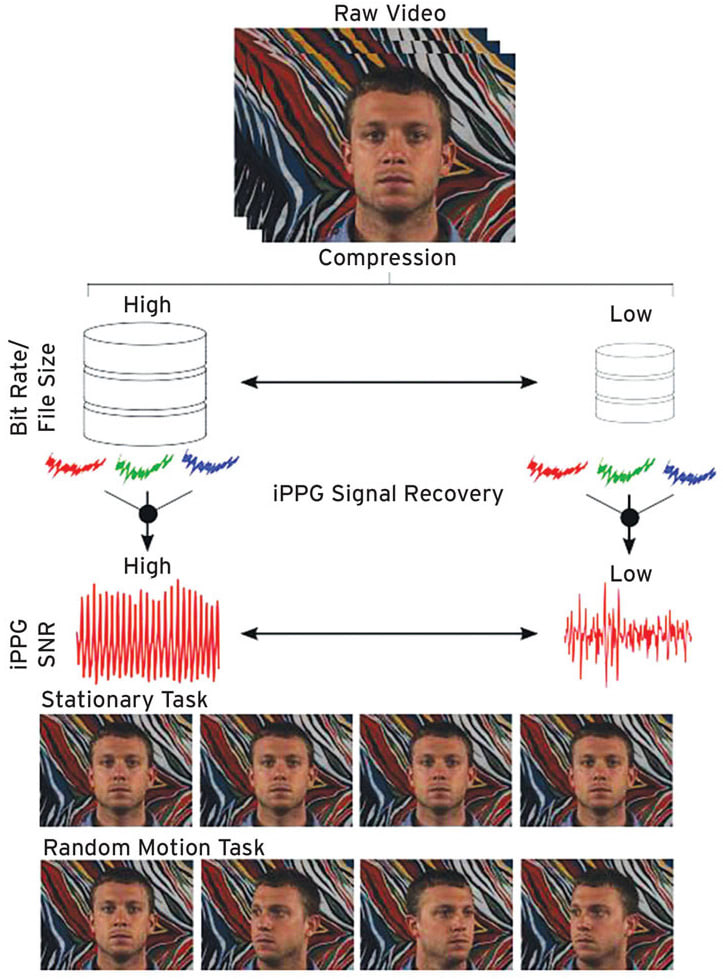
A number of parameters influence the accuracy of iPPG measurements. These include the imager quality, and the frame rate and resolution of the images. Previous research compared remote physiological measurement using a low cost webcam and a high-speed color CMOS and showed similar signals were captured from both cameras, further supporting that iPPG is a practical method for scalable applications such as telemedicine. It was also found that reducing frame rate from 120Hz to 30Hz and/or reducing image resolution from 658×492 pixels to 329×246 pixels had little impact on the accuracy of pulse rate measurements. Video compression is an important parameter that has not been systematically studied with regard to iPPG.
There are a number of methods for video compression that aim to reduce the bit rate while retaining the important visual information within a video. However, video compression algorithms are not designed with the intention of preserving photoplethysmographic data. On the contrary compression algorithms often make assumptions that small changes in pixel values between frames are not of high visual importance and discard them, influencing the underlying variations on which iPPG methods rely. This research presents a comparison of iPPG blood volume pulse (BVP) signal- to-noise ratios and pulse rate (PR) measurements from videos compressed using popular current and next-generation codecs (×264 and ×265).
In real-life applications, motion tolerance of iPPG measurement is likely to be important. Previous work has proposed methods for reducing motion artifacts in iPPG measurements. Due to the nature of inter-frame compression, compression is likely to have different impacts on physiological signal recovery depending on the level of head motion. Therefore, results on videos for stationary and motion tasks were evaluated.
Finding compression configurations that preserve valuable physiological data would allow new applications for iPPG measurement. For example, methods used for video recording/streaming through a web browser in video conferencing could be adapted to preserve iPPG data for analysis as part of a telehealth system. Additionally, alleviating the burden of storing raw video could enable sharing research datasets. A large dataset of uncompressed, raw videos with both stationary subjects and random head motions was analyzed in order to test the impact of video compression on the accuracy of remote physiological measurements. Participants (n=25) engaged in two, 5-minute tasks and were recorded using an array of cameras. Gold-standard electrocardiogram (ECG) measurements were captured alongside contact PPG measurements from the fingertip. A summary of this study and examples of frames from the two tasks are shown in the accompanying figure.
This work was done by Daniel McDuff, Microsoft Research; Ethan B. Blackford, Ball Aerospace; and Justin R. Estepp for the Air Force Research Laboratory. AFRL-0256
This Brief includes a Technical Support Package (TSP).
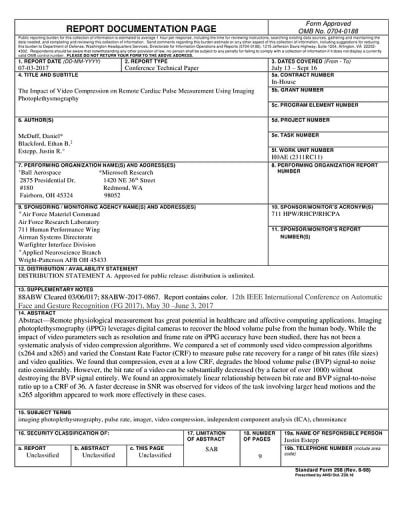
The Impact of Video Compression on Remote Cardiac Pulse Measurement Using Imaging Photoplethysmography
(reference AFRL-0256) is currently available for download from the TSP library.
Don't have an account?
More From SAE Media Group
Tech Briefs
Sub-Pixel Spatial Resolution Interferometry

Tech Briefs
Plenoptic Camera

Tech Briefs
Estimated Spectrum Adaptive Postfilter (ESAP)
Tech Briefs
Products of Tomorrow

Tech Briefs
NASA at 60: From Space to Earth
Aerospace & Defense Tech Briefs
Eyes In the Sky
Aerospace & Defense Tech Briefs
Real Time Physiological Status Monitoring
Tech Briefs
Keeping Drones Flying When a Motor Fails
Aerospace INSIDER
New Ways to Test Swarming Drones

Medical Design Briefs
Ultra-Miniature Image Sensor

Aerospace & Defense Tech Briefs
Eyes in the Sky: HD Ethernet Cameras Take Flight Test Imagery to New Heights
Test & Measurement Tech Briefs
ECG Small Signal General and Analysis
Aerospace & Defense Tech Briefs
Pushbroom Stereo for High-Speed UAV Navigation in Cluttered Environments
Aerospace & Defense Tech Briefs
Formal Process Modeling to Improve Human-Decision-Making During Test and Evaluation Range Control


Photonics & Imaging Technology
Measuring Aging, Fat and Water Content in Meat Products Using Hyperspectral Imaging
Aerospace & Defense Tech Briefs
SAE International Extends Call for Abstracts, Seeks Submissions for AeroTech Conference
Aerospace & Defense Tech Briefs
SIRE: A MIMO Radar for Landmine and IED Detection
Tech Briefs
Portable Laser-Guided Robotic Metrology (PLGRM)

Photonics & Imaging Technology
Megapixel Photon-Counting Camera Technology
Aerospace & Defense Tech Briefs
Subjective Mapping of Dust-Emission Sources by Using MODIS Imagery
Photonics & Imaging Technology
Helping Autonomous Vehicles See Around Corners

Overview
The document is a technical report detailing a conference paper titled "The Impact of Video Compression on Remote Cardiac Pulse Measurement Using Imaging Photoplethysmography," authored by Daniel J. McDuff, Ethan B. Blackford, and Justin R. Estepp. The research was conducted under the auspices of Microsoft Research and Ball Aerospace, with support from the U.S. Air Force Research Laboratory.
The study investigates the effects of video compression on the accuracy of remote cardiac pulse measurements obtained through imaging photoplethysmography (iPPG). iPPG is a non-invasive technique that uses video recordings to detect blood volume changes in the skin, allowing for heart rate monitoring without direct contact. This method has significant implications for remote health monitoring, particularly in scenarios where traditional sensors may be impractical.
The authors describe the experimental setup, which involved capturing 8-bit, 658x492 pixel raw Bayer-format images using specialized imagers equipped with 16 mm fixed focal length lenses. The lighting for the experiments was provided by SoLux full-color spectrum bulbs, strategically positioned to ensure optimal illumination of the participant's face. This setup aimed to maximize the visibility of subtle changes in skin color associated with blood flow.
The report emphasizes the importance of understanding how video compression algorithms can affect the quality of the captured data and, consequently, the accuracy of the cardiac pulse measurements. The authors acknowledge the contributions of Iris E. Davis and Margaret A. Bowers from Ball Aerospace, who played a crucial role in data collection for the study.
The findings of this research are particularly relevant in the context of telemedicine and remote patient monitoring, where reliable and accurate heart rate measurements are essential. By exploring the relationship between video compression and measurement accuracy, the study aims to inform the development of better algorithms and techniques for remote health monitoring applications.
Overall, the document presents a thorough examination of the challenges and considerations involved in using video technology for physiological measurements, highlighting the potential for advancements in healthcare technology through improved understanding of video processing techniques. The research underscores the growing importance of non-invasive monitoring methods in modern healthcare, paving the way for future innovations in remote patient care.
Top Stories
INSIDERManufacturing & Prototyping
 How Airbus is Using w-DED to 3D Print Larger Titanium Airplane Parts
INSIDERManned Systems
 FAA to Replace Aging Network of Ground-Based Radars
NewsTransportation
 CES 2026: Bosch is Ready to Bring AI to Your (Likely ICE-powered) Vehicle
NewsSoftware
 Accelerating Down the Road to Autonomy
EditorialDesign
 DarkSky One Wants to Make the World a Darker Place
INSIDERMaterials
 Can This Self-Healing Composite Make Airplane and Spacecraft Components Last...
Webcasts
Defense
 How Sift's Unified Observability Platform Accelerates Drone Innovation
Automotive
 E/E Architecture Redefined: Building Smarter, Safer, and Scalable...
Power
 Hydrogen Engines Are Heating Up for Heavy Duty
Electronics & Computers
 Advantages of Smart Power Distribution Unit Design for Automotive...
Unmanned Systems
 Quiet, Please: NVH Improvement Opportunities in the Early Design...
