




Dynamic Response and Failure Mechanisms of Layered Ceramic-Elastomer-Polymer/Metal Composites
This work could result in the fabrication of impact- and blast-resistant structural systems.
A thorough study through a combination of ballistic and impact experiments, microscopic failure characterization, and numerical simulations has been carried out in order to decipher the underlying mechanisms involved in the interaction between a blast and/or a blast-induced high-velocity projectile and advanced ceramic-polymer and metal-polymer composites, resulting in an improved ballistic efficiency and impact- and blast-resistant structural system.
A series of high-velocity impact and ballistic experiments has been performed on several metal-metal, metalpolyurea-metal, and polyurea-ceramic composites. New steel plate designs with different thicknesses were employed to avoid tearing of the sample at its supporting ring. New experiments support the hypothesis that the steel-polyurea sandwich samples show a noticeably better performance against blast loads, as compared with that of bare steel. The existing 3D finite element model has been improved to analyze this phenomenon in depth.
An axisymmetric model has also been generated that allows for very fine-mesh simulations. New penetration experiments have also been performed on some newly fabricated ceramic-polyurea-ceramic sandwich systems. These experimental results suggest that the use of polyurea in ceramic-polyurea composites to improve the ballistic resistance is not as effective as the use of other previously tested materials such as E-glass/epoxy or carbon-fiber/epoxy, whereas the reverse is the case for polyurea-steel layers and sandwich structures.
To study the effect of polymers on the performance of sandwich structures under blast loads, a set of experiments was performed on circular polyurea-steel sandwich samples using a 3" Hopkinson bar setup. Using an experimentally based material model for polyurea, the entire experiment was numerically modeled and analyzed in LS-DYNA, and the results were compared with the experimental results.
Three different configurations for the circular sandwich structures are considered: steel-steel, steelpolyurea-steel, and steel-polyurea-steelpolyurea. The Naval structural steel, DH-36, is used to manufacture the samples. The sandwich structure is placed between a cylindrical layer of soft polyurethane and a hollow steel ring. When the gun is triggered, high-pressure gas accelerates the projectile through a barrel towards the target. The projectile, which is made of aluminum, impacts the target at a high velocity, which is accurately measured by two magnetic sensors placed at the end of the barrel. Polyurethane, which is nearly incompressible, is now confined between the projectile and the sample. This subjects the sample to a pressure pulse. The history of transmitted force from the sample to the output bar is recorded by two strain gages mounted on the Hopkinson bar.
The experimental results reveal that when polyurea is cast between the steel plates, the performance of the sandwich structure is noticeably improved. In all cases with polyurea, the steel plate facing the blast does not experience fracture, whereas with the same amount of input energy, both front and back plates are severely fractured from the impact.
A better understanding of the sandwich-structure experiment has been achieved using computational techniques. Experimental measurements and observations include high-speed photography of the impact and penetration process, and examination of the final state of the deformed sample. However, a quantitative assessment of the entire process is highly desirable. Therefore, a 3D finite element model of the experiment has been developed that is suitable for explicit analysis in LS-DYNA. Proper material models for this model have been used that can capture the pressure, temperature, and rate sensitivities.
Simulation results show a large difference between the plastic deformation of the front plate, which faces the blast load, and the back plate. This explains why the front face survives the blast, while the back face acts like a sacrificial layer and absorbs a large amount of energy to save the front layer.
New samples with different steel plate thicknesses were made and tested. The new samples were thinner and have been tested to undergo the desired deformation when exposed to impact loadings. The new tests suggest that the performance of the sandwich structure against impact loading is consistently better than the performance of the bare steel. The finite element model has been improved to achieve a better match between the numerical and experimental results. Also, an axisymmetric model with a finer mesh has been developed, which shows similar results.
This work was done by Siavouche Nemat-Nasser of the University of California, San Diego, for the Office of Naval Research. For more information, download the Technical Support Package (free white paper) at www.defensetechbriefs.com/tsp under the Materials category. ONR-0021
This Brief includes a Technical Support Package (TSP).
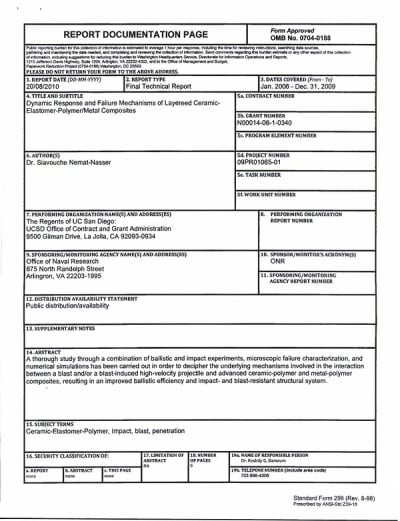
Dynamic Response and Failure Mechanisms of Layered Ceramic-Elastomer-Polymer/Metal Composites
(reference ONR-0021) is currently available for download from the TSP library.
Don't have an account?
More From SAE Media Group
Aerospace & Defense Tech Briefs
Hydraulic Testing of Polymer Matrix Composite 102mm Tube Section
Aerospace & Defense Tech Briefs
Mechanical Response of an Al-PTFE Composite to Uniaxial Compression Over a Range of Strain Rates and Temperatures
Photonics & Imaging Technology
Fiber Lasers for Powertrain Welding Applications
Tech Briefs
Self-Healing Aluminum Metal Matrix Composite
Tech Briefs
Conductive Carbon Fiber Polymer Composite

Motion Design
Plastic Bearings Reduce Weight and Improve Durability
Medical Design Briefs
Impact-Modified Acrylic Copolymers: Evaluating Chemical Resistance
Aerospace & Defense Tech Briefs
‘Nanostitches’ Enable Lighter and Tougher Composite Materials
Photonics & Imaging Technology
Deformation Fingerprints Will Help Researchers Identify, Design Better Metallic Materials
Medical Design Briefs
Metal-Ion Breakthrough Leads to New Biomaterials
Medical Design Briefs
Top 10 Reasons Stainless Steel Is Right for Healthcare Design
Tech Briefs
Method 3D-Prints Marine-Grade Stainless Steel
Tech Briefs
Biodegradable Microsensors for Food Monitoring
Aerospace & Defense Tech Briefs
Processing and Characterization of Lightweight Syntactic Materials
Medical Design Briefs
Functional PVD Coatings Improve Medical Device Performance and Life
Tech Briefs
Advanced Carbon Aerogels for Energy Applications
Automotive Engineering
Weaving a New Future for Composites
Tech Briefs
Miniscule Robots of Metal and Plastic


Medical Design Briefs
Effects of Tube Processing on the Fatigue Life of Nitinol: Part 1

Medical Design Briefs
Sticking Sensors to Skin Without Adhesives

Tech Briefs
Aluminum Electroplating Using Bromide Salts
Aerospace & Defense Tech Briefs
Evaluation of Additively Manufactured Ultrahard Steels
Overview
The document is a final technical report titled "Dynamic Response and Failure Mechanisms of Layered Ceramic-Elastomer-Polymer/Metal Composites," submitted to the Office of Naval Research (ONR) under grant number N00014-06-1-0340. The report covers research conducted from January 2006 to December 2009, led by Principal Investigator Dr. Sia Nemat-Nasser at the University of California, San Diego.
The study focuses on understanding the dynamic response and failure mechanisms of advanced composite materials, specifically layered ceramic-elastomer-polymer and metal-polymer composites, when subjected to ballistic impacts and blasts. The research employs a combination of experimental and numerical methods, including ballistic and impact experiments, microscopic failure characterization, and numerical simulations using LS-DYNA software.
Key findings from the research indicate that the interaction between blasts or high-velocity projectiles and these composite materials can significantly enhance ballistic efficiency and improve impact and blast resistance. The report details various experiments designed to analyze the response of these materials under impulsive loads, providing insights into their mechanical behavior and failure modes.
The report also highlights the contributions of various personnel involved in the project, including graduate and undergraduate researchers, and lists several publications resulting from the research. Notable publications include investigations into the response of monolithic and bilayer plates to impulsive loads, as well as studies on the micromechanisms of ductile fracturing in steel plates reinforced with polyurea.
Overall, the document serves as a comprehensive account of the research efforts aimed at advancing the understanding of composite materials in high-stress environments, with implications for military and structural applications. The findings are expected to contribute to the development of more effective protective systems against ballistic threats, enhancing safety and performance in various applications. The report is publicly available and aims to disseminate knowledge gained from the research to a broader audience.
Top Stories
INSIDERManufacturing & Prototyping
 How Airbus is Using w-DED to 3D Print Larger Titanium Airplane Parts
NewsAutomotive
 Microvision Aquires Luminar, Plans Relationship Restoration, Multi-industry Push
INSIDERAerospace
 A Next Generation Helmet System for Navy Pilots
INSIDERDesign
 New Raytheon and Lockheed Martin Agreements Expand Missile Defense Production
ArticlesAR/AI
 CES 2026: Bosch is Ready to Bring AI to Your (Likely ICE-powered) Vehicle
Road ReadyDesign

Webcasts
Semiconductors & ICs
 Advantages of Smart Power Distribution Unit Design for Automotive...
Unmanned Systems
 Quiet, Please: NVH Improvement Opportunities in the Early Design...
Electronics & Computers
 Cooling a New Generation of Aerospace and Defense Embedded...
Power
 Battery Abuse Testing: Pushing to Failure
AR/AI
 A FREE Two-Day Event Dedicated to Connected Mobility
